Army hands control of Malakand to civil agencies

1 / 4
Policemen stand guard at a check post in Lower Dir district. (AN photos)
2 / 4
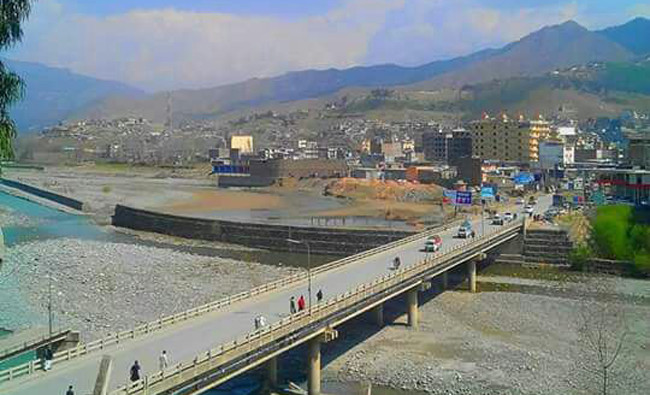
Malakand Division comprises several districts and is a scenic place having many tourist spots. (AN photos)
3 / 4
Police and army personnel jointly check vehicles at a check post in Upper Dir district. (AN photos)
4 / 4
Timargara Bazar. (AN photos)
Updated 11 April 2018
Follow

Army hands control of Malakand to civil agencies

  • The transfer of administrative powers in Malakand was initiated in the Upper and Lower Dir in a ceremony attended by senior civil and military officials.
  • In 2009, the army launched a military offensive, ‘Rah-e-Nijat,’ in the area when a local faction led by Mulla Fazlullah challenged the government.

PESHAWAR: Pakistan’s government and army have begun handing over administrative powers to civil authorities in Malakand, a senior official confirmed on Wednesday.

The process was initiated in Lower and Upper Dir, said Sarmad Saleem Akram, Lower Dir deputy commissioner.

He told Arab News that the army had handed over Bandagai checkpoint to a local administration on Wednesday, while Khall and Chakdara checkpoints would follow. 

“In the entire Lower Dir, only three checkpoints will now be jointly manned by the police and Frontier Corps (FC) personnel. The rest, all of them, have been handed over to the local police authorities,” he said.

Discussing the challenges resulting from transfer of security responsibility to civilian administration, Akram said: “There may be a problem in terms of shortage of security personnel, however Khyber Pakhtunkhwa (KP) police are trained to handle the situation.”

Akram said the army would probably withdraw from Malakand’s border checkpoints as well, handing over the area’s security to FC personnel.

Hafizur Rehman, who lives in Lower Dir, welcomed the change and said police would man the checkpoints more efficiently since they lived in the area and knew local residents. 

“Although the military ensures tight security of the area, police checks will be less time consuming since they know the locals,” he said.

“The police are ready to take up the challenges since it is a public service,” Shahab Ali Shah, district police officer in Upper Dir, said.

“If we need the military’s support, we will call them and they will be here to assist us.”

Kamran Khan, a schoolteacher from Upper Dir, said that the army had played a key role in restoring peace in the area.

“They ended public display of weapons and resolved several disputes in Dir,” he said. “The army can perhaps better control the security of the area.”

Peshawar-based analyst Rahimullah Yusufzai told Arab News that the transfer of security responsibilities from the army to the civil administration had been a lengthy process.

“There could be challenges in the future and this is why the army will be available to provide backup support to the police manning security checkpoints,” he said. 

He said that if the transfer of powers proved successful in the Upper and Lower Dir districts, it would be carried out in other areas of Malakand division as well.

“The army wants to reduce public dealing by soldiers on roadside checkpoints since this can sometimes create resentment among people,” he said.

Dr. Abaseen Yousafzai, a Peshawar University professor from Lower Dir, praised the army for establishing peace in the region and said he favored handing over control to civil administrators. 

“This was an extra burden on the army. The country’s military has done the right thing by transferring this responsibility to the police since it will help its soldiers concentrate on other important issues,” he said.

Yousafzai said that he now visited his village in Lower Dir at night without fear of militants or anti-state elements in the area.

The army stayed in Malakand for almost 10 years. It launched a military operation, Rah-e-Nijat, against militant groups in the region in 2009 after two peace accords failed.

The offensive was launched after the Taliban refused to lay down its arms despite a ruling that established sharia law in Malakand, one of the militant group’s chief demands.


Pakistanis at remote border describe scramble to leave Iran

Updated 03 March 2026
Follow

Pakistanis at remote border describe scramble to leave Iran

  • Returning Pakistani nationals recount missile fire in Tehran, transport gridlock as people rush to exit Iran
  • PM Sharif condemns targeting of Iranian leader as embassies urge citizens to leave amid escalating strikes

TAFTANT, Pakistan: Pakistani nationals hauled suitcases across the border from neighboring Iran, describing missiles being launched and travel chaos as they scrambled to leave the country after the US and Israel launched strikes over the weekend.

AFP journalists saw a steady trickle of people passing through large metal gates at the remote border crossing between Iran’s Mirjaveh and Taftan in Pakistan’s western Balochistan province.

Powerful explosions have rocked Iran’s capital Tehran since Saturday, with embassies from countries around the world telling their citizens to leave.

“All our Pakistani brothers who were in Tehran and other cities had started to leave and were arriving at the terminal, which caused a lot of crowd pressure,” 38-year-old trader Ameer Muhammad told AFP on Monday.

“Due to the crowds, there were major transport problems.”

The isolated Taftan border lies around 500 kilometers (310 miles) from Balochistan’s capital and largest city, Quetta.

AFP journalists saw the Iranian flag flying at half-mast as soldiers stood guard.

Most people wheeled bulky luggage over the frontier’s foot crossing, while freight lorries formed a long line.

Irshad Ahmed, a 49-year-old pilgrim, told AFP he was staying at a hostel in Tehran when he saw missiles being fired nearby.

“There was an army base near the hostel, and we saw many missiles being fired,” he said.

“After that, we went to the Pakistani embassy so that they could evacuate us from there. They brought us here safely.”

Pakistan’s Prime Minister Shehbaz Sharif has said the killing of Ayatollah Ali Khamenei was a “violation” of international law.

“It is an age old convention that the Heads of State/Government should not be targeted,” Sharif wrote on X.

The “people of Pakistan join the people of Iran in their hour of grief and sorrow and extend the most sincere condolences on the martyrdom” of Khamenei, he added.

A teacher at Tehran’s Pakistani embassy, who gave his name as Saqib, told AFP: “Before we left, the situation was normal. The situation was not that bad.”

The 38-year-old said the strikes on Tehran on Saturday “pushed us to leave the city.”

“The situation became bad on Saturday night, when attacks caused precious lives to be lost,” he said.