Roma shock Barcelona in remarkable comeback, Mohamed Salah scores in Liverpool win

1 / 2
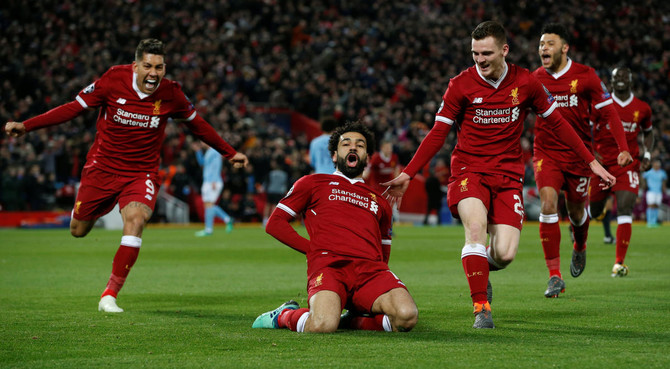
Liverpool's Mohamed Salah celebrates with Roberto Firmino and Andrew Robertson scoring their first goal. (REUTERS)
2 / 2
Roma's Daniele De Rossi celebrates at the end of the match. (REUTERS)
Updated 11 April 2018
Follow

Roma shock Barcelona in remarkable comeback, Mohamed Salah scores in Liverpool win

  • Roma advance on away goals after incredible performance in Italian capital
  • Jurgen Klopp's Liverpool in first semifinal in 10 years

ROME: Roma pulled off an extraordinary comeback with a 3-0 win over Barcelona on Tuesday to reach the Champions League semifinals after overturning a three-goal deficit from the first leg.
The Giallorossi advanced on away goals despite losing 4-1 in the first leg of the quarterfinals.
Center back Kostas Manolas scored the decisive goal with a header from a corner in the 82nd minute amid a deafening atmosphere inside the Stadio Olimpico.
Roma had begun the comeback early when Edin Dzeko controlled an over-the-top pass between two defenders and poked in after six minutes for his sixth goal in this season’s competition.
Then near the hour mark, Dzeko earned a penalty that Daniele De Rossi converted.
Barcelona strikers Lionel Messi and Luis Suarez hardly threatened as Roma dominated possession for long stretches and stifled the Catalan club with high pressure.
In Tuesday’s other quarterfinal, Liverpool reached the Champions League after recovering from conceding a goal inside two minutes against Manchester City to win 2-1 thanks to second-half strikes by Mohamed Salah and Roberto Firmino.
Gabriel Jesus’ early goal raised belief inside Etihad Stadium that one of the most unlikely Champions League comebacks was on, with Liverpool having won the first leg 3-0 at Anfield last week.
City’s attacking lineup was always susceptible to the counter-attack, however. And off one of them, Salah collected a loose ball, rounded goalkeeper Ederson Moraes and deftly chipped in the equalizer in the 56th for his 39th goal of the season.
With City now needing four goals in barely half an hour to advance, Liverpool knew a spot in the last four for the first time in 10 years was there for the taking. Firmino made sure of it by curling in the team’s second goal in the 77th.
Liverpool, who won 5-1 on aggregate, is bidding for their sixth title in Europe’s top competition — and their first since 2005.
It was the latest Champions League failure by City manager Pep Guardiola, who won the competition twice with Barcelona — in 2009 and 2011 — but hasn’t reached the final since in five season with Bayern Munich and City.
Guardiola was sent to the stands for the second half for arguing with referee Antonio Mateu Lahoz during halftime. He and City can legitimately complain that Leroy Sane had a goal wrongly disallowed for offside at the end of the first half, which would have made it 2-0.
But over two legs, City can have few complaints and were always up against it after conceding three goals in 19 first-half minutes at Anfield and failing to score an away goal.


Expressions of disquiet concerning cricket’s power base

Updated 4 sec ago
Follow

Expressions of disquiet concerning cricket’s power base

  • Increasing number of players, coaches may be prepared to oppose overconcentration of power in game

Last week’s crisis over Bangladesh’s participation in the upcoming men’s T20 World Cup ended with the International Cricket Council’s decision to replace Bangladesh with Scotland. In a show of support for Bangladesh, the Pakistan Cricket Board indulged in saber rattling by suggesting that it may boycott the tournament.

This is unlikely and would invite severe repercussions, effectively creating a schism in cricket. The stance may be interpreted as a continuation of Pakistan’s ongoing challenge to India’s hegemony of the game.

In a sign of the way in which views have polarized, Jason Gillespie, a former Australian cricketer and international coach, posted the following on X: “Has there been an explanation from the ICC why Bangladesh could not play their matches outside of India? From memory, India refused to play Champions Trophy matches in Pakistan and were allowed to play those matches outside of Pakistan. Can someone make this make sense?”

Among the plentiful responses were many from Indian sources, who were not kindly disposed towards Gillespie’s question. He took the post down, saying: “I got abused for asking a simple question.”

On the surface it may appear to be a simple question, but it hits at the heart of a complex issue. Gillespie’s critics have been quick to seize on the fact that he was, for six months in 2024, coach of the Pakistan national men’s Test team and that he will be the coach of the new Kingsman Hyderabad franchise in the Pakistan Super League in April. This involvement has been interpreted as evidence of bias against India.

Another respected player, Jason Holder, former captain of the West Indies, expressed some forthright thoughts in a podcast earlier this month. One of these related to the selection of Pakistani players in franchise leagues. He commented that it was sad that “certain Pakistanis can’t be involved in certain teams because they are owned by Indian owners.” Holder also expressed his sadness at the impact on cricket of relations between India and Pakistan.

Separately, Moeen Ali, of England, went further in an interview given while playing in the Bangladesh Premier League in January. His view is that the ICC does not act like a neutral guardian of the game, effectively serving the interests of “one cricket nation.” Ali added that everyone inside the game knows “who actually runs things,” but few are willing to say so publicly.

Neither did he directly, but we are safe to assume the glaringly obvious — that he was referring to India. It is understandable that many within the game are reluctant to rock the boat, partly out of fear about the opprobrium which follows, and to which Azeem Rafiq can testify.

Gillespie has been the source of social media abuse and Holder has also been subject to negative comment. He has played for franchises owned by Indians in India, South Africa, the UAE and the Caribbean. Ali has done likewise and it is noticeable that in December 2025 he announced that will play in the Pakistan Super League in April 2026, rather than the Indian Premier League, where he has represented three franchises since 2018. The league is now adopting an Indian, youth-driven strategy, which is reducing opportunities for experienced overseas players. In a surprise announcement this week, Ali announced that he will play for Yorkshire in the T20 Blast in 2026. This reverses his decision during 2025 to retire from English domestic cricket.

Opportunities for cricketers to play in franchise leagues are still on the increase. Almost 11 months ago I was fortunate to interview Abhishek Bachchan, who had been revealed as a co-owner of the European T20 Premier League. The league, which is approved by the ICC, consists of a partnership between the national cricket boards of Ireland, Scotland and the Netherlands. At the time of the interview the intention of the owners was to hold the first edition of the event between July 15 and Aug. 3, 2025.

In my column, following the interview, I suggested that the ETPL’s promoters had their work cut out, given that there were only five months to go until mid-July. It was clear that discussions with players and their agents were underway, as were those with potential franchisees and investors. At the time that space was crowded because the focus of these stakeholders was on the sale of equity in The Hundred. Postponement of the ETPL was announced in early June 2025. In the intervening months, time has been well spent leading to last week’s announcement that the ETPL will launch in August 2026.

Exact dates and format have not been revealed, but it is understood that late August to mid-September is the preferred option. The original idea was to hold the league prior to The Hundred, which occupies most of August. Instead, it is now planned to open after the 2026 Hundred concludes on Aug. 16. Originally a six-franchise league was proposed, based on teams in Dublin, Belfast, Edinburgh, Glasgow, Amsterdam and Rotterdam. This remains the case and, to date, three teams have been confirmed for Amsterdam, Belfast and Edinburgh.

It was a surprise to learn the identities of the owners. The rights to own the Amsterdam Flames have been acquired by a trio consisting of Steve Waugh, the former Australian captain; Jamie Dwyer, one of Australia’s greatest-ever male hockey players; and Tim Thomas, former CEO of the Centre for Australia-India Relations.

Another Australian cricketer, a current one, Glenn Maxwell, will own the Belfast-based Irish Wolves franchise, along with Rohan Lund, formerly CEO of the NRMA Group in Australia. In Edinburgh, the rights for the Castle Rockers lie with two former New Zealand cricketers, Kyle Mills and Nathan McCullum, older brother of Brendon McCullum, the current coach of the England men’s cricket team.

None of these individuals appear to have had any previous involvement in the ownership of franchise teams. Indeed, Waugh said that he has “always been selective about where I invest my time and energy in cricket. In many ways it marks a return to the game for me — but in a very different role. This is about helping uphold the standards and spirit of cricket while supporting its growth into Europe, which remains the game’s last great frontier.”

A stated aim of the ETPL promoters is to develop local talent. This was echoed by Kyle Mills, who referred to a partnership with Otago Cricket Board in New Zealand. This is intended to bring a pipeline of young talent through to the Rockers, along with the potential to develop local players and inspire the next generation to take up cricket. Each of the three franchises has secured big-name Australian and New Zealand cricketers for the inaugural competition.

So far, there is a different feel to the ETPL. As yet, the franchises are not funded by existing franchise owners in other leagues, some of which are dependent on Indian money. The Big Bash League is heading for privatization in Australia and there is little doubt that there will be strong interest from Indian investors. However, if an increasing number of players and coaches are prepared to express their disquiet about the overconcentration of power in the game, and alternative investors emerge, then the engulfing of cricket by one nation may be challenged.