LAHORE: Punjab Law Minister Rana Sanaullah said on Monday that the provincial administration would try to resolve the issue of Tehreek-e-Labaik’s sit-in through a peaceful dialogue process.
“Since this issue is related to the federal government, the provincial administration is in contact with it. We are also in touch with the leaders of Tehreek-e-Labaik to bring their protest to a positive conclusion,” he told Arab News.
The Punjab government has held two rounds of talks with the leaders of the religious-political group. In the first round, the State Minister for Interior, Talal Chaudhry, and the Chief Commissioner Islamabad, Aftab Akbar Durrani, were also present.
“The Punjab government will not use force against the participants of the sit-in to avoid a Faizabad-like situation,” the law minister added.
Earlier in the day, Tehreek-e-Labaik leaders announced that they would spread their protest across the country if their demands were not met in the next three days.
“We will block the motorway and all the national highways,” Sahibzada Usman Ali told Arab News. “Our workers will stage sit-ins and block the main roads of all the districts in the country. The protest will be seen from Khyber to Karachi, if the government does not accept our demands by Thursday afternoon.”
Tehreek-e-Labaik has staged a sit-in in front of Data Darbar, one of the most popular Sufi shrines in Pakistan, for the past seven days, causing numerous problems to the public.
Traffic congestion has become a norm in the neighborhood where business activities have also significantly declined. Schools in the nearby areas have not been operational for the past few days, and their residents have been finding it hard to carry out their routine activities.
The religious-political organization started its protest when an anti-terrorism court in Islamabad declared its leaders, including Khadim Hussain Rizvi and Afzal Qadri, proclaimed offenders.
Tehreek-e-Labaik is once again repeating its old demand of making the Raja Zafarul Haq Report public. The report investigated the change in the Khatam-e-Nabuwat clause in the Election Act, 2017.
The group also wants withdrawal of all cases against its leaders and workers, besides lodging police reports against the “culprits” who “martyred” its workers. Other than that, it wants the government to fulfill the terms agreed in the Army-brokered agreement during the Faizabad sit-in last year.
However, some members of the Punjab provincial administration say it will not be possible to accept these conditions.
“The demands made in the Faizabad agreement cannot be fulfilled since the Islamabad High Court has already declared the agreement null and void,” Malik Ahmad Khan, spokesperson of the Punjab Government, said while talking to Dawn News, a local television channel.
“There are some elements present at the sit-in who can create a violent situation if the government uses police action against them,” Khan added.


![]()
![]()

Punjab government wants to deal peacefully with Tehreek-e-Labaik protest
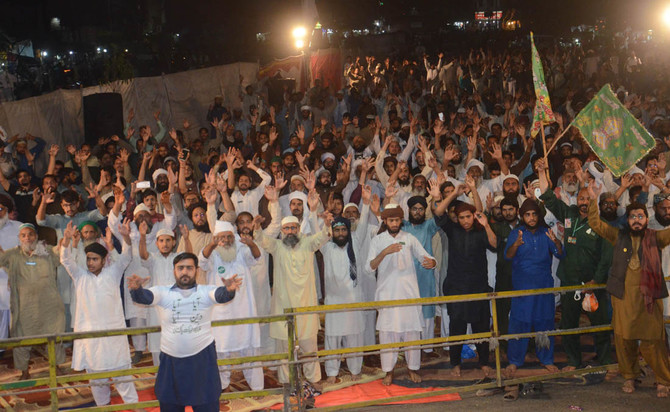
Punjab government wants to deal peacefully with Tehreek-e-Labaik protest
- The group has threatened to spread its protest across Pakistan if its demands are not met in three days
- Impossible to accept demands after Islamabad High Court’s ruling, maintain some members of provincial administration
Latest updates


© 2026 SAUDI RESEARCH & PUBLISHING COMPANY, All Rights Reserved And subject to Terms of Use Agreement.