London: In an exclusive interview with Arab News, Turki Mohammed Al-Shehri explains how an expanding renewables industry will boost employment as well as pave the way for a greener future.
A massive investment drive in green energy projects across Saudi Arabia is about creating jobs as well as diversifying the energy mix away from oil, according to the Kingdom’s renewables chief.
Last week Saudi Arabia revealed ambitious plans to produce 200 gigawatts of solar power by 2030, helping the country become a leading exporter of sustainable energy.
In an exclusive interview with Arab News, Turki Mohammed Al-Shehri, head of Saudi Arabia’s Renewable Energy Project Development Office (Repdo), said jobs and “local content” are guiding principles of the Kingdom’s renewables program. 
“A fundamental cornerstone of these projects will be local content. Local content is key — it is being stipulated in tenders,” said Al-Shehri in an interview in London.
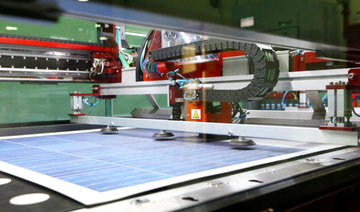
He said: “The idea is that the products and components that are used in these farms (turbines, panels, hoists and other parts) are brought in from local factories, and the idea is to grow the industry organically; we want local factories to also export outside the Kingdom, ensuring the creation of jobs, and this will make sure that everything that is built in the Kingdom will be on a competitive global basis.”
Al-Shehri told Bloomberg in January that eight renewables tenders would be issued this year for 4.125 gigawatts of capacity at a cost of between $5 billion and $7 billion.
Asked by Arab News if the Kingdom would also need foreign investment to develop the sector, Al-Shehri replied: “Due to the size of the projects, we do need foreign investment experience and know-how, yes.”
In terms of the nuts and bolts of how renewable tenders would work, he pointed to the example of Riyadh-based Acwa Power, which recently won the contract to build the Kingdom’s first utility-scale solar photovoltaic plant.
“As long as they meet our local content requirement of 30 percent as well as other stipulations, where and how they source the technology is up to them,” he said. “The objective is to have an economic energy mix, driven by low-cost energy, and to ensure that local competitive industry is created in the Kingdom.”
By building up solar and wind-power generation, KSA will free up oil reserves for export, strengthening the country’s balance sheet.
Last week Crown Prince Mohammed bin Salman unveiled plans to develop the world’s biggest solar power project for $200 billion in partnership with Japan’s SoftBank.
The memorandum of understanding aims to produce up to 200 gigawatts of power by 2030 — about 100 times the capacity of the current biggest projects.
If built on one site, the solar farm would cover an area twice the size of Hong Kong, according to a Bloomberg News calculation.
Acwa Power CEO Paddy Padmanathan, who along with Al-Shehri attended London’s recent Saudi-UK CEO Forum, said: “Personally, I think they (renewables) could make up 40 percent of the (KSA) energy mix in 2030.”
Turning to his company’s success in February of being awarded the 300-megawatt PV solar project in Sakaka, Padmanathan said: “The tender was a rigorous, transparent process at a new world-record tariff and will set the foundation for a robust and competitive market for renewable energy in the Kingdom.”
The 25-year Sakaka power purchase contract was awarded to Acwa at a new world-record tariff of 8.781 halala/kWh (per kilowatt hour) (2.3417 cents/kWh). Middle Eastern oil producers are looking to renewables to meet growing domestic consumption and would rather export as much oil as possible to generate income to meet internationally recognized green energy standards, such as those in the Paris climate accord, while also reducing reliance on fossil fuels.
Saudi Arabia wants to deploy more natural gas, as well as solar and wind, to reduce its dependence on oil-based power generation. Developing a renewable energy industry is a key plank of Saudi Vision 2030.
The Sakaka plant, which Acwa has already started constructing in Al-Jawf province, is backed by a 25-year power purchase agreement with the Saudi Power Procurement Company.
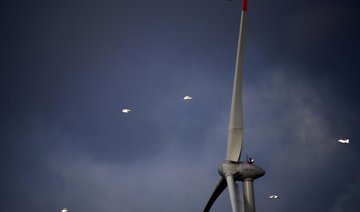
Last year the Kingdom also tendered a 400 megawatt wind project — its first — at Dumat Al-Jandal, for which Repdo prequalified a number of companies in 2017.
In a recent interview with Arab News, Adnan Amin, director-general of the International Renewable Agency, said renewables were incredibly cheap now. “The latest bids for Saudi solar projects are around 2.5 US cents per kWh, which is about a quarter of the cost of oil,” he said.
Victoria Cuming, head of policy covering Europe, Middle East and Africa for Bloomberg New Energy Finance (BNEF), told Arab News: “Looking at the MENA region as a whole, renewables should both replace fossil fuel and add to the mix, as electricity demand will double by 2040, according to BNEF forecasts.”
She expected the region to see a significant shift in the capacity mix, from being 93 percent fossil fuels today to just under half renewables in 2040, according to BNEF’s New Energy Outlook 2017.
Cuming said: “In the near term, this will be mainly driven by incentives such as auctions, but in less than a decade the shift will be driven by the economics. Utility-scale PV plants are already cheaper than combined-cycle gas plants in net importing countries such as Egypt.”
Provided governments continue to phase out fossil-fuel subsidies, “this will be the case across MENA by 2025. Ten years later, onshore wind farms will be cheaper than gas,” said Cuming.


![]()

Green energy drive will boost KSA employment: Saudi Arabia’s renewable energy chief
Green energy drive will boost KSA employment: Saudi Arabia’s renewable energy chief
- Turki Mohammed Al-Shehri, head of Saudi Arabia’s Renewable Energy Project Development Office speaks to Arab News
- Crown Prince Mohammed bin Salman unveiled plans to develop the world’s biggest solar power project for $200 billion
Related


Latest updates


© 2026 SAUDI RESEARCH & PUBLISHING COMPANY, All Rights Reserved And subject to Terms of Use Agreement.