LIBYA: Nearly a year after a Libyan militia announced it had set free the son and heir apparent of slain former ruler Muammar Qaddafi, the fate of Seif Al-Islam remains a mystery.
His reported release from detention by the Abu Bakr Al-Sadiq Brigade which once controlled the town of Zintan in Western Libya has never been confirmed and has fueled wild rumors.
While some insist he is still somewhere in Zintan, others claim Seif is dead.
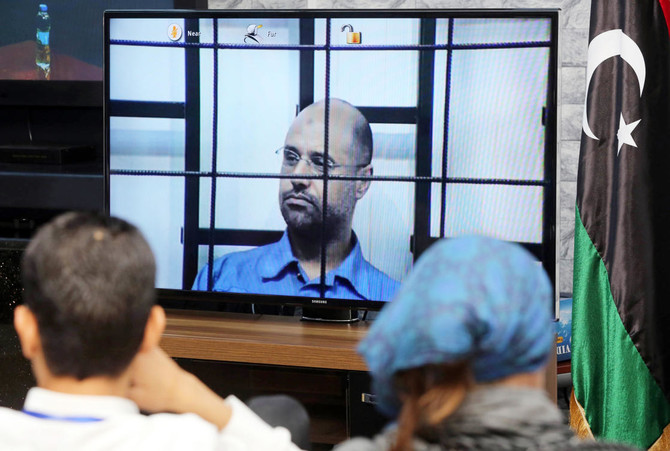
One thing is certain, however: He has not been seen or heard of since June 2014 when he appeared via video from Zintan during his trial by a Tripoli court.
And now Seif is back in the news, after former French President Nicolas Sarkozy was charged in Paris with financing his 2007 election campaign with money from Qaddafi.
In a 2011 interview with the Euronews television network, Seif said Sarkozy must “give back the money he took from Libya to finance his electoral campaign.”
Seif Al-Islam was captured by the Zintan-based militia in November 2011, days after Qaddafi was killed in a NATO-backed uprising against his decades-old rule.
The International Criminal Court (ICC) is in a legal tug-of-war with Libyan authorities to transfer Seif to The Hague, where he is wanted for crimes against humanity including murder.
But in July 2015, a Tripoli court sentenced the now 45-year-old to death in absentia along with eight other Al-Qaddafi-era figures.
According to several Libyan sources, and diplomats, Seif has not left Zintan, a largely tribal town 170 km southwest of Tripoli and one of the cradles of the 2011 uprising.
But is he a prisoner? No one in Zintan, a town of 40,000 inhabitants, is willing to give a clear answer.
“Yes. He is still a prisoner,” Mokhtar Al-Akhdar, a member of Zintan’s military council which groups the town’s key militias, said categorically when asked about Seif.
“Even if he is not a prisoner, he is wanted by the ICC ... and he has nowhere to go,” he quickly added, throwing more doubt on Seif’s fate.
Chaaban Al-Marhani, one of the town’s tribal leaders, also provided a confusing account of Seif’s whereabouts.
“He is here (in Zintan) and his is a prisoner but his fate in not in the hands of Zintan.”
A member of the security services, speaking on condition of anonymity, added to the confusion. “In any case Seif Al-Islam was never really a prisoner in the full meaning of the word. Ever since his arrest he has been under home arrest ... not in a prison,” he said.
The Abu Bakr Al-Sadiq Brigade which captured him more than six years ago had repeatedly refused to hand Seif over to authorities in Tripoli or the ICC.
The group said it released him in June 2017 as part of a general amnesty decreed by a Parliament based in eastern Libya but legal experts said Seif was not included in the amnesty.
The militia — which Zintan residents say was disbanded nearly a year ago — failed to persuade anyone when it announced his release a year ago because it had also reported setting him free a few months earlier.
Omar Gaith, a member of Parliament from Zintan, said he “cannot confirm or deny the liberation of Seif.”
“Seif Al-Islam is considered a criminal and a fugitive. If he is arrested he will be put on trial again,” he said.
The Tripoli court sentenced Seif to death, along with other Qaddafi-era officials, for crimes, including murder and complicity to incite rape during the 2011 uprising — a verdict criticized by the UN and human rights groups.
Due to the nature of these crimes “he can not benefit from any amnesty,” said the office of the prosecutor general in Tripoli.
The ICC prosecutor was not available for comment on Seif’s fate.

Mystery surrounds Qaddafi’s son amid prison discharge rumors

Hundreds mourn in Syria’s Homs after deadly mosque bombing
HOMS: Hundreds of mourners gathered Saturday despite rain and cold outside of a mosque in the Syrian city of Homs where a bombing the day before killed eight people and wounded 18.
The crowd gathered next to the Imam Ali ibn Abi Talib Mosque in the Wadi Al-Dhahab neighborhood, where the population is predominantly from the Alawite minority, before driving in convoys to bury the victims.
Officials have said the preliminary investigations indicate explosive devices were planted inside the mosque but have not yet publicly identified a suspect.
A little-known group calling itself Saraya Ansar Al-Sunna claimed responsibility for the attack in a statement posted on its Telegram channel, in which it indicated that the attack intended to target members of the Alawite sect, an offshoot of Shia Islam whom hard-line Islamists consider to be apostates.
The same group had previously claimed a suicide attack in June in which a gunman opened fire and then detonated an explosive vest inside a Greek Orthodox church in Dweil’a, on the outskirts of Damascus, killing 25 people as worshippers prayed on a Sunday.
A neighbor of the mosque, who asked to be identified only by the honorific Abu Ahmad (“father of Ahmad“) out of security concerns, said he was at home when he heard the sound of a “very very strong explosion.”
He and other neighbors went to the mosque and saw terrified people running out of it, he said. They entered and began trying to help the wounded, amid blood and scattered body parts on the floor.
While the neighborhood is primarily Alawite, he said the mosque had always been open to members of all sects to pray.
“It’s the house of God,” he said. “The mosque’s door is open to everyone. No one ever asked questions. Whoever wants to enter can enter.”
Mourners were unable to enter the mosque to pray Saturday because the crime scene remained cordoned off, so they prayed outside.
Some then marched through the streets chanting “Ya Ali,” in reference to the Prophet Muhammad’s cousin and son-in-law whom Shiite Muslims consider to be his rightful successor.
The crowd gathered next to the Imam Ali ibn Abi Talib Mosque in the Wadi Al-Dhahab neighborhood, where the population is predominantly from the Alawite minority, before driving in convoys to bury the victims.
Officials have said the preliminary investigations indicate explosive devices were planted inside the mosque but have not yet publicly identified a suspect.
A little-known group calling itself Saraya Ansar Al-Sunna claimed responsibility for the attack in a statement posted on its Telegram channel, in which it indicated that the attack intended to target members of the Alawite sect, an offshoot of Shia Islam whom hard-line Islamists consider to be apostates.
The same group had previously claimed a suicide attack in June in which a gunman opened fire and then detonated an explosive vest inside a Greek Orthodox church in Dweil’a, on the outskirts of Damascus, killing 25 people as worshippers prayed on a Sunday.
A neighbor of the mosque, who asked to be identified only by the honorific Abu Ahmad (“father of Ahmad“) out of security concerns, said he was at home when he heard the sound of a “very very strong explosion.”
He and other neighbors went to the mosque and saw terrified people running out of it, he said. They entered and began trying to help the wounded, amid blood and scattered body parts on the floor.
While the neighborhood is primarily Alawite, he said the mosque had always been open to members of all sects to pray.
“It’s the house of God,” he said. “The mosque’s door is open to everyone. No one ever asked questions. Whoever wants to enter can enter.”
Mourners were unable to enter the mosque to pray Saturday because the crime scene remained cordoned off, so they prayed outside.
Some then marched through the streets chanting “Ya Ali,” in reference to the Prophet Muhammad’s cousin and son-in-law whom Shiite Muslims consider to be his rightful successor.
© 2025 SAUDI RESEARCH & PUBLISHING COMPANY, All Rights Reserved And subject to Terms of Use Agreement.