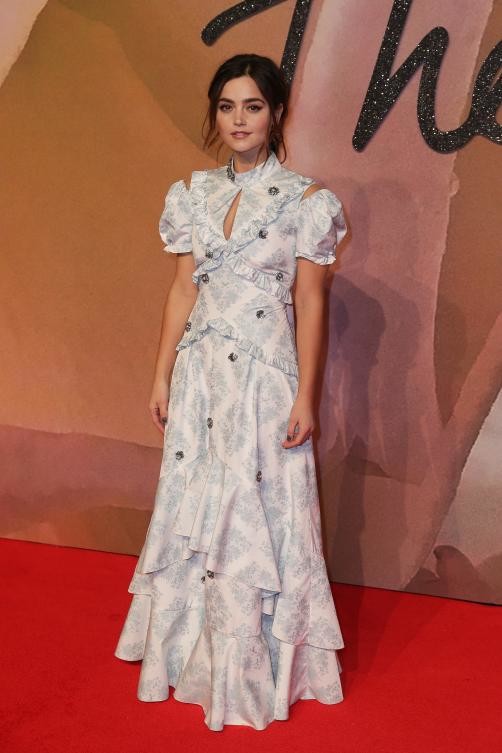
DUBAI: British actress Jenna Coleman is set to appear at this week’s Middle East Film and Comic Con (MEFCC) in Dubai.
Coleman, who is perhaps most famous for her portrayal of Clara Oswald in the television series “Doctor Who,” is set to meet eager fans on Thursday and Friday and will sign autographs and pose for photographs at the event.
The actress’ versatility has been put to the test in recent years, with her portrayal of Britain’s Queen Victoria on the ITV series “Victoria” garnering praise from critics. She also scored a role on the silver screen in 2011, playing the character of Connie in Hollywood blockbuster “Captain America: The First Avenger.”
She began her career on British TV show “Emmerdale” in 2005 and received a nomination at the 2006 National Television Awards for the Most Popular Newcomer award for her portrayal of character Jasmine Thomas on the soap.
Coleman will attend the event along with actor Ezra Miller who plays The Flash in the DC Universe. Miller recently starred in Hollywood film “Justice League” with Gal Gadot, Ben Affleck, Ray Fisher and Jason Momoa and previously starred in the Harry Potter spinoff movie, “Fantastic Beasts And Where To Find Them.”
When he is not acting, Miller tours the US with his band, Sons of an Illustrious Father.
The actor is set to touch down in the UAE this week and will meet fans on Friday and Saturday.
The MEFCC is set to run from April 5-7 at Dubai World Trade Center and will feature panel discussions, workshops and a raft of activities for fans of all ages.
One of the annual highlights of the event is the Artists’ Alley, a dedicated section where regional and international comic and manga artists showcase their latest creations for sale.
Comic Con is also popular among those who relish the chance to get creative and dress up as comic characters in what is known as cosplay, a hybrid of the words costume and play. Cosplayers from around the region attend the event in their full regalia, dressing up as popular characters from anime, comics and movies.


Jenna Coleman set for Dubai appearance
Jenna Coleman set for Dubai appearance
Rubaiya Qatar’s flagship ‘Unruly Waters’ promises compelling curation
DOHA: The ambitious new quadrennial Rubaiya Qatar opens this November across the country and its capital Doha, and its headline exhibition, “Unruly Waters,” promises to be a major intervention in contemporary curation.
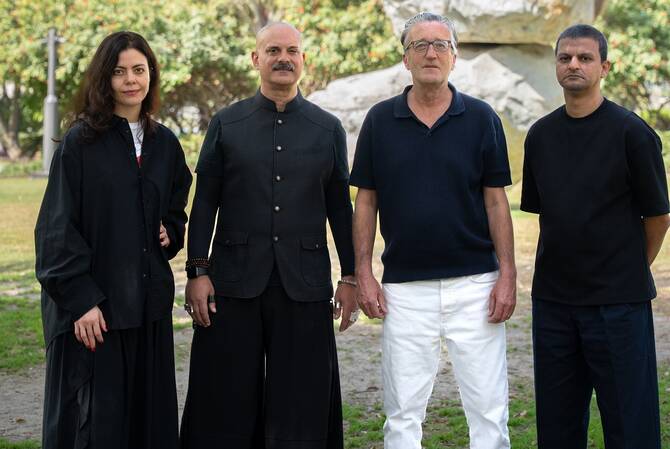
The show has four curators: Tom Eccles (executive director, Center for Curatorial Studies and the Hessel Museum of Art, Bard College); Ruba Katrib (chief curator and director of curatorial affairs, MoMA PS1); Mark Rappolt (editor-in-chief of ArtReview and ArtReview Asia); and Shabbir Hussain Mustafa (chief curator, Singapore Art Museum),
It features more than 50 artists and includes over 20 new commissions produced for the project. The show offers both a literal and metaphorical examination of water.
“Water is a kind of foil to talk about something else,” said Eccles at a briefing panel held alongside Art Basel Qatar last week, signaling a show that will use seas, currents and maritime histories to open conversations about trade, migration, ecology and cultural exchange.
The curators’ research was sparked, in part, by a maritime find now in Qatar’s collections: a shipwreck off the coast of Sumatra that yielded tens of thousands of objects and traced routes across the historic Maritime Silk Road.
Eccles said the material “gave us the world to think” beyond conventional regional frames and to reconfigure how an exhibition might map connections from the Gulf eastwards to south and southeast Asia.
The exhibition’s scale is matched by its ambition. “More than half of the show will be commissioned,” said Katrib, underlining the quadrennial’s commitment to new production and artworks conceived in dialogue with Doha’s audiences and sites.
Katrib emphasizes the show’s intergenerational and geographically wide-ranging cast of artists.
And the curators’ intent to foreground histories of trade — cups, pots and the everyday objects that circulated across oceanic networks — alongside more speculative practices addressing climate, migration and contingency.
Rappolt pointed out that “Unruly Waters” “is very much built on the work that our colleagues have done over several years in building infrastructures and networks.”
The curators have drawn on environmental history and scholarship — inviting contributions from historians and hosting academic exchanges — so that the exhibition functions as a platform for knowledge production, and dialogue.
Mustafa spoke about the plural, polyvocal structure of the show. The project maps multiple regions at once. “We have the Arab worlds. We have the Indian ocean worlds. We have Africa, we have Southeast Asia.”
And these zones will sit “alongside each other, not necessarily in agreement, but most certainly in a state of complexity.”


