Rare Picasso self-portrait expected to fetch $70 million

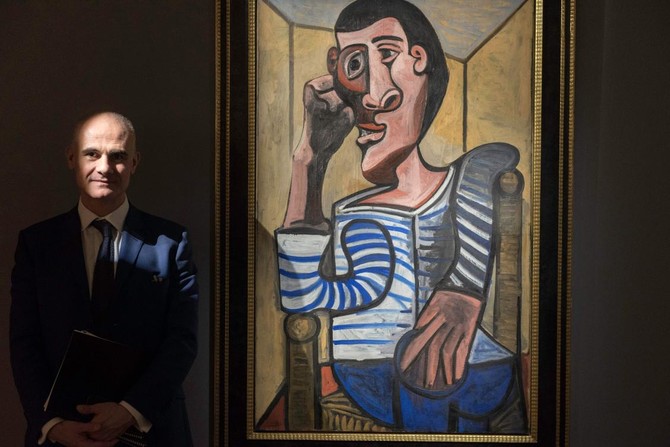
Conor Jordan, deputy chairman of impressionist and modern art at Christie’s stands next to Pablo Picasso’s ‘Le Marin’ during a media preview of Christie’s Hong Kong Spring Sales in Hong Kong on March 30, 2018. (AFP/Philip FONG)
Updated 30 March 2018
Follow

Rare Picasso self-portrait expected to fetch $70 million

HONG KONG: A rare Picasso believed to be a self-portrait created when he was under threat of deportation to a Nazi concentration camp is expected to fetch $70 million at auction, Christie’s said Friday as the work went on view in Hong Kong.
The oil painting “Le Marin” depicts a sad-looking man dressed in a blue and white striped sailor’s shirt sitting on a chair.
“You have ... a slightly dark sense around the picture. It’s nervous, it’s on edge and slightly gloomy,” said Conor Jordan, deputy chairman of impressionist and modern art at Christie’s.
The 130 by 81 centimeter (52 by 31 inch) vertical painting shows the man resting his head against his right hand, while his legs are crossed with his left hand on his knee.
“That’s a traditional symbol of melancholy,” Jordan added.
Created in 1943, during the Nazi occupation of France, the painting reflects the distress and anxiety of the Spanish painter who was under threat of being sent to a concentration camp in Germany.
Le Marin’s last appearance was 21 years ago at an auction of works from the collection of New York art collectors Victor and Sally Ganz.
The painting will be on view in Hong Kong until April 3 before traveling to London and then New York, where it will go under the hammer on May 15 as part of Christie’s Impressionist and Modern Art sale.
Le Marin is one of the five most important pieces by Picasso, according to Christie’s.
Last November, a series of 100 Picasso etchings which deal with his erotic obsessions and marital strife, as well as political turmoil in the 1930s, sold for 1.9 million euros ($2.2 million) in Paris to an unnamed American collector.
Picasso’s “The Women of Algiers (Version 0)” set a world record as the most expensive piece of art sold at auction when it fetched $179.4 million at Christie’s in New York in 2015.


Kawthar Al-Atiyah: ‘My paintings speak first to the body, then to the mind’ 

Updated 19 December 2025
Follow

Kawthar Al-Atiyah: ‘My paintings speak first to the body, then to the mind’ 

  • The Saudi artist discusses her creative process and her responsibility to ‘represent Saudi culture’ 

RIYADH: Contemporary Saudi artist Kawthar Al-Atiyah uses painting, sculpture and immersive material experimentation to create her deeply personal works. And those works focus on one recurring question: What does emotion look like when it becomes physical?  

“My practice begins with the body as a site of memory — its weight, its tension, its quiet shifts,” Al-Atiyah tells Arab News. “Emotion is never abstract to me. It lives in texture, in light, in the way material breathes.”  

This philosophy shapes the immersive surfaces she creates, which often seem suspended between presence and absence. “There is a moment when the body stops being flesh and becomes presence, something felt rather than seen,” she says. “I try to capture that threshold.”  

Al-Atiyah, a graduate of Princess Nourah bint Abdulrahman University, has steadily built an international profile for herself. Her participation in VOLTA Art Fair at Art Basel in Switzerland, MENART Fair in Paris, and exhibitions in the Gulf and Europe have positioned her as a leading Saudi voice in contemporary art.  

Showing abroad has shaped her understanding of how audiences engage with vulnerability. “Across countries and cultures, viewers reacted to my work in ways that revealed their own memories,” she says. “It affirmed my belief that the primary language of human beings is emotion. My paintings speak first to the body, then to the mind.” 

Al-Atiyah says her creative process begins long before paint touches canvas. Instead of sketching, she constructs physical environments made of materials including camel bone, raw cotton, transparent fabrics, and fragments of carpet.  

“When a concept arrives, I build it in real space,” she says. “I sculpt atmosphere, objects, light and emotion before I sculpt paint.  

“I layer color the way the body stores experience,” she continues. “Some layers stay buried, others resurface unexpectedly. I stop only when the internal rhythm feels resolved.”  

This sensitivity to the unseen has drawn attention from international institutions. Forbes Middle East included her among the 100 Most Influential Women in the Arab World in 2024 and selected several of her pieces for exhibition.  

“One of the works was privately owned, yet they insisted on showing it,” she says. “For me, that was a strong sign of trust and recognition. It affirmed my responsibility to represent Saudi culture with honesty and depth.”  

Her recent year-long exhibition at Ithra deepened her understanding of how regional audiences interpret her work.  

'Veil of Light.' (Supplied) 

“In the Gulf, people respond strongly to embodied memory,” she says. “They see themselves in the quiet tensions of the piece, perhaps because we share similar cultural rhythms.”  

A documentary is now in production exploring her process, offering viewers a rare look into the preparatory world that precedes each canvas.  

“People usually see the final work. But the emotional architecture built before the painting is where the story truly begins,” she explains.  

Beyond her own practice, Al-Atiyah is committed to art education through her work with Misk Art Institute. “Teaching is a dialogue,” she says. “I do not focus on technique alone. I teach students to develop intuition, to trust their senses, to translate internal experiences into honest visual language.”  

 'Jamalensan.' (Supplied) 

She believes that artists should be emotionally aware as well as technically skilled. “I want them to connect deeply with themselves so that what they create resonates beyond personal expression and becomes part of a cultural conversation,” she explains.  

In Saudi Arabia’s rapidly growing art scene, Al-Atiyah sees her role as both storyteller and facilitator.  

“Art is not decoration, it is a language,” she says. “If my work helps someone remember something they have forgotten or feel something they have buried, then I have done what I set out to do.”