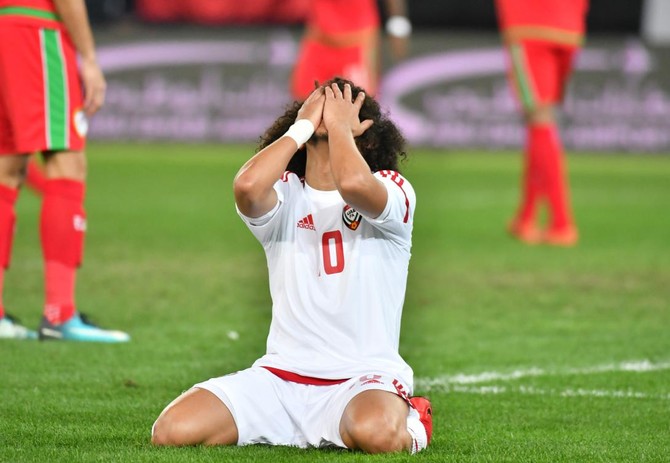
LONDON: The King’s Cup in Thailand represented a prime opportunity for Alberto Zaccheroni to turn a corner with the UAE as World Cup qualifying disappointment and a damaging end to the Arabian Gulf Cup campaign had left the Whites at a crossroads.
Instead the UAE returned to the emirates this week with even more questions then answers. Defeats to Slovakia and Gabon meant they ended the four-team tournament with the worst record — this came on the back of a Gulf Cup where they scored just once in five matches.
The King’s Cup came against the backdrop of the FA’s temporary expulsion of star duo Omar Abdulrahman and Ali Mabkhout for breaking curfew on the eve of the Gulf Cup final. But while their absence was keenly felt, unfortunately for Zaccheroni few were able to stand up and replace them.
With less than a year to go until the AFC Asian Cup on home soil it leaves the UAE in a familiar position that was apparent during a World Cup qualification full of ifs, buts, maybes and what ifs; an over-reliance on their core talent.
Unlike Japan, the UAE is not a large football country and Zaccheroni does not have swathes of resources to draw on, but the Italian veteran has serious work to do to transform the Whites beyond ‘The Amoory and Mabkhout Show’ before the Asian Cup kicks off next January.
It is a considerable conundrum for the former AC Milan and Juventus coach. On the one hand, he has two of Asia’s best attacking players at his disposal, so why not emphasize their attributes by playing to their strengths. But, conversely, scratch that impressive surface and you are not left with much else, as so proved in Bangkok.
There were some bright spots with Al-Ain playmaker Rayan Yaslam offering encouraging glimpses in the role of creator. The 23-year-old was making only his second and third appearance for his country but displayed a confidence and purpose in possession, producing a fine through-ball for Ahmed Khalil’s consolation goal against Slovakia.
However, Yaslam aside the UAE looked extremely average and the afterglow of the mismanagement surrounding Mahdi Ali’s departure as coach in March last year is yet to be extinguished.
Ali originally tendered his resignation in October 2016 following the UAE’s 3-0 defeat to Saudi Arabia, but with six games remaining to secure the necessary points to at least reach third position and a continental playoff.
The UAE FA inexplicably, however, rejected Ali’s resignation, largely not because they wanted him to stay as coach but due to the fact no credible replacement had been planned or even considered and he was instructed to continue.
Consequently, the team limped on, with the squad well aware their coach’s departure was a matter of when rather than if and performances reflected that with an unconvincing 2-0 victory over Iraq followed by defeats to Australia and Japan.
Edgardo Bauza was recruited as the FA realized the error of their delay but a 1-1 draw in Thailand all but ended hopes of a first World Cup appearance since 1990. For the nation’s Golden Generation, a group of players carefully honed under Ali’s stewardship after the 2012 Olympics, it represented a meek end to an ambitious and promising project.
Except rather than moving on, the situation around the national team has a feeling of more of the same. For all his qualities, Ali’s reluctance to experiment with personnel or tactics left the Whites a reassuringly familiar but also predictable side. The former coach had his favorites to start each game and as a result, the perceived lack of competition, led to comfort and, ultimately stagnation.
Zaccheroni’s need to change this has been emphasized and accelerated by failings in Thailand and Kuwait, but with an alarming talent drain in domestic football in the emirates, Abdulrahman plateauing and Mabkhout in danger of going the same way, as he continues to prove too good a striker for the Arabian Gulf League, the Italian does not have much time to create any forward momentum.


![]()
![]()
Time running out for Alberto Zaccheroni and UAE ahead of Asian Cup

Time running out for Alberto Zaccheroni and UAE ahead of Asian Cup


Latest updates


© 2026 SAUDI RESEARCH & PUBLISHING COMPANY, All Rights Reserved And subject to Terms of Use Agreement.