BANGALORE: It is an image that you will see more than once in the coming days. Number 414 and 415, the new kids on the baggy-green block, posing for a picture minutes before they made their debut against Pakistan at Lord’s. Tim Paine, then 25 and touted as the long-term replacement for Brad Haddin, is smiling.
The 21-year-old next to him is not. Smile is too mild a word. He has a Cheshire Cat grin. It is the face of a young man living his childhood dream.
That was one of cricket’s summers to forget, with the Pakistani trio of Salman Butt, Mohammad Amir and Mohammad Asif caught in a sting operation that revealed their involvement in spot-fixing. Steve Smith batted at No.8 and No.9 in that “neutral” Test, making 1 and 12. It was his leg-spin, which had prompted his selection, that made the greater impression, with figures of 3 for 51 in Pakistan’s second innings.
It took Smith another three years to establish himself in the side, but his meteoric ascent since was quite unlike anything cricket had seen since the days of Donald Bradman. In 2013, his breakout year, Smith made two hundreds and averaged 37.42. His averages in the next four calendar years were 81.85, 73.7, 71.93 and 76.76. In those 44 Tests, he made 21 centuries.
To put that into perspective, the peerless Bradman made 29 in 52 Tests. Virat Kohli, widely regarded as the world’s best all-format batsman, has 21 from 66 matches. It was not just the runs Smith scored either. It was where he made them — at least a hundred in every country that hosted him, apart from Bangladesh and the United Arab Emirates where he has played just two matches apiece.
In India, he made three hundreds in a four-Test series last year, in conditions where many of his illustrious predecessors had struggled. And to those that knew him well, that success was no accident. Smith combined being a cricket tragic with a Trojan approach to preparation. No stone left unturned.
In an interview last year with Fox Sports, Dani Willis, his fiancé, said: “Steve can be sitting at home and there’ll be no one at the cricket ground to feed balls. So, I’ll get the ‘hey, would you like to come and feed some balls?’ He sets everything up (with the bowling machine) and I just load the ball.”
He is also a thoroughly pleasant and soft-spoken young man, with none of the rough edges that have made it hard for the cricket-following public to take some of his teammates to their hearts. But now, because of a moment of utter madness, all those years of toil and building a reputation have been compromised.
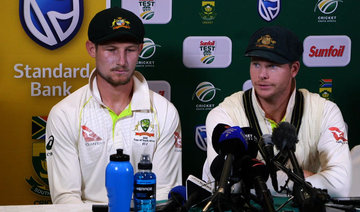
It was not just what Smith, David Warner and Cameron Bancroft did that has lanced Australian cricket to its very core. In the larger scheme of things, ball tampering is a misdemeanor rather than a crime. But the fact that they made a ham-handed plan, got caught and then lied about it in full view of the watching cameras has meant that it’s been treated the same way as corporate embezzlement or worse.
Cricket Australia’s inquiry clearly states that Warner — whose boorish conduct over the past half-decade has done little to win the team friends — was the instigator. It does not explain why Smith, who has now led the side for three years, chose to go along with the most dim-witted of plans.
Maybe the fear of sanctions stopped him coming clean to the umpires, but once multiple screen grabs had established in high definition what had transpired, it was bizarre that he chose to lie to the world at the press conference after the day’s play. Anyone with half-decent eyesight could see that Bancroft was holding a small square of sandpaper and not a strip of tape as was claimed. Why make matters worse with another untruth?
Cricket Australia and the team management deserve to be excoriated too for their part in this fiasco. A year ago, when Smith was caught on camera looking up at the dressing room in Bangalore for review advice, the board accepted his unsatisfactory “brain fade” explanation without so much as a proper inquiry. On that occasion, James Sutherland, the chief executive, mouthed empty platitudes about Smith’s “integrity.”
Look where that got us. By promoting a culture where players were not accountable for either their actions or their often-dismal on-field behavior, Cricket Australia sowed the seeds for this debacle. In an emotional column for PlayersVoice, Michael Hussey — one of the most admired of those to don the baggy green in recent years — wrote: “This current squad will one day be retired. And they will be confronted by the same question we all were at the end of our playing careers: Did we leave the team in a better place than we inherited it?
“If the answer is yes, it was a good career. If the answer is no, it wasn’t. It’s that simple.”
Right now, Smith, despite his tremendous batting feats, is on the wrong side of the ledger.


![]()

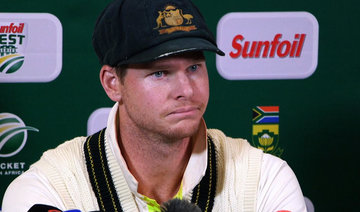
Steve Smith, the once golden boy of Australian cricket, faces fight of his career to restore his reputation
Steve Smith, the once golden boy of Australian cricket, faces fight of his career to restore his reputation

Latest updates


© 2026 SAUDI RESEARCH & PUBLISHING COMPANY, All Rights Reserved And subject to Terms of Use Agreement.