KARACHI: The Pakistan government plans to increase the revenue collection target by Rs 500 billion to Rs 4.5 trillion ($38.9 billion) for the next fiscal year in the forthcoming budget to be announced on April 27, said Haroon Akhtar Khan, special assistant to the Prime Minister for revenue and minister of state.
Khan addressed a pre-budget 2018-19 seminar on Monday.
Pakistan tax collection body the Federal Board of Revenue (FBR) had projected a revenue collection target of Rs 4 trillion for the current fiscal year 2017-18.
The government has collected Rs 2.26 trillion, up by 17.5 percent, revenue in the first eight months of the current fiscal year and hopes to achieve the target by the end of the fiscal year on June 30, 2018.
“The tax-to-GDP rate has increased to 12.5 percent from 9.5 percent,” Khan told participants of the seminar organized by the Pakistan Businessmen and Intellectuals Forum.
“For revenue collection we have set standards which will not be possible for the next leadership of the country to reverse,” he said, giving credit to FBR officials.
He assured that existing super tax, bonus share tax and dividend tax would be reviewed in the forthcoming budget. “The loss due to tax abolition would be arranged from other sources,” he said, without identifying the other sources.
He said the government wants to increase the individual income tax threshold from Rs 400,000. “We don’t want to lower the number of tax return filers,” he added.
Pakistan has devalued its national currency by 10 percent in the past four months in two phases which has depreciated against greenback from Rs 106 to Rs 115.
“It was very important,” Khan said, “because our imports were increasing by 26 percent per year and the government did its best to reduce them but could not succeed.”
He conceded that the government could not manage the rupee in a better way.
Responding to the concerns of the business community about the impact of the devaluation of the Pak rupee, he assured them that “there would be no shock to the economy,” mainly in the backdrop of historical low inflation and interest/policy rates. “If we do not adjust the currency as per the trends, our exports with the passage of time will be rendered uncompetitive in the international market,” he said.
Khan, whose government’s term ends in June, assured that the rupee would not be further devalued in the coming “several months” and the next government will be in a position to decide a future course of action.
He said the country’s foreign exchange reserves had declined from $19 billion to $12 billion because of the current account deficit.
Responding to the misgivings of businessmen about the free trade agreements (FTAs) with China and other countries, the state minister assured that the government has now decided not to sign any FTA without guarding national interests and taking the relevant sector on board.
Pakistan also plans to introduce a tax amnesty scheme for declaring offshore assets. “People from every sector have demanded the scheme. The government has prepared its draft with input from the court,” Khan said, adding that the amnesty scheme would be announced before the budget.
The state minister categorically denied that the government was moving away with regulatory duty imposed on the imports of some 356 goods to discourage imports. “The government will defend the case in court because Rs 80-90 billion are at stake,” he noted.
On the imminent placement of Pakistan on the grey list of the Financial Action Task Force in June, he said Pakistan has sacrificed too much and succeeded in defeating terrorism which could have spilled over from its borders. “We are a resilient nation and have fought with determination,” he said, adding that Pakistan’s sacrifices should not be downplayed.


![]()
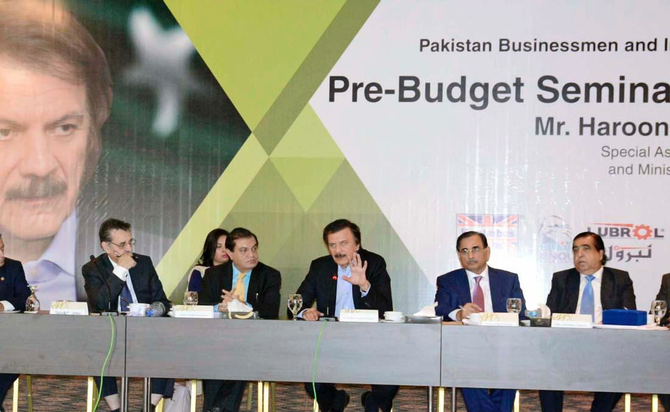
Pakistan to set Rs 4.5 trillion revenue collection target for next fiscal year
Pakistan to set Rs 4.5 trillion revenue collection target for next fiscal year
Latest updates


© 2026 SAUDI RESEARCH & PUBLISHING COMPANY, All Rights Reserved And subject to Terms of Use Agreement.