UAE says its first nuclear reactor is complete

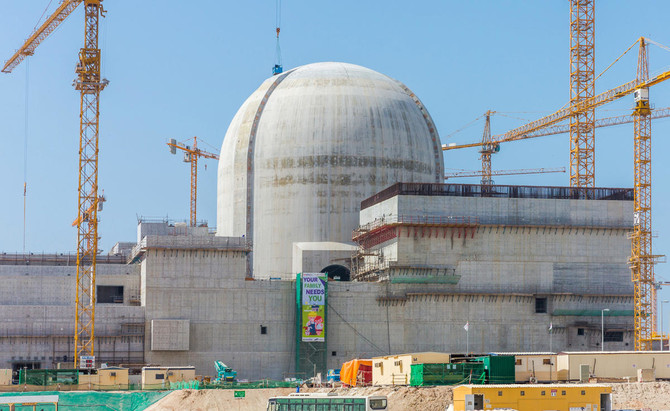
The Barakah nuclear power plant is being constructed by a consortium led by the Korea Electric Power Corporation. (AFP)
Updated 26 March 2018
Follow

UAE says its first nuclear reactor is complete

ABU DHABI: The United Arab Emirates said Monday that one of four nuclear reactors at its debut plant has been completed as it moves closer to becoming the first Arab nation to produce atomic power.
The announcement came after visiting South Korean President Moon Jae-in and Abu Dhabi Crown Prince Mohammed bin Zayed toured the $20-billion Barakah plant, the state-run WAM news agency reported.
The plant west of Abu Dhabi is being constructed by a consortium led by the Korea Electric Power Corporation (KEPCO).
Sheikh Mohammed described the achievement as “historical” for the energy sector of UAE, which is rich in oil and gas but is looking to increase other sources of power.
The UAE previously announced the first reactor would start operations in 2017 before delaying the start date.
The Emirates Nuclear Energy Corporation, which is overseeing the nuclear program, is awaiting the approvals from the regulatory authority to start operating.
Nuclear and renewables, which currently make up a small portion of the federation’s energy sources, are slated to contribute around 27 percent to UAE electricity needs by 2021.
The second reactor is 92 percent complete, the third 81 percent while 66 percent of the fourth has been completed, WAM reported.
When fully operational, the four reactors will produce 5,600 megawatts of electricity, or around 25 percent of the country’s needs, according to the UAE energy ministry.
UAE says it aims to continue diversifying toward its goal of 50-percent clean energy by 2050.
Saudi Arabia, the world’s top crude oil exporter, also has accelerated plans to acquire nuclear energy and is expected to prequalify several international companies next month to bid for building two nuclear reactors.


European gas prices soar almost 50% as Iran conflict halts Qatar LNG output

Updated 02 March 2026
Follow

European gas prices soar almost 50% as Iran conflict halts Qatar LNG output

  • Analysts warn prolonged disruption could push prices higher
  • Some shipments of oil, LNG through Strait of Hormuz suspended
  • Benchmark Asian LNG price up almost 39 percent

LONDON: ​Benchmark Dutch and British wholesale gas prices soared by almost 50 percent on Monday, after major liquefied natural gas exporter Qatar Energy said it had halted production due to attacks in the Middle East.

Qatar, soon to cement its role as the world’s second largest LNG exporter after the US, plays a major role in balancing both Asian and European markets’ demand of LNG.

Most tanker owners, oil majors and ‌trading houses ‌have suspended crude oil, fuel and liquefied natural ​gas shipments ‌via ⁠the ​Strait of ⁠Hormuz, trade sources said, after Tehran warned ships against moving through the waterway.

Europe has increased imports of LNG over the past few years as it seeks to phase out Russian gas following Russia’s invasion of Ukraine.

Around 20 percent of the world’s LNG transits through the Strait of Hormuz and a prolonged suspension or full closure would increase global competition for other ⁠sources of the gas, driving up prices internationally.

“Disruptions to ‌LNG flows would reignite competition between ‌Asia and Europe for available cargoes,” said ​Massimo Di Odoardo, vice president, gas ‌and LNG research at Wood Mackenzie.

The Dutch front-month contract at the ‌TTF hub, seen as a benchmark price for Europe, was up €14.56 at €46.52 per megawatt hour, or around $15.92/mmBtu, by 12:55 p.m. GMT, ICE data showed.

Prices were already some 25 percent higher earlier in the day but extended gains ‌after QatarEnergy’s production halt.

Benchmark Asian LNG prices jumped almost 39 percent on Monday morning with the S&P Global ⁠Energy Japan-Korea-Marker, widely used ⁠as an Asian LNG benchmark, at $15.068 per million British thermal units, Platts data showed.

“If LNG/gas markets start to price in an extended period of losses to Qatari LNG supply, TTF could potentially spike to 80-100 euros/MWh ($28-35/mmBtu),” Warren Patterson, head of commodities strategy at ING, said. The British April contract was up 40.83 pence at 119.40 pence per therm, ICE data showed.

Europe is also relying on LNG imports to help fill its gas storage sites which have been depleted over the winter and are currently around 30 percent full, the latest data from Gas Infrastructure ​Europe showed. In the European carbon ​market, the benchmark contract was down €1.10 at €69.17 a tonne