Indian agency denies reported security lapse in ID card project

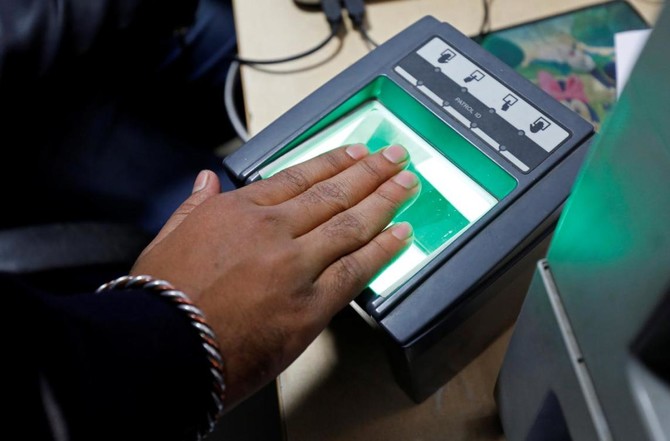
In this file photo, a woman goes through the process of finger scanning for the Unique Identification (UID) database system at a registration centre in New Delhi, India. (Reuters)
Updated 24 March 2018
Follow

Indian agency denies reported security lapse in ID card project

NEW DELHI: The semi-government agency behind India’s national identity card project on Saturday denied a report by news website ZDNet that the program has been hit by another security lapse that allows access to private information.
ZDNet reported that a data leak on a system run by a state-owned utility company, which it did not name, could allow access to private information of holders of the biometric “Aadhaar” ID cards, exposing their names, their unique 12-digit identity numbers, and their bank details.
But the Unique Identification Authority of India (UIDAI), which runs the Aadhaar program, said “there is no truth in this story” and that they were “contemplating legal action against ZDNet.”
ZDNet could not immediately be contacted for comment on the UIDAI’s response.
“There has been absolutely no breach of UIDAI’s Aadhaar database. Aadhaar remains safe and secure,” the agency said in a statement late on Saturday.
“Even if the claim purported in the story were taken as true, it would raise security concerns on database of that utility company and has nothing to do with the security of UIDAI’s Aadhaar database,” it said.
More than a billion users
ZDNet had reported that even though the security lapse had been flagged to some government agencies over a period of time, it has yet to be fixed. It said it was withholding the name of the utility and other details.
Karan Saini, a New Delhi-based security researcher, said that anyone with an Aadhaar number was affected.
“This is a security lapse. You don’t have to be a consumer to access these details. You just need the Uniform Resource Locator where the Application Programming Interface is located. These can be found in less than 20 minutes,” Saini told Reuters.
In recent months researchers and journalists who have identified loopholes in the identity project have said they have been slapped with criminal cases or harassed by government agencies because of their work.
Aadhaar, a biometric identification card with over 1.1 billion users, is the world’s biggest database.
But it has been facing increased scrutiny over privacy concerns following several instances of breaches and misuse.
Last Thursday, the CEO of the UIDAI said the biometric data attached to each Aadhaar was safe from hacking as the storage facility was not connected to the Internet.
“Each Aadhaar biometric is encrypted by a 2048-key combination and to decode it, the best and fastest computer of our era will take the age of the universe just to hack into one card’s biometric details,” Ajay Bhushan Pandey said.


Islamabad dismisses claims about paying up to 8 percent interest on foreign loans as ‘misleading’

Updated 5 sec ago
Follow

Islamabad dismisses claims about paying up to 8 percent interest on foreign loans as ‘misleading’

  • Pakistan has long relied on external loans to help bridge persistent gaps in public finances and foreign exchange reserves
  • Pakistan’s total external debt, liabilities stand at $138 billion at an overall average cost of around 4 percent, ministry says

KARACHI: Pakistan’s finance ministry on Sunday dismissed as “misleading” claims that the country is paying up to 8 percent interest on external loans, saying the overall average cost of external public debt is approximately 4 percent.

Pakistan has long relied on external loans to help bridge persistent gaps in public finances and foreign exchange reserves, driven largely by a narrow tax base, chronic trade deficits, rising debt-servicing costs and repeated balance-of-payments pressures.

Over the decades, successive governments have turned to multilateral and bilateral lenders, including the International Monetary Fund, the World Bank and the Asian Development Bank, to support budgetary needs and shore up foreign exchange reserves.

The finance ministry on Sunday issued a clarification in response to a “recent press commentary” regarding the country’s external debt position and associated interest payments, and said the figures required contextual explanation to ensure accurate understanding of Pakistan’s external debt profile.

“Pakistan’s total external debt and liabilities currently stand at $138 billion. This figure, however, encompasses a broad range of obligations, including public and publicly guaranteed debt, debt of Public Sector Enterprises (both guaranteed and non-guaranteed), bank borrowings, private-sector external debt, and intercompany liabilities to direct investors. It is therefore important to distinguish this aggregate figure from External Public (Government) Debt, which amounts to approximately $92 billion,” it said.

“Of the total External Public Debt, nearly 75 percent comprises concessional and long-term financing obtained from multilateral institutions (excluding the IMF) and bilateral development partners. Only about 7 percent of this debt consists of commercial loans, while another 7 percent relates to long-term Eurobonds. In light of this composition, the claim that Pakistan is paying interest on external loans ‘up to 8 percent’ is misleading.

The overall average cost of External Public Debt is approximately 4 percent, reflecting the predominantly concessional nature of the borrowing portfolio.”

With respect to interest payments, public external debt interest outflows increased from $1.99 billion in Fiscal Year (FY) 2022 to $3.59 billion in FY2025, representing an increase of 80.4 percent, not 84 percent as reported. In absolute terms, interest payments rose by $1.60 billion over this period, not $1.67 billion, it said.

According to the State Bank of Pakistan’s records, Pakistan’s total debt servicing payments to specific creditors during the period under reference were as follows: the IMF received $1.50 billion, of which $580 million constituted interest; Naya Pakistan Certificates payments totaled $1.56 billion, including $94 million in interest; the Asian Development Bank received $1.54 billion, including $615 million in interest; the World Bank received $1.25 billion, including $419 million in interest; and external commercial loans amounted to nearly $3 billion, of which $327 million represented interest payments.

“While interest payments have increased in absolute terms, this rise cannot be attributed solely to an expansion in the debt stock,” the ministry said. “Although the overall debt stock has increased slightly since FY2022, the additional inflows have primarily originated from concessional multilateral sources and the IMF’s Extended Fund Facility (EFF) under the ongoing IMF-supported program.”

Pakistan secured a $7 billion IMF bailout in Sept. 2024 as part of Prime Minister Shehbaz Sharif’s efforts to stabilize the South Asian economy that narrowly averted a default in 2023. The government has since been making efforts to boost trade and bring in foreign investment to consolidate recovery.

“It is also important to note that the increase in interest payments reflects prevailing global interest rate dynamics. In response to the inflation surge of 2021–22, the US Federal Reserve raised the federal funds rate from 0.75-1.00 percent in May 2022 to 5.25–5.50 percent by July 2023. Although rates have since moderated to around 3.75 percent, they remain significantly higher than 2022 levels,” the finance ministry said.

“The government remains committed to prudent debt management, transparency, and the continued strengthening of Pakistan’s macroeconomic stability,” it added.