KARACHI: More than 21.6 million people in Pakistan lack access to clean water, according to data collected through the UN’s Joint Monitoring Program, and released by the charity WaterAid.
The report “Water Gap The State of the World’s Water 2018” was released on Wednesday, in connection with World Water Day.
WaterAid’s report said that while 88.5 percent people have access to clean water close to home, there was a big gap between rich and poor — 79.2 percent of the poorest people had clean water compared with 98 percent of the country’s richest.
It was found that Sindh province had the worst water conditions with about 80 percent of supply to the province found unfit for human consumption.
In 2016 the Supreme Court set up a commission to explore water quality supply in the province.
“Only 85 water samples out of 336 collected from several districts for detailed physicochemical and microbiological parameters were fit for human consumption while 251 were found unsafe,” the commission said in a report submitted to the apex court in March 2017.
The Chief Secretary of Sindh in his statement before the judicial commission, submitted to the court in March 2017, admitted that the provincial administration of Sindh was responsible for providing basic facilities to all citizens.
The secretary had also submitted a list of 22 water and sanitation projects worth billions of rupees that were undertaken by different government and private partners across the Sindh province.
“The Chief Minister of Sindh is giving top priority to the water issue under the Sindh drinking water policy 2017,” Rasheed Channa, spokesman for Syed Murad Ali Shah, Chief Minister Sindh, told Arab News on Thursday.
He added that the chief minister believed the federal government was not properly funding water reservoir projects in the province.
“The issue will be raised again in the meeting of Council of Common Interest, a constitutional body which resolves disputes between the federation and the provinces,” Channa said.
Nadeem Ahmed, manager policy at WaterAid Pakistan, told Arab News that the government should take steps to ensure water treatment plants at every level.
“Around 90 percent water is not treated in Pakistan, and Sindh being the tail-end user, has become most vulnerable,” he said, adding: “One gallon of untreated water contaminates eight gallons of clean water.”
WaterAid says that every year around 289,000 children under five die of diarrhea directly linked to dirty water, inadequate toilet facilities and poor hygiene.
“Diarrhea, skin conditions and (many types of) infections, can all be linked to dirty water, alongside poor sanitation and poor hygiene. One in four newborn deaths are due to infections,” the organization says in its report.
Shahab Usto, the lawyer who filed the Supreme Court petition, told Arab News that around 450 million gallons per day of untreated water is being released in the sea. Around 90 percent water in Karachi is being supplied untreated and the situation is not different in other parts of Sindh province”, he added.
“If we will fail to provide safe drinking water to the people of Sindh, the province will become a colony of sick people in next 10 years”, Usto warned.


![]()
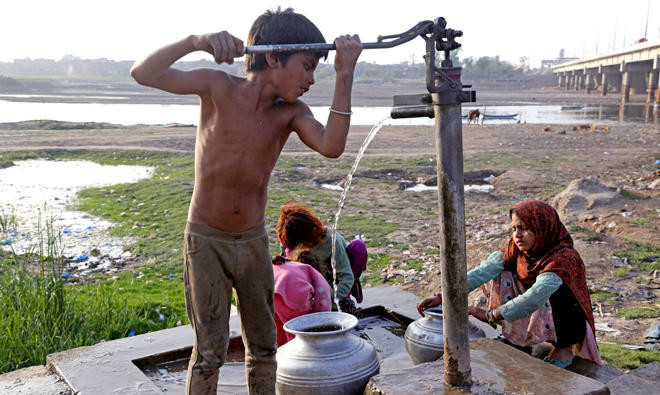
Pakistan battles to bring clean water to Sindh province
Pakistan battles to bring clean water to Sindh province
Latest updates


© 2026 SAUDI RESEARCH & PUBLISHING COMPANY, All Rights Reserved And subject to Terms of Use Agreement.