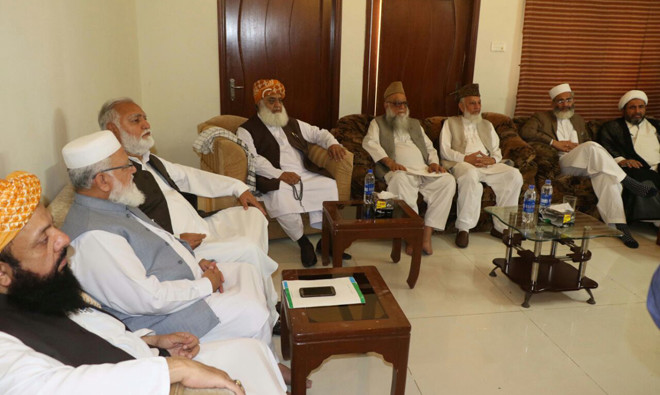
KARACHI: Chief of Jamiat Ulema-e-Islam (JUI-F), Maulana Fazlur Rehman, was elected President of the Muttahida Majlis-e-Amal (MMA) – an alliance of five religio-political parties – in its meeting in Karachi here on Tuesday.
Liaquat Baloch, General Secretary of the Jamaat-i-Islami (JI), another important party in the alliance, was elected General Secretary of the MMA.
The JUI-F’s Ghafoor Haidry and Islami Tehreek Party’s Allama Arif Wahidi were elected as Deputy Secretaries of the alliance.
Jamiat Ulema-e-Pakistan (JUP) President Shah Owais Noorani got the slot of central spokesman.
Alama Sajid Mir was elected head of the manifesto committee, whereas Alama Shabier Maismi was elected secretary finance.
The alliance formed in 2002 in the wake of the US invasion of Afghanistan, split in 2005 and was revived on Nov. 9, 2017 in Lahore but formally announced on Dec. 14, 2017 at Karachi.
Flanked by Jama’at-e-Islami chief Sirajul Haq, Jamiat Ahle Hadith President Sajid Mir, Jamiat Ulema-e-Pakistan (JUP) chief Maulana Owais Noorani and others, the newly elected president of the alliance told a post-meeting media briefing that the alliance will soon announce organizations up to district levels across Pakistan.
“Islam is the religion of peace and we, through the platform of the MMA, want to defeat the mindset which spreads extremism,” Rehman said. “Majlis-e-Amal is the voice of the oppressed; we will stand for oppressed people. Minorities of Pakistan have equal rights and we want to give them their due rights. We will stand for them,” he said, adding that the MMA will begin its new journey with these aims.
JI chief Sirajul Haq said that the mafias don’t want to see an Islamic government in Pakistan, “but we are determined to make Pakistan a welfare and prospering Islamic democrat state,” the JI chief said.
Analysts in Pakistan see an uphill task ahead for the religio-political parties.
Mazhar Abbas, a Karachi-based analyst, said gaining 2002-like electoral success will not be easy. “The anti-US sentiments were at an all-time high before the 2002 general elections, which the religious parties exploited to not only form a provincial government in KP but also secured a good position in Balochistan and Karachi.”
Although the JUI-F had been able to retain its popularity, JI faced a continued downfall, Abbas said, adding: “JI has found in the revival of the MMA an opportunity to keep itself relevant in electoral politics. Several JI candidates have forfeited their security deposit in most of the past by-elections.” In Balochistan, the alliance can get seats, said Abbas.
Khyber Pakhtunkhwa (KP), where the alliance had formed a government in 2002, still belongs to Pakistan Tehreek-e-Insaf (PTI), said Lehaz Ali, a Peshawar-based analyst, adding that the Imran Khan-led clique has focused on the Peshawar valley, comprising the developed and settled districts. “The PTI, which had fielded unknown faces banking on its popularity, has now turned toward the politics of the electable in order to ensure retaining the KP government,” Ali said. “A strong position for the PTI means fewer chances for the MMA to win seats.”
Wakil Rehman, a Karachi-based analyst with special focus on religious parties and Pashtun votes, says that during the general polls of 2013, JUI-F and JI – two major parties of the alliance – had together grabbed more votes than the winning candidate on many seats. “The alliance can take seats in Balochistan, KP and Karachi. In Karachi, they have a vote bank in district west and parts of district Malir, with a Pashtun population.”
The MMA now hopes that the alliance will help religious parties to win more seats. “The alliance had yielded great results in 2002 and we hope it will do better in our favor,” Qari Muhammad Usman, JUI-F deputy chief in Sindh, told Arab News.
However, he admitted the allied parties have no strategic targets. “Alliances are made according to the needs of the time and when such needs are fulfilled, these may be scrapped,” Usman said.
Wakil Rehman, believes that the growing distance of these religious parties with their respective allies has pushed them toward the revival of the MMA: “Every party has a different manifesto. These have been active against each other before the formation of the MMA in 2002 and after it was scrapped.”
Rehman added that the MMA was formed and has now been revived just months before elections. “For a long strategic alliance the parties would require to set aside their own identity, which is nearly impossible.”
“If they fail to obtain a majority for forming a KP government, the MMA parties may go for forming coalition governments in the center and provinces with their former allies,” said Ali, adding that the Election Commission of Pakistan doesn’t stop such alliances from switching loyalty.
“In that case the alliance will again prove short-lived,” Rehman concluded.


![]()
![]()
![]()

Fazlur Rehman elected President of Muttahida Majlis-e-Amal

Fazlur Rehman elected President of Muttahida Majlis-e-Amal
Latest updates


© 2026 SAUDI RESEARCH & PUBLISHING COMPANY, All Rights Reserved And subject to Terms of Use Agreement.