LONDON: Manchester United are second in the Premier League, on course for their highest finish and points total in England’s top tier since Sir Alex Ferguson retired five years ago. In the 20 months since Jose Mourinho took charge of his first competitive fixture as manager United have won two major trophies. At the weekend they reached the semifinal of a third.
When Manchester City secure this season’s Premier League title, Pep Guardiola will have matched Mourinho’s major trophy tally in the northwest, albeit with one title of superior status. Guardiola will have done that, as his rival recently pointed out, having inherited superior playing resources. Added to that has been the extra €205 million ($251 million) his Abu Dhabi employers have committed to transfer fees in his first two campaigns at the club, 54 percent higher than their closest rival for the title over that period.
United will not win the Champions League for the first time in a decade after a thoroughly disappointing loss to Spanish opposition last week. That 2-1 aggregate defeat was one of 20 eliminations suffered by Premier League clubs in their last 24 European knock-out ties against Liga outfits. For some of Mourinho's most ardent critics the exit offered an opportunity to argue he should be sacked.
When Mourinho sought to put United’s progress under his management into context, when the Portuguese delivered a detailed explanation of “the process” involved in restoring the club’s domestic and European fortunes, he was attacked again.
The longest answer of a coach who has won 20 major trophies at five different clubs in four different countries was labelled a “desperate rant;” “self-serving, self-aggrandizing, self-regarding, self-pitying, melodramatic, hard-luck claptrap.”
As anyone who has spent any length of time discussing football with him knows, Mourinho often delivers long and detailed answers. In his most recent interview with an English newspaper, the reply to an opening query on how much trouble United were in when he arrived as manager ran for over 10 minutes.
Should there be surprise that some of those advocating Mourinho’s dismissal prefer to critique the length of time he spoke for rather than the information and analysis contained in his words? Not really. It is just another angle of attack — if you cannot play the ball, play the man.
A coach who won the Spanish title with a record number of goals, victories and points against a Barcelona team that some of his critics have argued is the game’s greatest ever is decried for a failure to entertain.
Another argument is that Guardiola’s way of playing football has changed the game and that Mourinho’s decision not to ape the Catalan’s methods has left him outdated. The basic thesis is that success in modern football demands a team to be expansive, focused on controlling the ball and to place absolute primacy on attack. It is sometimes supported by statistics showing a 16 percent increase in Champions League knockout round goals scored during the “Guardiola era.”
You might want to ask about the causality of that correlation – have Champions League goals increased because the richest teams have grown richer and their squads grown exponentially stronger than their knock-out round opponents? (The last time a genuine financial outsider won the European Cup was 2004 – Mourinho's FC Porto.)
More importantly you might ask how many Champions Leagues the Guardiola method has actually won? The Catalan himself has two, and zero since separating himself from the uniquely talented group of La Masia graduates he led at Barcelona. He might win the Champions League this year with the most expensive squad assembled in the history of the game. He might not.
Since Guardiola quit Barcelona, Chelsea have won the European Cup playing pragmatic, counterattacking football, followed by Bayern Munich playing the Jupp Heynckes style Guardiola had already been hired by the German club to overhaul. Real Madrid have three of the last four European Cups playing a different game from Guardiola’s and Barca have one success with a system modified to take advantage of the Lionel Messi-Luis Suarez-Neymar attacking trident.
Other clubs adopting “proactive” tactical approaches in the Premier League? Zero trophies so far for Jurgen Klopp and Mauricio Pochettino. Last two title winners? Chelsea and Leicester City? “Super defensive teams, with a killer counterattack,” as Mourinho accurately described them in that recent Sunday Times interview.
What has Mourinho been doing at Manchester United with a squad that is in need of a significant upgrade to put it on a level with the Champions League superpowers? What he always done: Tailored his approach to the opponent and the circumstances of the match. Different tactics, different systems, different methods for different games.
Pragmatic? Yes. But unless a football manager expected to win titles has superior resources to his opponents is there any other sensible way to work?


![]()
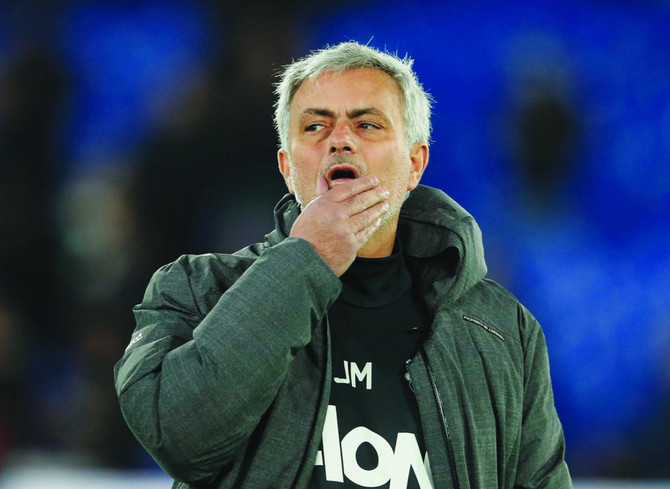
Despite trailing Manchester City, Jose Mourinho deserves respect for United achievements
Despite trailing Manchester City, Jose Mourinho deserves respect for United achievements

Latest updates


Recommended


© 2026 SAUDI RESEARCH & PUBLISHING COMPANY, All Rights Reserved And subject to Terms of Use Agreement.