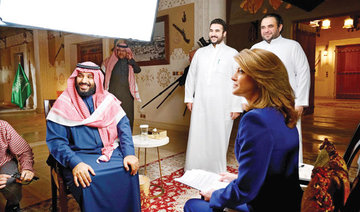
JEDDAH: Saudi Arabia's Crown Prince Mohammed bin Salman has said the anti-corruption crackdown he initiated in the Kingdom was "extremely necessary" because roughly $20 billion of state funds was "disappearing" every year.
In a wide-ranging interview aired by CBS television on “60 Minutes” on Sunday, the crown prince also spoke about the threats posed by Iran and its proxies across the region and the reforms being undertaken in the Kingdom to fight extremism.
The crown prince said that if Iran acquired a nuclear weapon then Saudi Arabia will too.
CBS anchorwoman Norah O’Donnell interviewed the crown prince in Riyadh two weeks ago, shortly before he left for his visit to Egypt and Britain.
O’Donnell earlier said there were "no time restrictions and no preconditions" and that the crown prince spoke candidly.
The crown prince said Saudi Arabia has recovered more than $100 billion so far in its crackdown against corruption.
"The amount exceeds $100 billion, but the real objective was not this amount or any other amount. The idea is not to get money, but to punish the corrupt and send a clear signal that whoever engages in corrupt deals will face the law," he said.
During the crackdown last November, the Kingdom detained a big number of incumbent and former government ministers, prominent businessmen, and at least 11 princes who were accused of corruption.
The accused were held at the Ritz Carlton Hotel for some time until they either returned what they have been accused of stealing from the government or proved their innocence.
On reports of human rights abuses in the Kingdom, Prince Mohammed assured that "Saudi Arabia believes in many of the principles of human rights."
"In fact, we believe in the notion of human rights, but ultimately Saudi standards are not the same as American standards. I don't want to say that we don't have shortcomings. We certainly do. But naturally, we are working to mend these shortcomings," he said.
Religious tolerance, women rights
Prince Mohammed said that his country was not always like what it has been in the last 40 years. “We were living a very normal life like the rest of the Gulf countries. Women were driving cars. There were movie theaters in Saudi Arabia. Women worked everywhere. We were just normal people developing like any other country in the world until the events of 1979,” he said.
The widespread perception of the Kingdom as a place with harsh Islamic laws impacted the youth of the country, recalled the crown prince. “After 1979, that's true. We were victims, especially my generation that suffered from this a great deal.”
"We have extremists who forbid mixing between the two sexes and are unable to differentiate between a man and a woman alone together and their being together in a workplace. Many of those ideas contradict the way of life during the time of the Prophet and the Caliphs. This is the real example and the true model," he said.
The prince was asked if women were equal to men. “Absolutely. We are all human beings and there is no difference,” he said.
On the issue of women’s dress code and the stipulations of the Sharia, the crown prince said: “Women wear decent, respectful clothing, like men. This, however, does not particularly specify a black abaya or a black head cover. The decision is entirely left for women to decide what type of decent and respectful attire she chooses to wear.”
With a ban lifted on women driving in the Kingdom and women getting ready to sit behind the wheel this June, the crown prince was again asked the issue of women and driving in Saudi Arabia. He said: “This is no longer an issue. Today, driving schools have been established and will open soon. In a few months, women will drive in Saudi Arabia. We are finally over that painful period that we cannot justify.” The crown prince also said work is underway to a new initiative to introduce regulations ensuring equal pay for men and women.
Prince Mohammed promised to eradicate any trace of extremist elements in the Kingdom's educational institutions. “Saudi schools have been invaded by many elements from the Muslim Brotherhood organization, surely to a great extent. Even now, there are some elements left. It will be a short while until they are all eradicated completely,” he said, adding “no country in the world would accept that its educational system be invaded by any radical group.”
Regional security
On regional security, the crown prince said Iran poses a clear and present danger. He likened Iran’s supreme leader, Ali Khamenei, to Hitler, adding that the Iranian mullah’s expansionist plans poses a serious threat to the security of the Middle East.
“He wants to expand. He wants to create his own project in the Middle East very much like Hitler who wanted to expand at the time. Many countries around the world and in Europe did not realize how dangerous Hitler was until what happened, happened. I don't want to see the same events happening in the Middle East,” he said.
Prince Mohammed said Saudi Arabia has no interest in acquiring a nuclear bomb, but “if Iran developed a nuclear bomb, we will follow suit as soon as possible.”
Crown Prince Mohammed, who is also the defense minister, said Iranian ideology had infiltrated parts of neighbor Yemen. “During that time, this militia was conducting military maneuvers right next to our borders and positioning missiles at our borders,” he said, referring to the Houthi militia that is fighting the UN-recognized Yemen government of President Abed Rabbo Mansour Hadi.
Houthi militias have launched missiles toward Saudi Arabia’s Makkah region and at the capital, Riyadh. Scores of civilians have also been killed or hurt in these strikes. Most of these missiles have been traced to Iran.
“I can't imagine that the United States will accept one day to have a militia in Mexico launching missiles on Washington D.C., New York and LA while Americans are watching these missiles and doing nothing,” he added.
He said the catastrophe in Yemen was ’truly very painful’ and hoped the Houthi militia “ceases using the humanitarian situation to their advantage in order to draw sympathy from the international community. They block humanitarian aid in order to create famine and a humanitarian crisis.”
On the suggestion that what was happening in Yemen was a proxy war, the crown prince said: “Unfortunately, Iran is playing a harmful role. The Iranian regime is based on pure ideology. Many of the Al-Qaeda operatives are protected in Iran and it refuses to surrender them to justice, and continues to refuse to extradite them to the United States. This includes the son of Osama bin Laden, the new leader of Al-Qaeda. He lives in Iran and works out of Iran. He is supported by Iran.”
“Iran is not a rival to Saudi Arabia. Its army is not among the top five armies in the Muslim world. The Saudi economy is larger than the Iranian economy. Iran is far from being equal to Saudi Arabia,” He said.
Personal wealth
Asked to comment on news reports on his personal wealth, he said: “My personal life is something I'd like to keep to myself and I don't try to draw attention to it. If some newspapers want to point something out about it, that's up to them. As far as my private expenses, I'm a rich person and not a poor person. I'm not Gandhi or Mandela. I'm a member of the ruling family that existed for hundreds of years before the founding of Saudi Arabia. We own very large lots of land, and my personal life is the same as it was 10 or 20 years ago. But what I do as a person is to spend part of my personal income on charity. I spend at least 51% on people and 49 on myself.”
The crown prince talked warmly about his father, King Salman’s fondness for history and how he would foster a love of reading in his children' “He loves history very much. He is an avid reader of history. Each week, he would assign each one of us a book. And at the end of the week, he would ask us about the content of that book. The king always says, "If you read the history of a thousand years, you have the experience of a thousand years,” the crown prince recounted.
When the 32-year-old heir to the throne was posed the prospect of him shaping the Kingdom’s future for the next 50 years, he said “only God knows how long one will live.”
Can anything stop Saudi Arabia’s Crown Prince Mohammed bin Salman? “Only death,” he said.