JAKARTA: The leaders of ASEAN countries and Australia reiterated on Sunday their commitment to combat borderless violent extremism and to work more closely to prevent the flow of foreign terrorist fighters into the region.
The leaders were concluding the ASEAN-Australia special summit, held for the first time in Sydney over the weekend.
In a joint statement dubbed the “Sydney Declaration” issued at the end of the special summit, the 11 leaders said they “unequivocally condemn in the strongest terms terrorism in all its forms and manifestations.”
They also said they would enhance regional cooperation to address the root cause of conditions that contribute to the growth and spread of violent extremism and radicalization.
To cement their commitment, the 10 ASEAN member states and Australia agreed on Saturday to a joint counterterrorism pact which marks a deepened and expanded cooperation. The memorandum of understanding (MoU) was signed by the bloc’s Secretary General, Lim Jock Hoi, and Australia’s Minister for Foreign Affairs Julie Bishop, and witnessed by the 10 ASEAN and Australian leaders at the end of the ASEAN-Australia counterterrorism conference.
Indonesian President Joko Widodo said in his speech at the forum that he appreciated Australia’s active cooperation with ASEAN in combating terrorism, citing Australia’s role in co-hosting with Indonesia in July the sub-regional counterterrorism forum involving Malaysia, the Philippines, Brunei, Singapore and New Zealand to address borderless terrorism and the adverse impact of then-besieged Marawi in the southern Philippines.
According to a statement from the presidential palace press bureau, Widodo also welcomed the MoU signing, saying: “Based on my observation, the MoU underscores a balance between hard and soft approaches” in fighting violent extremism.
Chief of Indonesia’s counterterrorism agency, Commissioner Gen. Suhardi Alius, said Indonesia shared at the forum its experience in counterterrorism efforts such as amending the anti-terrorism law to include provisions that would criminalize Indonesian citizens’ involvement in plotting, training and traveling for terror-related purposes.
In a press release, Alius said he also shared the agency’s recent efforts to reconcile 124 former convicts with 51 survivors and family members of those who died in terror attacks in the country.
Australian Prime Minister Malcolm Turnbull said Australia sees ASEAN as an essential security partner and called for unity in the face of terror, which he said was carried out by a small minority of people who defame and blaspheme against Islam.
“They have sought to sow discord by their perverted and nihilistic interpretation of Islam, to provoke hatred between Sunni and Shia Muslims and to drive a wedge between Muslims and non-Muslims,” Turnbull said, according to a transcript.
“Our best allies in the war against this scourge are the vast majority of Muslims — around the world, around the region, here in Australia — and their leaders,” he added, mentioning Widodo, Malaysian PM Najib Razak and Sultan Hassanal Bolkiah of Brunei, all of whom are leaders of Muslim-majority ASEAN nations.
Turnbull also highlighted the possible threats of Asian-origin Daesh fighters who are returning to the region “battle-hardened and trained.”
“It is vital for Australia and our ASEAN partners to collaborate across borders to ensure that our counterterrorism legal frameworks are robust enough to provide effective investigation, prosecution and punishment, while being flexible enough to adapt to the changing and uncertain security environment,” Turnbull said.
The counterterrorism pact includes cooperation to develop and implement counterterrorism legislation, an ASEAN-Australia workshop on using electronic evidence in terrorism and transnational crime-related investigations and prosecutions, and exchange programs for financial intelligence analysts.
Australia and the ASEAN countries will also establish regional dialogues and forums with law enforcement partners, aimed at combating the threat of Daesh-affiliated terrorists. Australia will provide a capacity-building program for ASEAN law enforcement partners on technology-enabled crime to assist in detecting and disrupting terrorist activity.


![]()
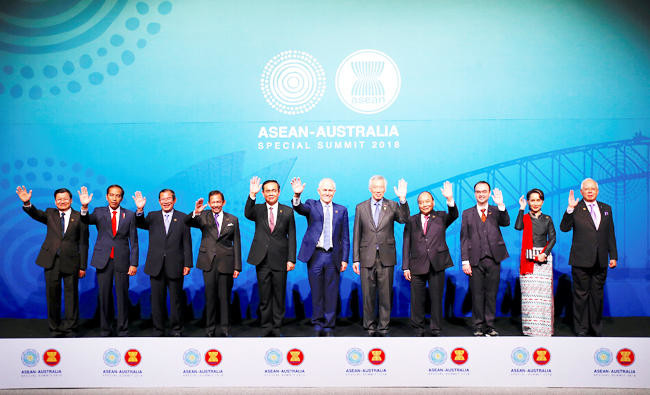
Australia, ASEAN vow to combat Daesh
Australia, ASEAN vow to combat Daesh


Latest updates


© 2026 SAUDI RESEARCH & PUBLISHING COMPANY, All Rights Reserved And subject to Terms of Use Agreement.