ISLAMABAD: Pakistan’s top security adviser has said Afghan Taliban insurgents “do not have any excuse” to continue war after President Ashraf Ghani’s proposals to recognize the Taliban as a political party, allow them open an office in Kabul, issue passports to their members and remove the names of senior commanders from the UN terrorist blacklists.
The Taliban have not issued any formal reaction to President Ghani’s latest initiative but a Taliban political official has told Arab News the Afghan leader has “skipped” the real issue — foreign invasion — in his address to the “Kabul Process” meeting in the Afghan capital on Feb. 28.
Pakistan National Security Adviser (NSA) Nasir Khan Janjua, who wrapped up his day-long visit to Kabul on Saturday evening, said on his return on Sunday that he has expressed complete support for the long-awaited peace offer.
Janjua’s office said he had elaborate and successful meetings with President Ashraf Ghani, Chief Executive Dr. Abdullah Abdullah, his counterpart Haneef Atmar, minister of defense, and the intelligence chief.
Abdullah’s office quoted the Pakistani NSA as saying: “The Taliban have no excuse to continue war” after what he described as unprecedented peace efforts.
In the statement on his return, Janjua termed the peace offer as “a light on the other side of the tunnel in a war which had become rather perpetual.”
The Taliban declined to offer any comments on Pakistan’s NSA remarks.
Janjua said the Afghan president “desired a roadmap to be prepared for a comprehensive engagement with Pakistan to carry the relationship further with a leap of faith.”
He confirmed President Ghani also handed over the letter of invitation to him for the Prime Minister of Pakistan and expected him to visit as soon as possible.
Analysts in Pakistan believe the main purpose of the NSA talks in Kabul was to “reduce mistrust” between the two countries.
Imtiaz Gul, head of the Center for Research and Security Studies in Islamabad, says the visit is a major confidence-building measure that could “open the way for bilateral dialogue.”
“The visit will also underline Pakistan’s push on the Taliban to come to the negotiations table,” Gul told Arab News.
Defense analyst Lt. Gen Amjad Shoaib called for more high-level interaction between the two countries which will help to create understanding on security issues. He termed the NSA visit as a major confidence-building measure and that there is a need for high-level exchanges.
“There is currently lack of bilateral interaction. Both countries should enhance intelligence sharing and Afghanistan should give up its opposition to the border management and fencing,” Gen. Amjad told Arab News on Sunday.
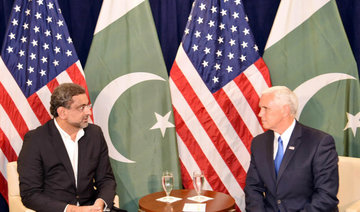
It is believed that Pakistan is under pressure from the US to act against the Afghan Taliban and its affiliate the Haqqani Network, and the same demand was repeated during the meeting between Prime Minister Abbasi and US Vice President Mike Pence in Washington on Friday.
“Pence reiterated President Trump’s request that the Government of Pakistan must do more to address the continued presence of the Taliban, the Haqqani Network, and other terrorist groups operating in their country,” a White House statement said after the meeting.
“The vice president stated that US efforts to eliminate terrorist groups who threaten US security and the stability of the region will continue and noted that Pakistan could and should work more closely with the United States,” the statement said.

Taliban have ‘no excuse’ to continue war after Ghani’s peace overture, says Pakistan
Afghanistan says it thwarted Pakistani airstrike on Bagram Air Base as fighting enters fourth day
- The fighting has been the most severe between the neighbors for years
- Pakistan accuses Taliban government of harboring militant groups that stage attacks against it
KABUL: Afghanistan thwarted attempted airstrikes on Bagram Air Base, the former US military base north of Kabul, authorities said Sunday, while cross-border fighting between Pakistan and Afghanistan stretched into a fourth day.
The fighting has been the most severe between the neighbors for years, with Pakistan declaring that it’s in “open war” with Afghanistan.
The conflict has alarmed the international community, particularly as the area is one where other militant organizations, including Al-Qaeda and the Daesh group, still have a presence and have been trying to resurface.
Pakistan accuses Afghanistan’s Taliban government of harboring militant groups that stage attacks against it and also of allying with its archrival India.
Border clashes in October killed dozens of soldiers, civilians and suspected militants until a Qatari-mediated ceasefire ended the intense fighting. But several rounds of peace talks in Turkiye in November failed to produce a lasting agreement, and the two sides have occasionally traded fire since then.
On Sunday, the police headquarters of Parwan province, where Bagram is located, said in a statement that several Pakistani military jets had entered Afghan airspace “and attempted to bomb Bagram Air Base” at around 5 a.m.
The statement said Afghan forces responded with “anti-aircraft and missile defense systems” and had managed to thwart the attack.
There was no immediate response from Pakistan’s military or government regarding Kabul’s claim of attempted airstrikes on Bagram or the ongoing fighting.
Bagram was the United States’ largest military base in Afghanistan. It was taken over by the Taliban as they swept across the country and took control in the wake of the chaotic US withdrawal from the country in 2021. Last year, US President Donald Trump suggested he wanted to reestablish a US presence at the base.
The current fighting began when Afghanistan launched a broad cross-border attack on Thursday night, saying it was in retaliation for Pakistani airstrikes the previous Sunday.
Pakistan had said its airstrike had targeted the outlawed Pakistani Taliban, also known as Tehreek-e-Taliban Pakistan, or TTP. Afghanistan had said only civilians were killed.
The TTP militant group, which is separate but closely allied with Afghanistan’s ruling Taliban, operates inside Pakistan, where it has been blamed for hundreds of deaths in bombings and other attacks over the years.
Pakistan accuses Afghanistan’s Taliban government of providing a safe haven within Afghanistan for the TTP, an accusation that Afghanistan denies.
After Thursday’s Afghan attack, Pakistani Defense Minister Khawaja Mohammad Asif declared that “our patience has now run out. Now it is open war between us.”
In the ongoing fighting, each side claims to have killed hundreds of the other side’s forces — and both governments put their own casualties at drastically lower numbers.
Two Pakistani security officials said that Pakistani ground forces were still in control on Sunday of a key Afghan post and a 32-square-kilometer area in the southern Zhob sector near Kandahar province, after having seized it during fighting Friday. The captured post and surrounding area remain under Pakistani control, they added. The officials spoke on condition of anonymity, because they weren’t authorized to speak publicly.
In Kabul, the Afghan government rejected Pakistan’s claims. Deputy government spokesman Hamdullah Fitrat called the reports “baseless.”
Afghan officials said that fighting had continued overnight and into Sunday in the border areas.
The police command spokesman for Nangarhar province, Said Tayyeb Hammad, said that anti-aircraft missiles were used from the provincial capital, Jalalabad, and surrounding areas on Pakistani fighter jets flying overhead Sunday morning.
Defense Ministry spokesman Enayatulah Khowarazmi said that Afghan forces had launched counterattacks with snipers across the border from Nangarhar, Paktia, Khost and Kandahar provinces overnight. He said that two Pakistani drones had been shot down and dozens of Pakistani soldiers had been killed.
Fitrat said that Pakistani drone attacks hit civilian homes in Nangarhar province late Saturday, killing a woman and a child, while mortar fire killed another civilian when it hit a home in Paktia province.
There was no immediate response to the claims from Pakistani officials.


