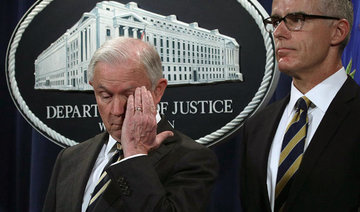
WASHINGTON: Andrew McCabe, the onetime FBI deputy director long scorned by President Donald Trump and just fired by the attorney general, kept personal memos detailing interactions with the president that have been provided to the special counsel’s office and are similar to the notes compiled by dismissed FBI chief James Comey, The Associated Press has learned.
The memos could factor into special counsel Robert Mueller’s investigation as his team examines Trump campaign ties to Russia and possible obstruction of justice.
McCabe’s memos include details of his own interactions with the president, according to a person with direct knowledge of the situation who wasn’t authorized to discuss the notes publicly and spoke on condition of anonymity. They also recount different conversations he had with Comey, who kept notes on meetings with Trump that unnerved him.
Though the precise contents are unknown, the memos possibly could help substantiate McCabe’s assertion that he was unfairly maligned by a White House he says had declared “war” on the FBI and Mueller’s investigation. They almost certainly contain, as Comey’s memos did, previously undisclosed details about encounters between the Trump administration and FBI that could be of interest to Mueller.
The disclosure Saturday came hours after Trump called McCabe’s firing by Attorney General Jeff Sessions “a great day for Democracy” and asserted without elaboration that McCabe knew “all about the lies and corruption going on at the highest levels off the FBI!” In the last year, Trump has repeatedly condemned as emblematic of an FBI that he insists is biased against his administration.
That sent former CIA Director John Brennan, an outspoken Trump critic, into a Twitter tizzy: “When the full extent of your venality, moral turpitude, and political corruption becomes known, you will take your rightful place as a disgraced demagogue in the dustbin of history. You may scapegoat Andy McCabe, but you will not destroy America...America will triumph over you.”
Sessions said he acted on the recommendation of FBI disciplinary officials who said McCabe had not been candid with a watchdog office investigation. McCabe was fired two days before his retirement date on Sunday. The dismissal likely jeopardizes his ability to collect his full pension benefits and, more broadly, could add to the turmoil that has enveloped the FBI since Comey’s firing and as the bureau moves ahead with an investigation the White House has dismissed as a hoax.
An upcoming inspector general’s report is expected to conclude that McCabe, who spent more than 20 years with the FBI, had authorized the release of information to the media and was not forthcoming with the watchdog office as it examined the bureau’s handling of the Hillary Clinton email investigation. McCabe has vigorously disputed the allegations and said his credibility had been attacked as “part of a larger effort not just to slander me personally” but also the FBI and law enforcement.
“It is part of this administration’s ongoing war on the FBI and the efforts of the special counsel investigation, which continue to this day,” he added. “Their persistence in this campaign only highlights the importance of the special counsel’s work.”
The firing set off dueling tweets between Trump, who called the termination a “great day for the hard working men and women of the FBI,” and Comey, the director he fired 10 months ago.
Trump called Comey “sanctimonious” and said Comey made McCabe “look like a choirboy.” Comey, referencing his highly anticipated book that comes out next month, responded with his own tweet: “Mr. President, the American people will hear my story very soon. And they can judge for themselves who is honorable and who is not.”
Also Saturday, Trump’s personal lawyer, John Dowd, cited the “brilliant and courageous example” by Sessions and the FBI’s Office of Professional Responsibility and said Deputy Attorney General Rod Rosenstein should “bring an end” to the Russia investigation “manufactured” by Comey.
Dowd told the AP that he neither was calling on Rosenstein, who oversees Mueller’s inquiry, to fire the special counsel immediately nor had discussed with Rosenstein the idea of dismissing Mueller or ending the probe.
Mueller is investigating whether Trump’s actions, including Comey’s ouster, constitute obstruction of justice. McCabe could be an important witness, and his memos could be used by investigators as they look into whether Trump sought to thwart the FBI probe. Comey’s own memos, including one in which he says Trump encouraged him to end an investigation into former national security adviser Michael Flynn, have been provided to Mueller and are part of his investigation.
McCabe, in a statement defending himself, asserted he was singled out by the administration because of the “role I played, the actions I took, and the events I witnessed in the aftermath” of Comey’s firing last May.
He became acting director after that but clashed with the Trump administration, including when he publicly rejected White House assertions that Comey had lost the support of the rank-and-file. He abruptly left the deputy director position in January and went on leave.
The firing arises from an inspector general review into how the FBI handled the Clinton email investigation. That inquiry focused not only on specific decisions made by FBI leadership but also on news media leaks.
McCabe came under scrutiny over an October 2016 news report that revealed differing approaches within the FBI and Justice Department over how aggressively the Clinton Foundation should be investigated. The watchdog office has concluded that McCabe authorized FBI officials to speak to a Wall Street Journal reporter for that story and that McCabe had not been forthcoming with investigators. McCabe denies it.
McCabe became entangled in presidential politics in 2016 after it was revealed that his wife, during her unsuccessful run for state Senate in Virginia one year earlier, received campaign contributions from the political action committee of then-Gov. Terry McAuliffe, D-Virginia, a longtime Clinton friend. The FBI has said McCabe received the necessary ethics approval about his wife’s candidacy and was not supervising the Clinton investigation at the time of the contributions.


![]()

McCabe kept memos on Trump dealings; Mueller now has them
McCabe kept memos on Trump dealings; Mueller now has them

Latest updates





© 2026 SAUDI RESEARCH & PUBLISHING COMPANY, All Rights Reserved And subject to Terms of Use Agreement.