Pakistani students graduating from KSA are Kingdom’s goodwill ambassadors

1 / 4
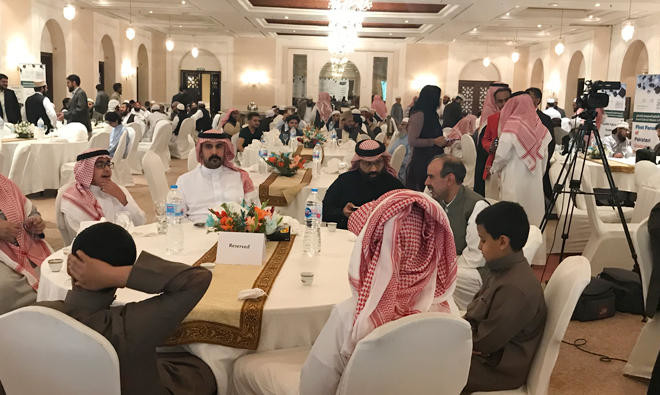
Over 200 hundred Pakistani graduates, educated mostly in Shairah Law and Islamic teaching from Kingdom attending the forum in Islamabad on Mar. 16, 2018. (AN photo)
2 / 4
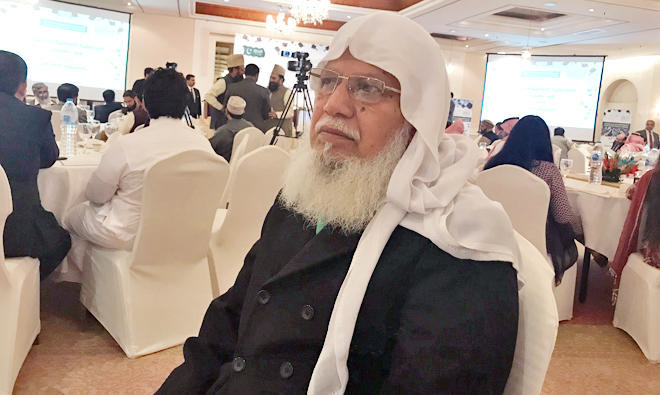
Dr. Muhammad Ubaid Ullah completed his Phd in Islamic Jurisprudence from Umm Al-Qura University. (AN photo)
3 / 4
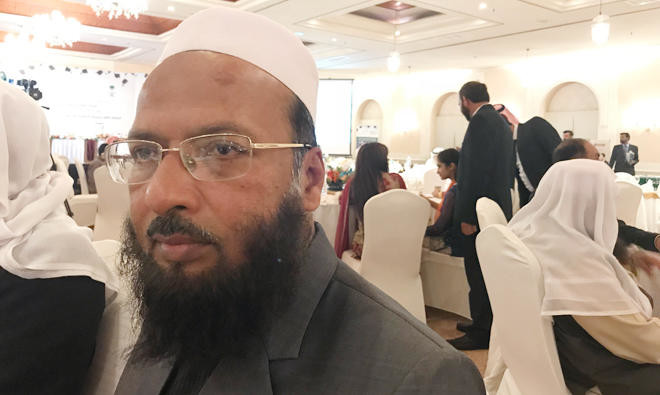
Dr. Qasim Ashraf, a Pakistan educationist completed his doctorate in Faculty of Shariah and Law from Al-Imam Mohammad Ibn Saud Islamic University Riyadh. (AN photo)
4 / 4
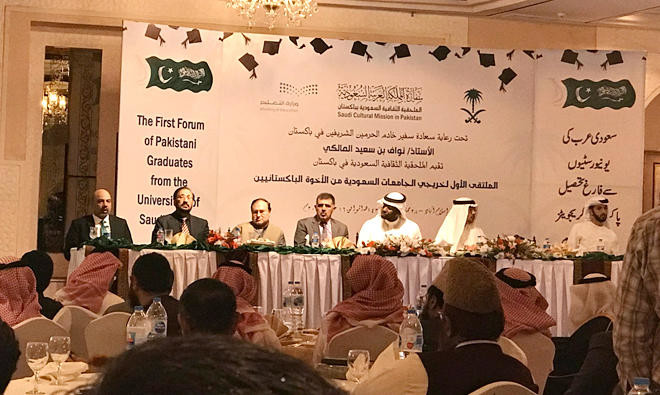
KSA Embassy holds First Forum of Pakistani graduates from universities of Kingdom, in Islamabad on Mar. 16, 2018. (AN photo)
Updated 30 September 2018
Follow

Pakistani students graduating from KSA are Kingdom’s goodwill ambassadors

ISLAMABAD: The Saudi embassy on Friday night held the first forum of Pakistani graduates from the universities of Saudi Arabia.
The Kingdom has been offering scholarships for Pakistani students to complete their higher education at the varsities of KSA.
The grand hall of an upscale hotel in the Pakistani capital was jam-packed with more than 200 graduates, educated mostly in Shariah law and Islamic teaching.
Ali bin Mohammad Hosswai, cultural attaché at the Saudi embassy, while addressing the gathering, said he thought this was the first interactive session with students educated in the KSA but that it was just the beginning. “We will have many more in future,” he said.
Tamar Al-Abdullah, another diplomat dealing with cultural affairs at the embassy, told Arab News that “the Pakistani students had been traveling to the Kingdom over decades and completed their higher education in different universities in the KSA.
“The Kingdom provided them with scholarships besides free stay, travel and stipend, everything they needed.”
Dr. Qasim Ashraf, a Pakistan educationist in the Faculty of Shariah Law at the International Islamic University in Islamabad, completed his doctorate at Al-Imam Mohammad Ibn Saud Islamic University, Riyadh.
“I stayed in the Kingdom from 1992 to 1998. It was a really good experience and I think these scholarships are very important for Pakistani students. There are fine universities in Kingdom for Shariah law, Islamic studies, and Arabic language,” he told Arab News.
“My PhD from the Kingdom played a key role in my educational career.”
Another attendee at the event, Dr. Muhammad Ubaid Ullah, told Arab News he was in the Kingdom on a scholarship program from 1982 to 1997.
“I completed my PhD in Islamic jurisprudence from Umm Al-Qura University,” he said. “The government and people of the Kingdom gave us and our families immense respect and provided us with the best educational facilities.”
Pakistan and Saudi Arabia have enjoyed close and friendly relations for decades.
After defense cooperation, the states are now working to enhance business-to-business ties and cultural exchange.
“There are so many people, scholars, in Pakistan who completed their education in KSA. They are the ambassadors of the Kingdom in Pakistan,” said Ullah.
Participants at the event said that during their studies they acted as Pakistan’s cultural ambassadors in KSA.


Pakistan reviews austerity measures amid Middle East crisis, urges strict nationwide implementation

Updated 11 March 2026
Follow

Pakistan reviews austerity measures amid Middle East crisis, urges strict nationwide implementation

  • Deputy Prime Minister Ishaq Dar chairs review meeting of austerity steps
  • Officials briefed on salary cuts, school closures, four‑day week, petrol conservation

ISLAMABAD: Pakistan’s government on Wednesday assessed progress on a sweeping set of austerity measures introduced to mitigate the country’s economic strain from sharply rising global oil prices and supply disruptions linked to the ongoing war in the Middle East.

Prime Minister Shehbaz Sharif this week announced a series of austerity steps, including a four‑day work week for government offices, requiring 50  percent of staff to work from home, cutting fuel allowances for official vehicles by half, grounding up to 60  percent of the government fleet and closing all schools for two weeks to conserve fuel amid the global oil crisis.

The measures were unveiled in response to global oil market volatility triggered by the conflict involving the United States, Israel and Iran, which has disrupted supply routes such as the Strait of Hormuz and pushed crude prices sharply higher, straining Pakistan’s heavily import‑dependent energy sector.

“The meeting stressed the importance of strict and transparent adherence to the austerity measures, promoting fiscal responsibility and prudent use of public resources,” Deputy Prime Minister and Foreign Minister Senator Mohammad Ishaq Dar said in a statement.

He was chairing a meeting of the Committee for Monitoring and Implementation of Conservation and Additional Austerity Measures, constituted under the directions of the PM, bringing together federal and provincial officials to review execution of the broad cost‑cutting plan. 

Dar emphasized the government’s commitment to enforcing the PM’s austerity steps nationwide. The committee’s review also covered reductions in departmental expenditure, deductions from salaries of senior officials earning over Rs. 300,000 ($1,120), and coordination with provincial administrations to ensure uniform implementation of the plan.

Participants at the meeting reiterated that all ministries and divisions must continue strict monitoring and reporting, with transparent oversight mechanisms, as Pakistan navigates the economic pressures from the prolonged Middle East crisis and its fallout on global energy and trade markets.