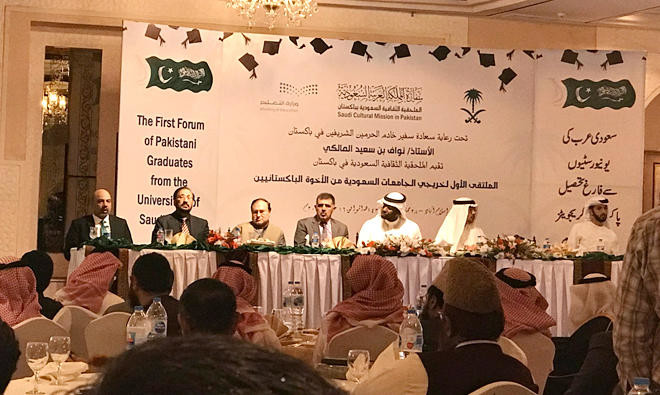
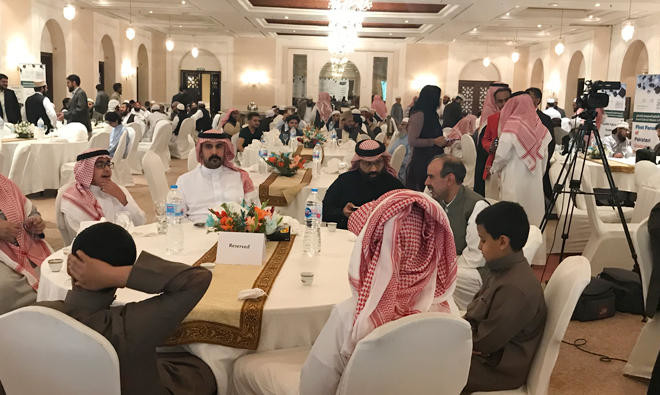
ISLAMABAD: The Saudi embassy on Friday night held the first forum of Pakistani graduates from the universities of Saudi Arabia.
The Kingdom has been offering scholarships for Pakistani students to complete their higher education at the varsities of KSA.
The grand hall of an upscale hotel in the Pakistani capital was jam-packed with more than 200 graduates, educated mostly in Shariah law and Islamic teaching.
Ali bin Mohammad Hosswai, cultural attaché at the Saudi embassy, while addressing the gathering, said he thought this was the first interactive session with students educated in the KSA but that it was just the beginning. “We will have many more in future,” he said.
Tamar Al-Abdullah, another diplomat dealing with cultural affairs at the embassy, told Arab News that “the Pakistani students had been traveling to the Kingdom over decades and completed their higher education in different universities in the KSA.
“The Kingdom provided them with scholarships besides free stay, travel and stipend, everything they needed.”
Dr. Qasim Ashraf, a Pakistan educationist in the Faculty of Shariah Law at the International Islamic University in Islamabad, completed his doctorate at Al-Imam Mohammad Ibn Saud Islamic University, Riyadh.
“I stayed in the Kingdom from 1992 to 1998. It was a really good experience and I think these scholarships are very important for Pakistani students. There are fine universities in Kingdom for Shariah law, Islamic studies, and Arabic language,” he told Arab News.
“My PhD from the Kingdom played a key role in my educational career.”
Another attendee at the event, Dr. Muhammad Ubaid Ullah, told Arab News he was in the Kingdom on a scholarship program from 1982 to 1997.
“I completed my PhD in Islamic jurisprudence from Umm Al-Qura University,” he said. “The government and people of the Kingdom gave us and our families immense respect and provided us with the best educational facilities.”
Pakistan and Saudi Arabia have enjoyed close and friendly relations for decades.
After defense cooperation, the states are now working to enhance business-to-business ties and cultural exchange.
“There are so many people, scholars, in Pakistan who completed their education in KSA. They are the ambassadors of the Kingdom in Pakistan,” said Ullah.
Participants at the event said that during their studies they acted as Pakistan’s cultural ambassadors in KSA.

Pakistani students graduating from KSA are Kingdom’s goodwill ambassadors
Pakistan destroyed seven TTP camps in Afghanistan strikes, 80 militants killed — official
- Saturday’s airstrikes followed a series of attacks inside Pakistan amid a surge in militancy
- The Afghan Taliban authorities accuse Pakistani forces of killing civilians in the airstrikes
ISLAMABAD: Pakistan’s airstrikes in Afghanistan destroyed seven Tehreek-e-Taliban Pakistan (TTP) camps and killed over 80 militants, a Pakistani security official said on Sunday, with the Afghan Taliban accusing Pakistani forces of killing civilians in the assault.
Saturday’s airstrikes followed a series of attacks inside Pakistan amid a surge in militancy. Authorities say the attacks, particularly in Khyber Pakhtunkhwa province and the Pakistani capital of Islamabad, were carried out by the TTP and allied groups that Islamabad alleges are operating from sanctuaries in Afghanistan. Kabul denies this.
According to Pakistan’s information ministry, recent incidents included a suicide bombing at a Shiite mosque in Islamabad, separate attacks in Bajaur and Bannu, and another recent incident in Bannu during the holy month of Ramadan, which started earlier this week. The government said it had “conclusive evidence” linking the attacks to militants directed by leadership based in Afghanistan.
“Last night, Pakistan’s intelligence-based air strikes destroyed seven centers of Fitna Al-Khawarij TTP in three provinces of Nangarhar, Paktika and Khost, in which more than eighty Khawarij (TTP militants) have been confirmed killed, while more are expected,” a Pakistani security official, who spoke on condition of anonymity, told Arab News.
An earlier statement from Pakistan’s information ministry said the targets included a camp of a Daesh regional affiliate, the Islamic State Khorasan Province (ISKP), which claimed a suicide bombing at an Islamabad Shiite mosque that killed 32 people this month.
In an X post, Afghan government spokesperson Zabihullah Mujahid said Pakistani forces had violated Afghan territory.
“Pakistani special military circles have once again trespassed into Afghan territory,” Mujahid said. “Last night, they bombed our civilian compatriots in Nangarhar and Paktika provinces, martyring and wounding dozens of people, including women and children.”
The Afghan Taliban’s claims of civilian casualties could not be independently verified. Pakistan did not immediately comment on the allegation that civilians had been killed in the strikes.
In a post on X, Afghanistan’s foreign ministry said it had summoned Pakistan’s charge d’affaires to Afghanistan Ubaid-ur-Rehman Nizamani and lodged protest through a formal démarche in response to the Pakistani military strikes.
“IEA-MoFA (The Islamic Emirate of Afghanistan’s Ministry of Foreign Affairs) vehemently condemns the violation of Afghanistan’s airspace and the targeting of civilians, describing it as a flagrant breach of Afghanistan’s territorial integrity & a provocative action,” it said in a statement.
“The Pakistani side was also categorically informed that safeguarding Afghanistan’s territorial integrity is the religious responsibility of the Islamic Emirate of Afghanistan; henceforth, the responsibility for any adverse consequences of such actions will rest with the opposing side.”
Tensions between Islamabad and Kabul have escalated since the Afghan Taliban returned to power in 2021. Pakistan says cross-border militant attacks have increased since then and has accused the Taliban of failing to honor commitments under the 2020 Doha Agreement to prevent Afghan soil from being used for attacks against other countries. The Taliban deny allowing such activity and have previously rejected similar accusations.
Saturday’s exchange of accusations marks one of the most direct confrontations between the two neighbors in recent months and risks further straining already fragile ties along the volatile border.