2000-year-old Buddha statue from Peshawar to be exhibited in Switzerland

1 / 5
The giant statue of Buddha in Peshawar Museum.
2 / 5
Outer view of the museum building, which was constructed as Victoria Hall in memory of Queen Victoria. (AN photo)
3 / 5
Entrance to the museum, established in 1907. (AN photo)
4 / 5
Outer view of the museum building, which was constructed as Victoria Hall in memory of Queen Victoria. (AN photo)
5 / 5
KP Archaeology and Tourism Minister Muhammad Tariq (left) and Rietberg Museum Director Albert Lutz (right) sign an agreement to display the statue at an exhibition in Switzerland. (Photo courtesy: KP’s Department of Archaeology)
Updated 16 March 2018
Follow

2000-year-old Buddha statue from Peshawar to be exhibited in Switzerland

PESHAWAR: A uniquely large Buddha statue that has been in Peshawar Museum for more than a century will soon be displayed at an exhibition in Switzerland, officials at Khyber Pakhtunkhwa’s (KP) Department of Archaeology said on Friday.
The department’s director, Abdul Samad, said KP’s Archaeology and Tourism Minister Muhammad Tariq signed an agreement to this effect with Rietberg Museum Director Albert Lutz on Tuesday in Zurich.
The exhibition will begin in December this year and last for three months and 18 days, Tariq said.
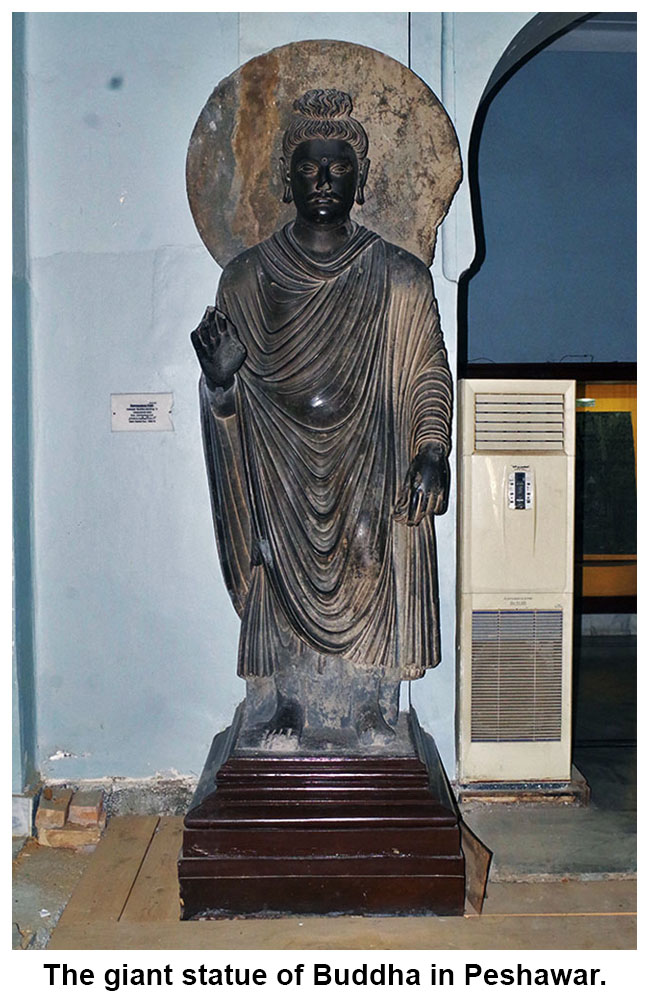
“The statue has been insured for $20 million,” he told Arab News. “In case of any damage to it, the money will be paid to Peshawar Museum.”
This is the first time the statue will be taken to an international exhibition. “Every exhibition has a central attraction,” Samad told Arab News. “This sculpture will play that role in Switzerland.”
The KP administration is promoting religious tourism, he said, adding that the province was not only home to the popular Gandhara civilization but is also sacred to Hindus and Sikhs.
“Last year, we did an exhibition about Buddhism in South Korea and displayed 42 objects for three months,” Samad said.
“Young people who’ve been brought up in Buddhist lands after the 9/11 attacks don’t know much about Pakistan, especially KP, and its significance to their religion. We want to raise awareness about it throughout the world.”
Tourists from around the world visit Switzerland and its museums, and their encounter with the Buddha statue will help promote a positive image of Pakistan, Samad said.
The statue is 2,000 years old, said one of the department’s research officers, Nawaz-ud-Din, adding: “It was discovered during British rule in Seri Bahlol in Mardan in 1909, and handed over to Peshawar Museum in 1911.”
Seri Bahlol is a world heritage site located about 70 km northwest of KP’s provincial capital Peshawar.
Nawaz-ud-Din said the statue is 365 cm high and 46.42 cm wide, and the museum has 4,147 other objects related to Buddhism.
Peshawar Museum was established in 1907. Its previous name was Victoria Hall, as it was established in Queen Victoria’s memory during British rule.


Sindh assembly passes resolution rejecting move to separate Karachi

Updated 21 February 2026
Follow

Sindh assembly passes resolution rejecting move to separate Karachi

  • Chief Minister Shah cites constitutional safeguards against altering provincial boundaries
  • Calls to separate Karachi intensified amid governance concerns after a mall fire last month

ISLAMABAD: The provincial assembly of Pakistan’s southern Sindh province on Saturday passed a resolution rejecting any move to separate Karachi, declaring its territorial integrity “non-negotiable” amid political calls to carve the city out as a separate administrative unit.

The resolution comes after fresh demands by the Muttahida Qaumi Movement (MQM) and other voices to grant Karachi provincial or federal status following governance challenges highlighted by the deadly Gul Plaza fire earlier this year that killed 80 people.

Karachi, Pakistan’s largest and most densely populated city, is the country’s main commercial hub and contributes a significant share to the national economy.

Chief Minister Syed Murad Ali Shah tabled the resolution in the assembly, condemning what he described as “divisive statements” about breaking up Sindh or detaching Karachi.

“The province that played a foundational role in the creation of Pakistan cannot allow the fragmentation of its own historic homeland,” Shah told lawmakers, adding that any attempt to divide Sindh or separate Karachi was contrary to the constitution and democratic norms.

Citing Article 239 of Pakistan’s 1973 Constitution, which requires the consent of not less than two-thirds of a provincial assembly to alter provincial boundaries, Shah said any such move could not proceed without the assembly’s approval.

“If any such move is attempted, it is this Assembly — by a two-thirds majority — that will decide,” he said.

The resolution reaffirmed that Karachi would “forever remain” an integral part of Sindh and directed the provincial government to forward the motion to the president, prime minister and parliamentary leadership for record.

Shah said the resolution was not aimed at anyone but referred to the shifting stance of MQM in the debate while warning that opposing the resolution would amount to supporting the division of Sindh.

The party has been a major political force in Karachi with a significant vote bank in the city and has frequently criticized Shah’s provincial administration over its governance of Pakistan’s largest metropolis.

Taha Ahmed Khan, a senior MQM leader, acknowledged that his party had “presented its demand openly on television channels with clear and logical arguments” to separate Karachi from Sindh.

“It is a purely constitutional debate,” he told Arab News by phone. “We are aware that the Pakistan Peoples Party, which rules the province, holds a two-thirds majority and that a new province cannot be created at this stage. But that does not mean new provinces can never be formed.”

Calls to alter Karachi’s status have periodically surfaced amid longstanding complaints over governance, infrastructure and administrative control in the megacity, though no formal proposal to redraw provincial boundaries has been introduced at the federal level.