Collapse of Miami bridge built with “innovative” system kills 4

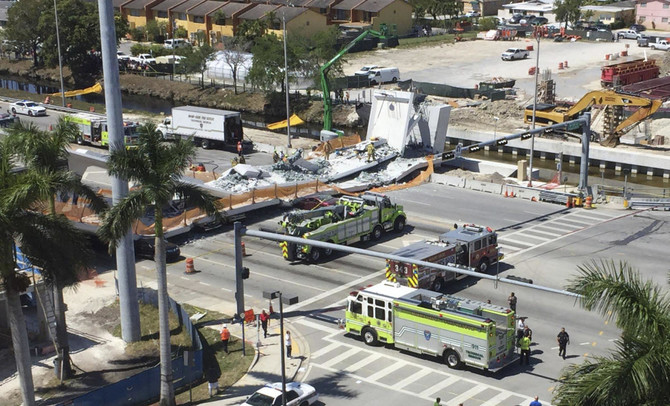
Emergency personnel responds to a collapsed pedestrian bridge connecting Florida International University Florida International on Thursday, March 15, 2018 in the Miami area. (Roberto Koltun/The Miami Herald via AP)
Updated 16 March 2018
Follow

Collapse of Miami bridge built with “innovative” system kills 4

MIAMI: A pedestrian bridge that was under construction collapsed onto a busy Miami highway Thursday afternoon, crushing vehicles beneath massive slabs of concrete and steel and killing at least four people, authorities said.
Search-and-rescue crews worked into the night, using dogs, search cameras and sensitive listening devices in a frantic search to find survivors among the debris.
“Everybody is working hard to make sure we rescue anyone who can be rescued,” Florida Gov. Rick Scott said.
But Miami-Dade police director Juan Perez said hopes were dwindling as the hours passed.
“We know that there’s going to be a negative outcome at the end of the day,” Perez said.
Four people were found dead amid the chaotic scene, and nine victims were taken “early on” to hospitals, Fire Chief Dave Downey said without elaborating on their conditions.
The partially built 950-ton (860-metric ton) bridge had been assembled by the side of the highway and moved into place Saturday to great fanfare. The span stretched almost 200 feet (60 meters) to connect Florida International University with the city of Sweetwater. It was expected to open to foot traffic next year.
“This bridge was about goodness, not sadness,” said FIU President Mark Rosenberg. “Now we’re feeling immense sadness, uncontrollable sadness.”
Scott said an exhaustive investigation will uncover “why this happened and what happened,” and he vowed to hold accountable those responsible.
National Transportation Safety Board chairman Robert Sumwalt III said a team of specialists was heading to Miami on Thursday night to investigate.
Jacob Miller, a senior at FIU, was visiting a friend in a dorm when he heard sirens and horns honking. He went to a balcony and could see rubble coming down.
“I saw there were multiple cars crushed under the bridge. It was just terrible,” he said.
An accelerated construction method was supposed to reduce risks to workers and pedestrians and minimize traffic disruption, the university said.
Renderings of the finished bridge showed a tall, off-center tower with cables attached to the walkway to support it. When the bridge collapsed, the main tower had not yet been installed, and it was unclear what the builders were using as temporary supports.
Robert Bea, a professor of engineering and construction management at the University of California, Berkeley, said it’s too early to know exactly what happened, but the decision to use what the bridge builders called an “innovative installation” was risky, especially because the bridge spanned a heavily traveled thoroughfare.
“Innovations take a design firm into an area where they don’t have applicable experience, and then we have another unexpected failure on our hands,” Bea said after reviewing the bridge’s design and photos of the collapse.
Sweetwater police Detective Juan Llera was in a nearby meeting when the bridge collapsed.
“I heard a ‘boom’ like a bomb had exploded,” he said. “At first I thought it was a terrorist attack.”
He said he saw three injured construction workers. One had a head injury and was passing in and out of consciousness, another one had a leg injury leg and the third was lying on the street unconscious. Llera started performing CPR on him.
“We were able to keep him alive to send him to the hospital,” Llera said.
Kendall Regional Medical Center received 10 injured people. Of those, two were in “extremely critical” condition and eight were stable with injuries such as broken bones, bruises and abrasions, said Dr. Mark McKenney, the hospital’s director of general surgery.
Of the two more serious cases, one arrived in cardiac arrest but was revived. The other had a serious brain injury, McKenney said.
The main companies behind the $14.2 million construction project have faced questions about their past work, and one was fined in 2012 when a 90-ton (80-metric ton) section of a bridge collapsed in Virginia.
Munilla Construction Management, or MCM, the Miami-based construction management firm that won the bridge contract, had a news release on its website touting the project with FIGG Bridge Engineers, a Tallahassee firm. After the collapse, it said the site had become temporarily unavailable due to increased web traffic. “It has since been restored.”
MCM said on Twitter that it is “a family business and we are all devastated and doing everything we can to assist. We will conduct a full investigation to determine exactly what went wrong and will cooperate with investigators on scene in every way.”
FIGG said in a statement, “In our 40-year history, nothing like this has ever happened before.”
But FIGG was fined in 2012 after a 90-ton (80-metric ton) section of a bridge it was building in Virginia crashed onto railroad tracks below, causing minor injuries to several workers. The citation from the Virginia Department of Labor and Industry said FIGG did not properly inspect a girder and had not obtained written consent from its manufacturer before modifying it, according to a story in The Virginian-Pilot.
Court documents show that MCM was accused of substandard work in a lawsuit filed earlier this month. The suit said a worker at Fort Lauderdale International Airport, where the company is working on an expansion, was injured when a makeshift MCM-built bridge collapsed under his weight.
The suit accused the company of employing “incompetent, inexperienced, unskilled or careless employees” at the job site.
A review of Occupational Safety Health Administration records shows that MCM has been fined for 11 safety violations in the past five years. The fines totaling more than $50,000 arose from complaints about unsafe trenches, cement dust and other problems at its Florida work sites.
Florida International University is the second largest university in the state, with 55,000 students, most of whom live off-campus. The bridge was supposed to be a safe way to cross a busy highway.
A university student was killed in August while crossing the road that the bridge was supposed to span.


Mexico fears more violence after army kills leader of powerful Jalisco cartel

Updated 1 sec ago
Follow

Mexico fears more violence after army kills leader of powerful Jalisco cartel

GUADALAJARA: School was canceled in several Mexican states and local and foreign governments alike warned their citizens to stay inside, as widespread violence erupted following the army’s killing of the powerful leader of the Jalisco New Generation Cartel.
Nemesio Rubén Oseguera Cervantes, known as “El Mencho” was the boss of one of the fastest-growing criminal networks in Mexico, notorious for trafficking fentanyl, methamphetamine and cocaine to the United States and staging brazen attacks against government officials who challenged it.
He was killed during a shoot-out in his home state of Jalisco as the Mexican military attempted to capture him. Cartel members responded with violence across the country, blocking roads and setting fire to vehicles.
President Claudia Sheinbaum urged calm and authorities announced late Sunday they had cleared most of the more than 250 cartel roadblocks across 20 states. The White House confirmed that the US provided intelligence support to the operation to capture the cartel leader and applauded Mexico’s army for taking down a man who was one of the most wanted criminals in both countries.
Mexico hoped the death of the world’s biggest fentanyl traffickers would ease Trump administration pressure to do more against the cartels, but many remained hunkered down and on edge as they waited to see the powerful cartel’s reaction.
Many fear more violence
Guadalajara, the capital of Jalisco state and Mexico’s second-largest city, was almost completely shut down on Sunday as fearful residents stayed home.
Passengers arriving to the city’s international airport Sunday night were told it was operating with limited personnel because of the burst of violence.
Jacinta Murcia, a 64-year-old nutrition products vendor, was among those nervously walking late Sunday night through the airport, where earlier in the day travelers sprinted and ducked behind chairs fearing violence. Most flights into the city were suspended on Sunday.
Murcia anxiously scrolled through news stories on social media showing the face of “El Mencho” and sent messages to her children, who were tracking her location as she tried to travel across the city to her house after dark.
“My plan today leaving the airport is to see if there are any taxis, but I’m scared of everything. That there are blockades, that there’s a curfew, that something could happen,” she said. “I’m all alone.”
Authorities in Jalisco, Michoacan and Guanajuato reported at least 14 other people killed Sunday, including seven National Guard troops.
Videos circulating on social media showed tourists in Puerto Vallarta walking on the beach with smoke rising in the distance.
In another part of the airport a group of elderly Mexicans gathered, discussing how to get home.
“We better all go together,” one said. “Go with God.”
A blow against a cartel could be a diplomatic coup
David Mora, Mexico analyst for International Crisis Group, said the capture and outburst of violence marks a point of inflection in Sheinbaum’s push to crack down on cartels and relieve US pressures.
US President Donald Trump has demanded Mexico do more to fight the smuggling of the often-deadly drug fentanyl, threatening to impose more tariffs or take unilateral military action if the country does not show results.
There were early signs that Mexico’s efforts were well received by the United States.
US Amb. Ron Johnson recognized the success of the Mexican armed forces and their sacrifice in a statement late Sunday. He added that “under the leadership of President Trump and President Sheinbaum, bilateral cooperation has reached unprecedented levels.”
But it may also pave the way for more violence as rival criminal groups take advantage of the blow dealt to the CJNG, Mora said.
“This might be a moment in which those other groups see that the cartel is weakened and want to seize the opportunity for them to expand control and to gain control over Cartel Jalisco in those states,” he said.
“Ever since President Sheinbaum has been in power, the army has been way more confrontational, combative against criminal groups in Mexico,” Mora said. “This is signaling to the US that if we keep cooperating, sharing intelligence, Mexico can do it, we don’t need US troops on Mexican soil.”
‘El Mencho’ was a major target
Oseguera Cervantes, who was wounded in the operation to capture him Sunday in Tapalpa, Jalisco, about a two-hour drive southwest of Guadalajara, died while being flown to Mexico City, the Defense Department said in a statement.
During the operation, troops came under fire and killed four people at the location. Three more people, including Oseguera Cervantes, were wounded and later died, the statement said.
White House Press Secretary Karoline Leavitt said via X that the US government provided intelligence support for the operation. “‘El Mencho’ was a top target for the Mexican and United States government as one of the top traffickers of fentanyl into our homeland,” she wrote. She commended Mexico’s military for its work.
The US State Department had offered a reward of up to $15 million for information leading to the arrest of El Mencho. The Jalisco New Generation Cartel is one of the most powerful and fastest growing criminal organizations in Mexico and began operating around 2009.
In February 2025, the Trump administration designated the cartel as a foreign terrorist organization.
Sheinbaum has criticized the “kingpin” strategy of previous administrations that took out cartel leaders, only to trigger explosions of violence as cartels fractured. While she has remained popular in Mexico, security is a persistent concern and since US President Donald Trump took office a year ago, she has been under tremendous pressure to show results against drug trafficking.
The Jalisco cartel has been one of the most aggressive cartels in its attacks on the military — including on helicopters — and is a pioneer in launching explosives from drones and installing mines. In 2020, it carried out a spectacular assassination attempt with grenades and high-powered rifles in the heart of Mexico City against the then head of the capital’s police force and now federal security secretary.