MOSCOW: Dissident Soviet scientist Vil Mirzayanov gained notoriety in the 1990s when he blew the cover on Moscow’s secret experimentation with Novichok, the nerve gas used in the poisoning of a Russian ex-spy in Britain.
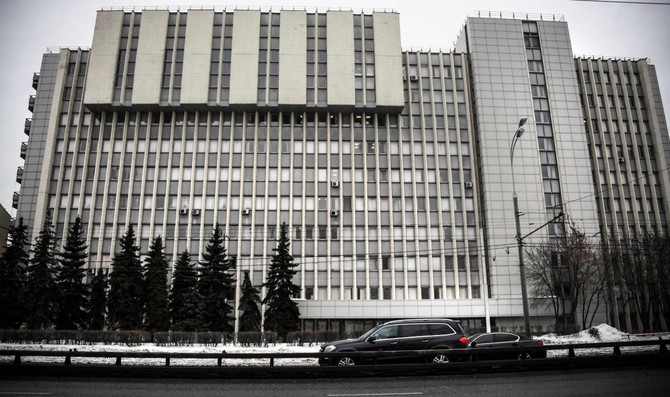
Mirzayanov had worked for almost three decades in the Soviet Union at the State Scientific Research Institute of Organic Chemistry and Technology.
After he was fired in 1992, he and another scientist wrote a newspaper article revealing how the government had developed deadly chemical compounds known as Novichok — or “newcomer” in English.
Now 83 and living in the US, Mirzayanov described the sophisticated substances used to make the Novichok agents which had been developed under a classified program codenamed Foliant, or folio.
Novichok agents are binary chemical weapons, he said, which means that their potency only manifests itself after chemical synthesis of relatively harmless components.
Since the same chemical elements in Novichok are used to make pesticides, facilities producing these substances can easily be disguised as civilian factories, he wrote.
Mirzayanov said he had witnessed several scientists failing to regain their health after exposure to a Novichok-type agent.
“The damage it inflicts is practically incurable,” he said in the article.
Asked this week about the March 4 poisoning of former double agent Sergei Skripal and his daughter, he was quoted as saying: “These people are gone — the man and his daughter. Even if they survive they will not recover.”
In his memoirs published in Russian in 2002, Mirzayanov said his institute and others in the country involved in the chemical weapons program continued their research even after the collapse of the Soviet Union in the early 1990s and as Russia proclaimed disarmament and a ban on chemical weapons.
Binary bombs had been developed since the 1970s and were tested at a military base used for chemical weapons in a town called Shikhany in Russia’s southern Saratov region and also in Uzbekistan, Mirzayanov wrote.
“Like hundreds of other scientists, I was participating in a conspiracy against the future convention on chemical weapons,” he said.
He had been put in charge of controlling potential leaks of harmful chemicals used in the Foliant program into the air and waterways.
His memoirs describe witnessing a relatively unsuccessful test of a precursor to Novichok-type agents based on a chemical named simply “Substance-33.”
In the test, the substance was deployed in vapor form via a bomb dropped from a plane.
The Novichok agents were not listed in the eventual Chemical Weapons Convention because Russia kept them secret, Mirziayanov argued.
Mirzayanov became involved in Russia’s nascent democratic movement and wanted to make his concerns about the chemical weapons program public.
As a result of his dissident activities, he was fired from the institute. He then decided to write the whistle-blowing article in a Moscow newspaper along with another chemist, Lev Fyodorov.
They warned of poor safety standards at the Moscow facility and vast quantities of harmful chemicals stored elsewhere in Russia.
The article led the authorities to prosecute Mirzayanov for divulging state secrets. He was arrested in October 1992 and held for several days in Moscow’s notorious Lefortovo prison, used by the security services.
His case was eventually closed in 1994 after considerable international pressure on the Russian authorities. Mirzayanov has lived in the United States since 1996.
Russia declared in 2017 that it had destroyed all of its chemical weapon stockpile.
Moscow has rejected accusations of involvement in poisoning Skripal.


![]()
The scientist who leaked Russia’s Novichok ‘conspiracy’
The scientist who leaked Russia’s Novichok ‘conspiracy’


Latest updates


© 2026 SAUDI RESEARCH & PUBLISHING COMPANY, All Rights Reserved And subject to Terms of Use Agreement.