Abu Dhabi hotel room rates fall by almost a quarter in February

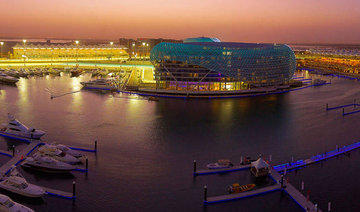
Above, the Yas Viceroy hotel in Abu Dhabi’s Yas island. (AFP)
Updated 13 March 2018
Follow

Abu Dhabi hotel room rates fall by almost a quarter in February

DUBAI: Abu Dhabi hotel room rates fell by almost a quarter in February as demand slowed, with a major exhibition being held in the emirate in an off year.
Average daily room rates (ADR) were down 23.3 percent to 431.34 dirhams in February, industry monitor STR said, while revenue per available room was 19.4 percent lower to 349.20 percent.
Occupancy rate meanwhile rose 5.1 percent to 81 percent as hotel room supply remained flat while demand was 5.1 percent higher.
“Preliminary 2018 data for Abu Dhabi, United Arab Emirates, indicates strong occupancy growth but lower rates due to difficult-to-match comparisons from 2017,” STR said.
“The absolute occupancy level would be the highest for a February in Abu Dhabi since 2009,” it said. “The decline in ADR came as a result of an off year for the biennial International Defence Exhibition & Conference (IDEX), which will be held once again in February 2019.
More than 105,000 visitors attended the show’s 2017 edition, with about 1,235 companies - including big hitters such as Boeing, Lockheed Martin, Northrop Grumman and Rostec - from 57 countries attending the event.
Abu Dhabi tourism authorities are expecting six million hotel guests this year as the emirate steps up efforts to promote tourism.
The recently opened Louvre Abu Dhabi – the only regional presence of France’s famous museum – hopes to entice art enthusiasts and other visitors from around the world, particularly China and Russia.


Saudi Arabia’s industrial production jumps 10.4% in January: GASTAT

Updated 10 March 2026
Follow

Saudi Arabia’s industrial production jumps 10.4% in January: GASTAT

RIYADH: Saudi Arabia’s industrial production index rose to 115 in January, up 10.4 percent from a year earlier, driven by higher crude output and stronger mining activity, official data showed. 

The latest report released by the General Authority for Statistics showed that the annual surge was primarily fueled by a 13.3 percent jump in the mining and quarrying sub-index, which includes oil production.  

Saudi Arabia raised crude oil output to 10.1 million barrels per day in January from 8.9 million barrels per day a year earlier, supporting growth in the mining and quarrying sub-index and contributing to the broader expansion in industrial activity. 

The latest IPI figures underscore continued momentum in the Kingdom’s industrial sector as Saudi Arabia pursues economic diversification under its Vision 2030 agenda. 

The manufacturing sector, a key pillar of the Kingdom’s economic diversification efforts, also contributed positively to the annual growth. The manufacturing sub-index rose by 6.8 percent compared to January of the previous year.  

This was underpinned by strong performances in the manufacture of chemicals and chemical products, which grew by 10.6 percent, and the manufacture of coke and refined petroleum products, which increased by 9.1 percent. The food products industry also saw an annual growth of 9.1 percent. 

The water supply, sewerage, and waste management activities recorded the highest annual growth among the major sectors, increasing by 11.7 percent. 

Despite the strong year-on-year performance, the IPI showed a slight contraction on a monthly basis, decreasing by 0.5 percent compared to December 2025. This decline was driven by a 1.4 percent drop in the manufacturing sub-index from the previous month.  

The monthly downturn in manufacturing was largely attributed to decreases in the same sectors that fueled its annual growth, with coke and petroleum products down 1.1 percent and chemicals down 1.2 percent. 

A breakdown by main economic activities shows that the index for oil activities jumped 12.5 percent annually, while non-oil activities also posted a healthy gain of 5.3 percent.  

On a monthly basis, both indices saw minor declines, with oil activities dipping 0.1 percent and non-oil activities falling by 1.5 percent. 

The electricity, gas, and air conditioning supply sub-index was the only major sector to record an annual decrease, falling by 1.3 percent compared to January 2025.