

Plane flying from UAE to Turkey crashes in Iran, killing 11

In this May 20, 2016 photo, a Bombardier CL604 aircraft descends to land in Istanbul. The Turkish private jet flying from the United Arab Emirates to Istanbul carrying a group of young women crashed Sunday night, March 11, 2018 in a mountainous region of Iran, killing all 11 people on board, authorities said. (AP Photo/Yigit Cicekci)
Updated 12 March 2018
Follow

Plane flying from UAE to Turkey crashes in Iran, killing 11

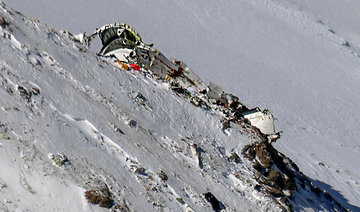
TEHRAN: A Turkish private jet flying from the United Arab Emirates to Istanbul carrying a group of young women crashed Sunday night in a mountainous region of Iran during a heavy rain, killing all 11 people on board, authorities said. The doomed aircraft days earlier carried a bachelorette party bound for Dubai.
Iranian state television quoted Mojtaba Khaledi, the spokesman of the country’s emergency management organization, as saying the plane hit a mountain near Shahr-e Kord and burst into flames. Shahr-e Kord is some 370 kilometers (230 miles) south of the capital, Tehran.
Khaledi later told a website associated with state TV that local villagers had reached the site in the Zagros Mountains and found only badly burned bodies and no survivors. He said DNA tests would be needed to identify the dead.
Villagers near the crash earlier said they saw flames coming from the plane’s engine before the crash, according to a report by Iran’s state-run judiciary news agency Mizan.
The plane took off around 4:41 p.m. (1311 GMT) Sunday and reached a cruising altitude of just over 35,000 feet, according to FlightRadar24, a flight-tracking website. At around 6:01 p.m. (1431 GMT), something appears to have gone wrong with the flight as it rapidly gained altitude and then dropped drastically within minutes, data published by the website showed.


A post shared by Mina Başaran (@minabasaran) on

The General Civil Aviation Authority in the UAE said the flight took off from Sharjah International Airport on its way to Istanbul. A private company that handles public relations for the Sharjah airfield, the home of low-cost airline Air Arabia, declined to immediately comment. Sharjah is a neighboring emirate of Dubai.


A post shared by Mina Başaran (@minabasaran) on

Turkey’s private Dogan News Agency identified the plane as a Bombardier CL604, tail number TC-TRB. Turkey’s Transport Ministry said the plane belongs to a company named Basaran Holding.
Basaran Investment Holding is active in the food, finance, energy, construction, tourism and travel industries, according to the company’s website.
Mina Basaran, the 28-year-old daughter of Basaran’s chairman who is part of the company’s board of managers and is in line to run the business, posted photographs on Instagram of what appeared to be her bachelorette party in Dubai.
Among those photographs was an image of the plane posted three days ago. In it, Basaran poses on the tarmac carrying flowers, wearing a denim jacket reading “Mrs. Bride” and the hashtag “#bettertogether.” In another picture, she holds heart-shaped balloons inside the plane.


A post shared by Mina Başaran (@minabasaran) on

One day ago, Basaran posted a picture with seven smiling friends from a Dubai resort. The last videos posted to her account showed her and friends enjoying a concert by the British pop star Rita Ora at a popular Dubai nightclub. There was no further activity on her account after that.
It wasn’t clear who was on the plane at the time of the crash, though Iranian emergency management officials described all the passengers as being young women, according to IRNA.
Sunday’s crash comes after an Iranian ATR-72, a twin-engine turboprop used for short-distance regional flying, crashed in southern Iran, killing all 65 people on board in February.

Egyptian woman faces death threats for filming alleged harasser

Updated 13 February 2026
Follow

Egyptian woman faces death threats for filming alleged harasser

  • Case revives longstanding national debate in Egypt over harassment and violence against women
  • A 2013 UN study found that 99.3 percent of Egyptian women reported experiencing harassment

CAIRO: A young Egyptian woman is facing death threats after posting a video showing the face of a man she says repeatedly harassed her, reviving debate over how victims are treated in the country.
Mariam Shawky, an actress in her twenties, filmed the man aboard a crowded Cairo bus earlier this week, accusing him of stalking and harassing her near her workplace on multiple occasions.
“This time, he followed me on the bus,” Shawky, who has been dubbed “the bus girl” by local media, said in a clip posted on TikTok.
“He kept harassing me,” added the woman, who did not respond to an AFP request for comment.
Hoping other passengers would intervene, Shawky instead found herself isolated. The video shows several men at the back of the bus staring at her coldly as she confronts her alleged harasser.
The man mocks her appearance, calls her “trash,” questions her clothing and moves toward her in what appears to be a threatening manner.
No one steps in to help. One male passenger, holding prayer beads, orders her to sit down and be quiet, while another gently restrains the man but does not defend Shawky.
Death threats
As the video spread across social media, the woman received a brief flurry of support, but it was quickly overwhelmed by a torrent of abuse.
Some high-profile public figures fueled the backlash.
Singer Hassan Shakosh suggested she had provoked the situation by wearing a piercing, saying it was “obvious what she was looking for.”
Online, the comments were more extreme. “I’ll be the first to kill you,” one user wrote. “If you were killed, no one would mourn you,” said another.
The case has revived a longstanding national debate in Egypt over harassment and violence against women.
A 2013 UN study found that 99.3 percent of Egyptian women reported experiencing harassment, with more than 80 percent saying they faced it regularly on public transport.
That same year, widespread protests against sexual violence rocked the Egyptian capital.
In 2014, a law criminalizing street harassment was passed. However, progress since then has been limited. Enforcement remains inconsistent and authorities have never released figures on the number of convictions.
Public concern spiked after previous high-profile incidents, including the 2022 killing of university student Nayera Ashraf, stabbed to death by a man whose advances she had rejected.
The perpetrator was executed, yet at the time “some asked for his release,” said prominent Egyptian feminist activist Nadeen Ashraf, whose social-media campaigning helped spark Egypt’s MeToo movement in 2020.
Denials
In the latest case, the authorities moved to act even though the bus company denied any incident had taken place in a statement later reissued by the Ministry of Transport.
The Interior Ministry said that the man seen in the video had been “identified and arrested” the day after the clip went viral.
Confronted with the footage, he denied both the harassment and ever having met the woman before, according to the ministry.
Local media reported he was later released on bail of 1,000 Egyptian pounds (around $20), before being detained again over a pre-existing loan case.
His lawyer has called for a psychiatric evaluation of Shawky, accusing her of damaging Egypt’s reputation.
These images tell “the whole world that there are harassers in Egypt and that Egyptian men encourage harassment, defend it and remain silent,” said lawyer Ali Fayez on Facebook.
Ashraf told AFP that the case revealed above all “a systemic and structural problem.”
She said such incidents were “never taken seriously” and that blame was almost always shifted onto women’s appearance.
“If the woman is veiled, they’ll say her clothes are tight. And if her hair is uncovered, they’ll look at her hair. And even if she wears a niqab, they’ll say she’s wearing makeup.”
“There will always be something.”