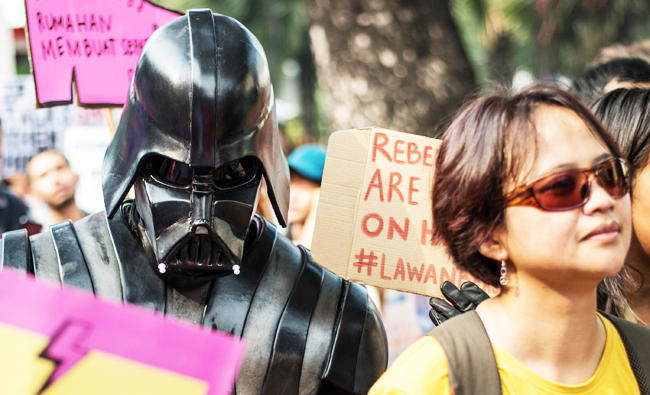
JAKARTA: Indonesia’s National Commission on Violence Against Women, or Komnas Perempuan (KP), recorded last year an increase in violence against women, mainly in private domain, by 25 percent from 259,150 reported cases in 2016 to 348,447 in 2017.
A KP commissioner, Thaufiek Zulbahary, told Arab News that the commission also recorded a rising trend of incest and cyber-based violence against women, in which women fell victim to bogus work recruitment, cyber harassment, malicious distribution, online defamation and infringement of their privacy, among others.
“Cyber-based violence has emerged massively but there’s a lack of reporting and handling of the cases. Cyber-based violence degrades women’s lives. They can fall victim to it more than once and the case affects them for the rest of their life,” Zulbahary told Arab News.
The KP released its annual report on violence against women on March 8 every year since 2001 in conjunction with the International Women’s Day. The commission recorded cases of violence against women that occur at private, community and state level.
“Cases of abuse against women are increasing in varied forms while response from the authorities remains slow. The trend also shows that the perpetrators are those in the productive age bracket,” Zulbahary said.
Another KP commissioner, Mariana , told Arab News that husbands being abusive to their wives constitute the largest part of the reported cases occurring in private domain, with 5,167 cases, followed by 2,227 cases of violence against daughters or young girls and 1,873 cases of abusive dates.
The report also recorded 1,210 cases of incest committed by older males.
Human trafficking cases involving women tricked into bogus recruitment by men in their community also marked violence against women at community level.
Most of these women were lured into recruitment with the promise to work as a migrant worker in neighboring Malaysia or Middle Eastern countries, where domestic workers from Indonesia are in high demand, despite a government-imposed moratorium on placement of Indonesian domestic workers to 21 countries in the Middle East since 2015 following a string of abuse cases of Indonesian migrant workers by their employers.
Tyas Weningsih Putri was a victim of trafficking when she tried her luck to work in a bird’s nest cultivation factory in Malaysia. It was her second time to work as a migrant worker in Malaysia so she was able to sense that something was wrong when her local ID bears an address that is different with the location of the factory where she worked.
She told Arab News that she did not receive the 900 ringgit salary that was promised to her and when the police raided the factory in March 2017, she wasn’t immediately freed but had to endure another two months in jail on immigration violation charges. She was freed in May and had returned to her hometown in Kendal, Central Java now.
The KP urged the Parliament to pass the Violence Against Women Bill into a law while ensuring it has a gender perspective of human rights and protection to victims.
“The police also has to start thorough documentation on femicides so they can have a map on what causes the problem and determine steps to prevent and deal with the cases,” said KP Deputy Chairwoman Yuniyanti Chuzaifah.

Violence against women remains rampant in Indonesia
US intel did not suggest a preemptive strike from Iran before US-Israeli attacks, AP sources say
- The official said a variety of factors created a golden opportunity to take out much of Iran’s leadership
WASHINGTON: Trump administration officials told congressional staff in private briefings Sunday that US intelligence did not suggest Iran was preparing to launch a preemptive strike against the US, three people familiar with the briefings said.
The administration officials instead acknowledged there was a more general threat in the region from Iran’s missiles and proxy forces, two of the people said. The third person, however, said the administration emphasized that Iran’s missiles and proxy forces posed an imminent threat to US personnel and allies in the region.
The officials did not provide any clarity about what would happen next in Iran after the joint US-Israeli operation, the two people said. All three people insisted on anonymity to discuss details that have not been made public.
The information conveyed to the congressional staff contrasts with the message from President Donald Trump. “Our objective is to defend the American people by eliminating imminent threats from the Iranian regime. A vicious group of very hard, terrible people,” he said in a video message after launching strikes on Iran.
Senior Trump administration officials, who like others were not authorized to comment publicly and spoke on condition of anonymity, had told reporters Saturday that there were indicators that the Iranians could launch a preemptive attack.
The White House and Pentagon did not immediately reply to requests for comment on Sunday night. Details of the briefing were first reported by Politico.
On Tuesday, Secretary of State Marco Rubio, Defense Secretary Pete Hegseth, CIA Director John Ratcliffe and Gen. Dan Caine, chairman of the Joint Chiefs of Staff, will brief the full membership of Congress on the US military operation against Iran, the White House said Sunday. Rubio also was slated to brief Hill leadership Monday, the same day Hegseth and Caine are planning a press conference about the operation.
Three strikes, three locations, within a single minute
The military operation came after authorities from Israel and the US spent weeks tracking the movements of senior Iranian leaders, including Supreme Leader Ayatollah Ali Khamenei, and shared information that allowed the strikes to be carried out in a surprise daylight attack, according to an Israeli military official and another person familiar with the operation.
The eventual barrage of US-Israeli attacks on Iran came so quickly that they were nearly simultaneous — with three strikes in three locations hitting within a single minute — killing Khamenei and some 40 senior figures, including the head of the paramilitary Revolutionary Guard and the country’s defense minister, the Israeli military official said Sunday.
The official said a variety of factors created a golden opportunity to take out much of Iran’s leadership, like weeks of training and monitoring the movements of senior figures as well as intelligence in real-time before the attack began that key targets were gathered together.
Striking by day also gave an additional element of surprise, said the official, who said so many major, rapid-fire strikes were critical to keep key officials from fleeing after the first strike. The official said Israel closely cooperated with its US counterparts and had used a similar tactic at the beginning of last June’s war — which resulted in the killing of several senior Iranian figures.
The official also noted Khamenei having posted defiant tweets taunting President Donald Trump in the days before the attack.
The details about the strikes came as the conflict entered its second day, with Trump saying in a video message Sunday that he expected it would continue until “all of our objectives are achieved.” He did not spell out what those objectives were.
The Republican president also said the US military and its partners hit hundreds of targets in Iran, including Revolutionary Guard facilities, Iranian air defense systems and nine warships, “all in a matter of literally minutes.”
CIA had long tracked top Iranian leaders
Before the attacks, the CIA had for months tracked the movements of senior Iranian leaders, including Khamenei.
The intelligence was shared with Israeli officials, and the timing of the strikes was adjusted in part because of that information about the Iranian leaders’ location, according to the person familiar with the planning.
The intelligence-sharing between US and Israel reflects the preparation that went into the strikes, which threw the future of the Islamic Republic into uncertainty and raised the risk of escalating regional conflict.
The US regularly shares intelligence with allies including Israel. Those partnerships, and the accuracy of the intelligence they yield, is often critical not only to the success of a military operation but also to the public’s support for it.
Virginia Sen. Mark Warner, the senior Democrat on the committee, told The Associated Press that, historically, “our working relationship with the Mossad and Israel is really strong.” Mossad is the Israeli spy agency.
Warner said he has serious concerns about the justification for the strikes, Trump’s long-term plans for the conflict and the risks that US service members will face. The military announced Sunday that three American troops had been killed in the Iran operation.
“No tears will be shed over their leadership being eliminated, but always the question is: OK, what next?” Warner said.
Iran has signaled it’s open to talks with the US
A senior White House official said Iran’s “new potential leadership” has suggested it is open to talks with the United States. That official, who spoke on condition of anonymity to discuss internal administration deliberations, said Trump has indicated he’s “eventually” willing to talk but that for now the military operation “continues unabated.”
The official did not say who the potential new Iranian leaders are or how they made their alleged willingness to talk known. Separately, Trump told The Atlantic that he planned to speak with Iran’s new leadership.
“They want to talk, and I have agreed to talk, so I will be talking to them,” he said Sunday, declining comment on the timing.