TEHRAN: In recent months, Iran has been beset by economic problems despite the promises surrounding the 2015 nuclear deal it struck with world powers.
Its clerically overseen government is starting to take notice. Politicians now offer the idea of possible government referendums or early elections. Even Supreme Leader Ayatollah Ali Khamenei acknowledged the depths of the problems ahead of the 40th anniversary of Iran’s revolution.
“Progress has been made in various sectors in the real sense of the word; however, we admit that in the area of ‘justice’ we are lagging behind,” Khamenei said in February, according to an official transcript. “We should apologize to Allah the Exalted and to our dear people.”
Whether change can come, however, is in question. Iran today largely remains a state-run economy. It has tried to privatize some of its industries, but critics say they have been handed over to a wealthy elite that looted them and ran them into the ground.
One major strike now grips the Iran National Steel Industrial Group in Ahvaz, in the country’s southwest, where hundreds of workers say they have not been paid in three months. Authorities say some demonstrators have been arrested during the strike.
More than 3.2 million Iranians are jobless, government spokesman Mohammad-Bagher Nobakht has said. The unemployment rate is over 11 percent.
Banks remain hobbled by billions of dollars in bad loans, some from the era of nuclear sanctions and others tainted with fraud. The collapse last year of the Caspian Credit Institute, which promised depositors the kinds of returns rarely seen outside of Ponzi schemes, showed the economic desperation faced by many in Iran.
Meanwhile, much of the economy is in the grip of Iran’s security services.
Under President Hassan Rouhani, a relatively moderate cleric whose government reached the atomic accord, there has been a push toward ending military control of some businesses. However, the Guard is unlikely to give up its power easily.
Some suggest hard-liners and the Guard may welcome the economic turmoil in Iran as it weakens Rouhani’s position. His popularity has slipped since winning a landslide re-election in May 2017, in part over the country’s economic woes.
Analysts believe a hard-line protest in late December likely lit the fuse for the nationwide demonstrations that swept across some 75 cities. While initially focused on the economy, they quickly turned anti-government. At least 25 people were killed in clashes surrounding the demonstrations, while nearly 5,000 reportedly were arrested.
In the time since, Rouhani has suggested holding a referendum, without specifying what exactly would be voted on.
“If factions have differences, there is no need to fight, bring it to the ballot,” Rouhani said in a speech Feb. 11. “Do whatever the people say.”
Such words do not come lightly. There have been only two referendums since the Revolution. A 1979 referendum installed Iran’s Islamic republic. A 1989 constitutional referendum eliminated the post of prime minister, created Iran’s Supreme National Security Council and made other changes.
A letter signed by 15 prominent Iranians published a day after Rouhani’s speech called for a referendum on whether Iran should become a secular parliamentary democracy. The letter was signed by Iranians living inside the country and abroad, including Nobel Prize laureate Shirin Ebadi.
But even among moderates in Iran’s clerical establishment, there seems to be little interest in such far-reaching changes, which would spell the end of the Islamic Republic. Hard-liners, who dominate the country’s security services, are adamantly opposed.
“I am telling the anti-Islamic government network, the anti-Iranians and those runaway counterrevolutionaries... their wish for a public referendum will never come true,” Tehran Friday prayer leader Ayatollah Ahmad Khatami said Feb. 15, according to the state-run IRNA news agency.
Yet there are signs that authorities realize that something will have to give. Khamenei’s apology in February took many by surprise, especially as the country’s true hard-liners believe he is the representative of God on earth.
Khamenei’s apology came after a letter from Mehdi Karroubi, an opposition activist who remains under house arrest, demanding that the supreme leader take responsibility for failures.
Iran’s former hard-line President Mahmoud Ahmadinejad, blamed by many for the country’s economic woes, has come out for early elections.


![]()
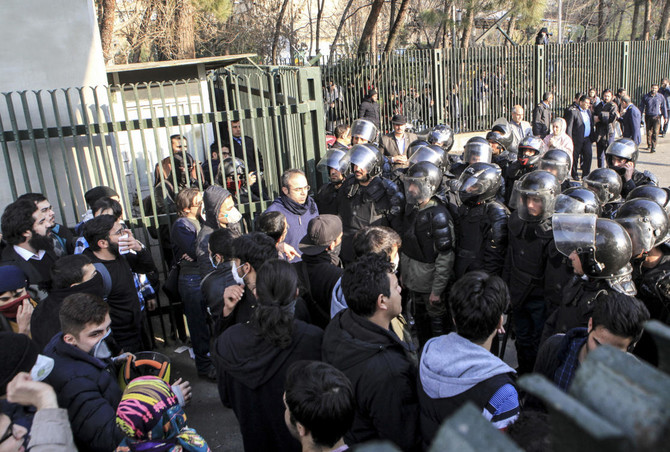
Economic woes push Iranians over the edge
Economic woes push Iranians over the edge

Latest updates




© 2026 SAUDI RESEARCH & PUBLISHING COMPANY, All Rights Reserved And subject to Terms of Use Agreement.