Afghan Taliban urge religious scholars to boycott peace conference

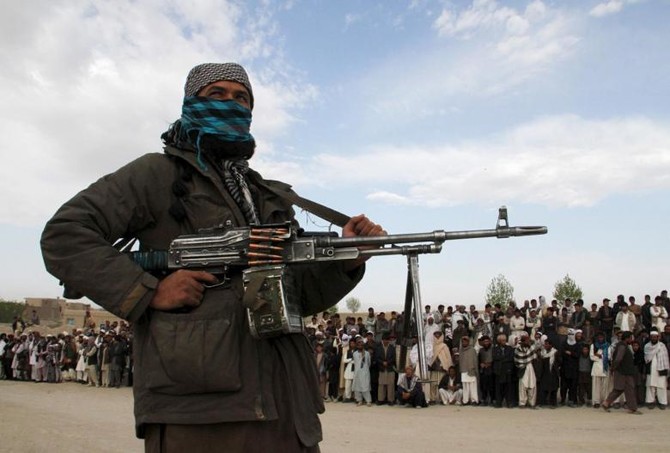
In this file photo, a member of the Taliban insurgent and other people stand at the site during the execution of three men in Ghazni Province April 18, 2015. (REUTERS)
Updated 10 March 2018
Follow

Afghan Taliban urge religious scholars to boycott peace conference

KABUL: The Taliban urged Islamic scholars on Saturday not to take part in a conference due to take place in Indonesia aimed at building agreement and support for possible future peace talks in Afghanistan.
The call follows President Ashraf Ghani’s offer last month to hold peace talks with the Taliban and comes as international powers have sought to build pressure on the movement to accept negotiations to end more than 16 years of war in Afghanistan.
The Taliban have so far proved unresponsive to the offer. And on Saturday they said the proposed conference of religious scholars from Afghanistan, Pakistan and Indonesia was merely intended to “legitimize the presence of infidel invaders in the Islamic country of Afghanistan.”
The conference, proposed by Indonesian President Joko Widodo in January and due to be held later this month, was an effort to present “the sacred Jihad in Afghanistan ... as unlawful bloodshed,” the Taliban said in a statement.
“Do not afford an opportunity to the invading infidels in Afghanistan to misuse your name and participation in this conference as means of attaining their malicious objective.”
Fighting to drive out international forces and re-establish their version of strict Islamic law, the Taliban control or contest large areas of Afghanistan and inflict heavy casualties on government security forces.
They have offered to talk to the United States about a possible peace agreement but have so far ruled out direct talks with the Western-backed government in Kabul, which they say is an illegitimate foreign-imposed regime.
Despite their unpromising rhetoric, however, Western diplomats say that efforts have been intensifying behind the scenes to lay the groundwork for possible future talks with regular contacts through intermediaries.
At the same time, the United States has stepped up battlefield pressure, notably through air strikes on the Taliban as Afghanistan’s international partners have sought to build up diplomatic support from neighboring countries to push the movement to the negotiating table.
They have also invested considerable effort in trying to build consensus among religious scholars against tactics such as suicide bombings, which have been regularly carried out by Taliban and other insurgent groups. (Reporting by James Mackenzie editing by Clelia Oziel)


Trump sues the BBC for defamation over editing of January 6 speech, seeks up to $10 billion in damages

Updated 25 min 52 sec ago
Follow

Trump sues the BBC for defamation over editing of January 6 speech, seeks up to $10 billion in damages

  • A BBC spokesperson told Reuters earlier on Monday that it had “no further contact from President Trump’s lawyers at this point
  • The BBC is funded through a mandatory license fee on all TV viewers, which UK lawyers say could make any payout to Trump politically fraught

WASHING: President Donald Trump sued the BBC on Monday for defamation over edited clips of a speech that made it appear he directed supporters to storm the US Capitol, opening an international front in his fight against media coverage he deems untrue or unfair. Trump accused Britain’s publicly owned broadcaster of defaming him by splicing together parts of a January 6, 2021 speech, including one section where he told supporters to march on the Capitol and another where he said “fight like hell.” It omitted a section in which he called for peaceful protest.
Trump’s lawsuit alleges the BBC defamed him and violated a Florida law that bars deceptive and unfair trade practices. He is seeking $5 billion in damages for each of the lawsuit’s two counts. The BBC has apologized to Trump, admitted an error of judgment and acknowledged that the edit gave the mistaken impression that he had made a direct call for violent action. But it has said there is no legal basis to sue.
Trump, in his lawsuit filed Monday in Miami federal court, said the BBC despite its apology “has made no showing of actual remorse for its wrongdoing nor meaningful institutional changes to prevent future journalistic abuses.”
The BBC is funded through a mandatory license fee on all TV viewers, which UK lawyers say could make any payout to Trump politically fraught.
A spokesman for Trump’s legal team said in a statement the BBC “has a long pattern of deceiving its audience in coverage of President Trump, all in service of its own leftist political agenda.”
A BBC spokesperson told Reuters earlier on Monday that it had “no further contact from President Trump’s lawyers at this point. Our position remains the same.” The broadcaster did not immediately respond to a request for comment after the lawsuit was filed.

CRISIS LED TO RESIGNATIONS
Facing one of the biggest crises in its 103-year history, the BBC has said it has no plans to rebroadcast the documentary on any of its platforms.
The dispute over the clip, featured on the BBC’s “Panorama” documentary show shortly before the 2024 presidential election, sparked a public relations crisis for the broadcaster, leading to the resignations of its two most senior officials.
Trump’s lawyers say the BBC caused him overwhelming reputational and financial harm.
The documentary drew scrutiny after the leak of a BBC memo by an external standards adviser that raised concerns about how it was edited, part of a wider investigation of political bias at the publicly funded broadcaster.
The documentary was not broadcast in the United States.
Trump may have sued in the US because defamation claims in Britain must be brought within a year of publication, a window that has closed for the “Panorama” episode.
To overcome the US Constitution’s legal protections for free speech and the press, Trump will need to prove not only that the edit was false and defamatory but also that the BBC knowingly misled viewers or acted recklessly.
The broadcaster could argue that the documentary was substantially true and its editing decisions did not create a false impression, legal experts said. It could also claim the program did not damage Trump’s reputation.
Other media have settled with Trump, including CBS and ABC when Trump sued them following his comeback win in the November 2024 election.
Trump has filed lawsuits against the New York Times, the Wall Street Journal and a newspaper in Iowa, all three of which have denied wrongdoing. The attack on the US Capitol in January 2021 was aimed at blocking Congress from certifying Joe Biden’s presidential win over Trump in the 2020 US election.