BRUSSELS: The Trump administration’s decision to impose tariffs on aluminum and steel imports drew warnings on Friday from businesses and US trading partners that the measure could backfire, provoking a trade war without resolving the problems it is intended to address.
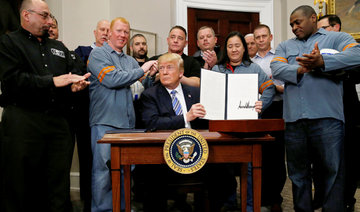
President Donald Trump said the tariffs, due to take effect in 15 days, are needed to protect US workers. Businesses said the 25 percent tariff on imported steel and 10 percent levy on aluminum will jack up costs, raising prices for consumers and potentially putting people out of work.
The move drew consternation outside the US.
China’s Commerce Ministry said it “firmly opposes” the move but gave no indication if Beijing might make good on threats to retaliate.
“These measures could make a significant impact on the economic and cooperative relationship between Japan and the US, who are allies,” Taro Kono, Japan’s foreign minister, said in a statement.
The head of EUROFER, Europe’s main steel federation, said Trump’s reasons for slapping tariffs on steel and aluminum were an absurdity and that the move could cost tens of thousands of jobs across the Continent.
In both Asia and Europe steel producers worry over the loss of market access and also that steel from other exporting nations will flood in.
EUROFER chief Axel Eggert said “the loss of exports to the US, combined with an expected massive import surge in the EU could cost tens of thousands of jobs in the EU steel industry and related sectors.”
Trump has complained over low-cost Chinese exports of steel and aluminum, but the latest move was likely to hit Japan and South Korea harder.
The US bought just 1.1 percent of China’s steel exports last year compared with 12 percent for South Korea and 5 percent for Japan, according to the US International Trade Commission.
“Significant damage in South Korea’s steel exports to the United States seems unavoidable,” South Korean trade minister Paik Un-gyu said in a statement.
A large share of Japanese and Chinese steel goes to Southeast Asia, where booming construction and light industries are fueling strong demand for steel and the region is dependent on imports to meet its needs.
The US tariffs could push producers to sell still more to Southeast Asia, depressing steel prices. That would hurt producers but boost profits of construction and other industries in Southeast Asia.
Hong Kong, which has a busy port handling shipments moving between mainland China and the US, said it “regrets and disapproves” of the decision. The city’s Commerce and Economic Development Bureau said it filed a formal representation with the US on Feb. 27 opposing the tariffs.
Indonesia’s trade minister, Enggartiasto Lukito, expressed concern that industries other than steel and aluminum that are more crucial to Indonesia could eventually be targeted.
“It’s not a big deal for our steel and aluminum industry, but it’s a big problem if the US does a similar policy against palm oil, we are ready for a trade war,” Lukito said.
Indonesia and Malaysia are the world’s biggest producers of palm oil, a commodity that is used in a dizzying number of consumer products.
But Indonesian Vice President Jusuf Kalla said the country had the option of retaliating, with action against imports of US soybeans, wheat and aircraft.
In the US, Gary Shapiro, president and CEO of the Consumer Technology Association, which represents more than 2,200 companies, said the tariffs could cost far more American jobs than they would create.
US automakers are among the businesses with the most at stake, accounting for 38 percent of the aluminum and 15 percent of the steel consumed in the country, according to Ward’s Automotive Reports.
The Alliance of Automobile Manufacturers warned the tariffs will also drive up the price of steel made in the US.
If the entire cost were passed to consumers, which may not be possible, it could add about $300 to the price of the average vehicle, said Kristen Dziczek, director of the Center for Automotive Research’s Industry, Labor & Economics Group.
The tariffs will affect a wide range of products, including high-tech gadgets, food, furniture and beverages. The Beer Institute, a trade group representing the world’s largest brewers, estimates the 10 percent tariff on the aluminum encasing most beer is sold in the US will push costs up by $348 million annually, threatening more than 20,000 jobs in the industry.
“Imported aluminum used to make beer cans is not a threat to national security,” said Jim McGreevy, the Beer Institute’s CEO.
The head of the National Retail Federation, whose members include department store chains, grocery stores and other merchants around the world, also raised objections to the tariffs on Thursday, calling them a tax on all Americans.
“A tariff is a tax, plain and simple,” said Matthew Shay, president and CEO of the NRF. “Consumers are just beginning to see more money in their paychecks following tax reform, but those gains will soon be offset by higher prices for products ranging from canned goods to cars to electronics.”
Housing trade groups also took a dim view of the tariffs, saying the policy would raise costs and slow building at a time when the nation faces a severe shortage in homes and rental housing.


![]()

US trading partners, businesses say import tariffs will backfire
US trading partners, businesses say import tariffs will backfire

Latest updates


© 2026 SAUDI RESEARCH & PUBLISHING COMPANY, All Rights Reserved And subject to Terms of Use Agreement.