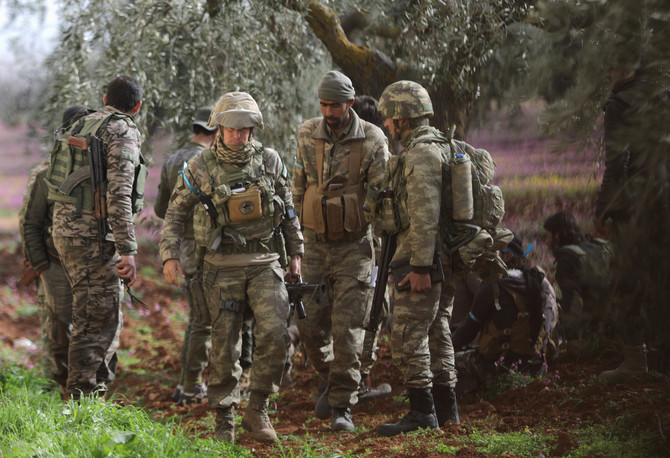
ANKARA: President Recep Tayyip Erdogan on Friday said Turkish forces and allied rebels could enter the center of the Kurdish-held Syrian town of Afrin “at any moment,” a day after the capture of another key strategic town.
“Now our objective is Afrin... As of now, we have Afrin encircled. We can enter Afrin at any moment, God willing,” Erdogan told his ruling party in Ankara, a day after Turkish forces took control of the town of Jandairis west of Afrin.
“The operations in Afrin will continue until this swamp of terror is dried,” he warned, adding Turkey’s armed forces will push on after operations in Afrin and Manbij to sweep Syrian Kurdish fighters from the length of Turkey’ border with Syria.
Ankara's claim s on Afrin were challenged by the kurdish fighters there. a spoksman for the fighters group backed by the US military said that Turkish troops are still ten kilometers far from center of Afrin.
Ankara on January 20 launched operation “Olive Branch” in the Afrin region of northern Syria against the YPG) militia who control the area but Turkey regards as a terror group.
On Thursday, Turkey’s foreign minister said Turkish forces would complete the Afrin offensive by May and would carry out a joint offensive against Kurdish militants in Iraq with Baghdad following Iraq parliamentary elections.
Despite encountering fierce resistance — which has seen 42 Turkish troops lose their lives — the Turkish military and its Syrian allies appear to have gained new momentum in the last weeks.
The capture of Jandairis — one of the key centers in the region other than Afrin itself — was seen by analysts as giving Ankara a clear path toward its main target.
But the operation has ratcheted up tensions with the United States, pitting Turkey’s army against a militia force allied with its fellow NATO member in the battle against Daesh militants.
Erdogan also reaffirmed his previous vows that Turkey would not limit itself to clearing the Afrin region of the YPG, saying it wanted to carry on to the town of Manbij to the east and then to the Iraqi border.
“Today we are in Afrin and tomorrow we will be in Manbij. And the next day we will ensure that terrorists are cleared east of the Euphrates River up to the Iraqi border,” he said.
Manbij is regarded as a particularly delicate issue as the United States — unlike in Afrin — has a presence there, raising the prospect of a direct clash with Turkey.
On a visit to Ankara last month, US Secretary of State Rex Tillerson said that Turkey and the US had to solve the tensions surrounding Manbij as a “priority.”


Erdogan says Turkey can enter Afrin center at any moment
Erdogan says Turkey can enter Afrin center at any moment

Sudan Quintet urges ‘those with influence’ to halt weapons flow, deescalate conflict ahead of Ramadan
- Group of 5 organizations condemns ‘increasingly destructive means of warfare’ in Sudan’s civil war, warns that civilians bear the brunt of fighting
- UN spokesperson describes ‘horrific’ situation on the ground, expresses ‘deep alarm’ at escalating attacks on civilian and humanitarian infrastructure
NEW YORK CITY: A group of five international and regional organizations on Wednesday called for an immediate end to flows of weapons and fighters into Sudan, and for coordinated action to deescalate the war in the country and protect civilians as the third anniversary of the start of the conflict approaches.
The so-called Sudan Quintet — comprising the African Union, the Intergovernmental Authority on Development, the League of Arab States, the EU and the UN — said those with influence over the warring factions must act to “halt the flow of weapons, fighters and other forms of support that sustain violence and contribute to the fragmentation of Sudan.”
In a joint statement, the Quintet expressed “grave concern at the continued escalation of the conflict” and called for “the immediate halting of any further military escalation, including the use of increasingly destructive means of warfare.” Civilians are bearing the brunt of the fighting, it warned.
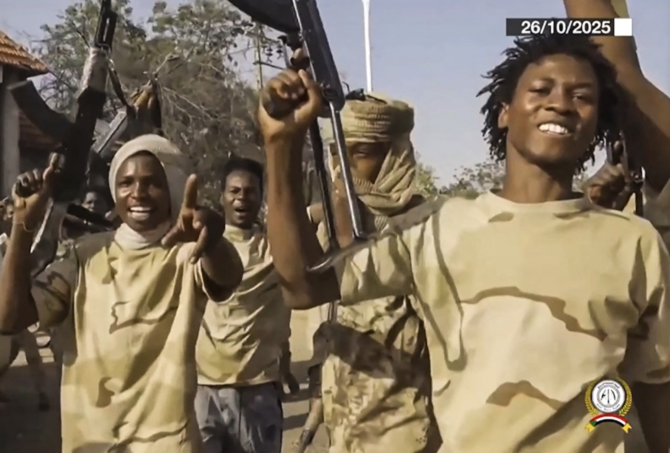
The conflict began in April 2023 when tensions between rival military factions the Sudanese Armed Forces and the paramilitary Rapid Support Forces escalated into full-scale war in the capital Khartoum and spread across the country.
The war has killed tens of thousands of people; US intelligence officials and independent analysts have suggested the true death toll could be in the hundreds of thousands.
The conflict has also triggered what the UN describes as one of the worst humanitarian crises in the world. More than 33 million people are in need of humanitarian assistance, and more than 13.6 million have been displaced by the fighting, 9.3 million of them within Sudan and about 4.3 million to neighboring countries.
The Quintet said the rapidly deteriorating situation in the Kordofan region and Blue Nile State was particularly alarming, citing reports of deadly drone strikes, the tightening grip of sieges around major population centers, and attacks on critical infrastructure such as hospitals, schools and humanitarian assets.
It also highlighted issues such as forced displacements, severe constraints on humanitarian access, and attacks on aid convoys. These developments “underscore the urgency of immediate action to prevent atrocities,” it said.
Recalling “the horrors witnessed in El-Fasher” and earlier warnings that went unheeded, the Quintet said civilians “must no longer bear the cost of ongoing hostilities.” The organizations stressed that the protection of civilians and critical infrastructure was a fundamental obligation under international law, and that the principles of international humanitarian law applies to all parties to the conflict.
“Civilians and civilian infrastructure must be protected, international humanitarian law must be respected, and safe, rapid and unhindered humanitarian access to all areas in need must be ensured,” they said.
“Serious violations of international humanitarian law cannot go unaddressed,” they added, and perpetrators must be held accountable.
With the start of the holy month of Ramadan only a week away, the Quintet urged all sides to embrace efforts to broker a humanitarian truce and “immediately deescalate hostilities” so as to prevent further loss of life and enable life-saving assistance to reach those in need.
The organizations reaffirmed their commitment to the sovereignty, unity and territorial integrity of Sudan, and said they remain committed to efforts to facilitate a Sudanese-owned, inclusive political dialogue with the aim of ending the war and paving the way for a peaceful political transition.
The situation on the ground in Sudan continues to be “horrific,” UN spokesperson Stephane Dujarric said on Wednesday as he expressed “deep alarm” at “the escalating attacks that we’re seeing in the country, where aerial strikes are placing civilians at grave risk and directly hitting humanitarian and public infrastructure.”
A drone strike on a mosque in the city of Al-Rahat in North Kordofan state at dawn on Wednesday killed two children and injured 13, all of them students attending a school at the mosque.
This followed drone strikes on a primary school in the town of Dilling in South Kordofan late on Tuesday, where injuries were also reported. The same night, a World Food Programme warehouse in Kadugli, the state capital of Kordofan, was struck by a suspected rocket attack that caused significant damage to buildings and mobile storage units.
In recent days drone strikes been reported in other parts of South Kordofan, North Kordofan and West Kordofan, Dujarric said, all of them close to key supply routes connecting the city of El-Obeid in North Kordofan with Dilling and Kadugli in South Kordofan.
“This is endangering civilians, including humanitarian workers,” Dujarric told reporters in New York. “The fact that we have to reiterate almost every day that civilians, civilian infrastructure, places of worship, schools and hospitals cannot and should not be targeted is a tragedy unto itself.
“Yet we have to keep reminding the parties of this almost every day, and that they need to respect international humanitarian law amid these deeply concerning developments.”


