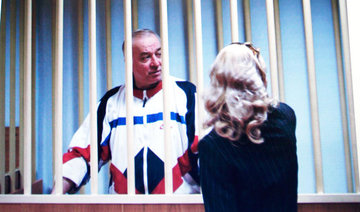
MOSCOW: Sergei Skripal, a former Russian double agent whose mysterious collapse in England sparked fears of a possible poisoning by Moscow, has been living in Britain since a high-profile spy swap in 2010.
Police were probing his exposure to an unknown substance, which left him unconscious on a bench in the city of Salisbury and saw media draw parallels to the case of Alexander Litvinenko, an ex-spy who died of radioactive polonium poisoning in 2006.
But there are important differences between Litvinenko, who fled prosecution in Russia, and the man identified by British media as Skripal, who confessed to spying for London and was jailed before being pardoned and exchanged.
Skripal, 66, was an ex-military intelligence officer when he was detained in December 2004 near his home in Moscow.
He had been recruited by British intelligence while still an active officer with the Russian military’s Main Intelligence Directorate (GRU) in the 1990s.
His job for the British was to pass on information about the identities of undercover Russian intelligence agents in various European countries.
He had continued this task even after he stopped working for the Russian military in 1999, receiving information from his former colleagues, the FSB security service said at the time.
“The spy inflicted considerable damage to the defense capability and security of the state with his actions,” it said.
After working for the military, Skripal was employed with the Russian foreign ministry and later became an entrepreneur, according to reports.
In exchange for his work, MI6 made payments to him to a bank account in Spain, totalling over $100,000, Russian authorities said at the time.
Skripal faced up to 20 years in prison on a charge of state treason but was sentenced by a military tribunal to 13 years because of his cooperation with the investigation.
In July 2010, then-president Dmitry Medvedev signed a pardon for Skripal and three other Russians that were swapped with the United States.
These were Alexander Zaporozhsky, Gennady Vasilenko and Igor Sutyagin.
Zaporozhsky and Sutyagin were, like Skripal, serving sentences for state treason. Vasilenko, a former KGB agent, was serving a sentence for other crimes.
Ten Kremlin agents were expelled by Washington in the course of the exchange at Vienna airport on July 9, 2010.
By far the most high-profile of those ten agents was photogenic redhead Anna Chapman who led a very public life for some time after her return to Russia but later dropped off the radar.
The Kremlin on Tuesday said it had no information regarding Skripal’s collapse and would not even say whether he was still a Russian citizen.
Igor Sutyagin, who went to Britain following the swap together with Skripal, said they shared a bottle of whiskey on their 2010 flight over, but have not kept in touch.
“If it was a reprisal against Skripal, it is unclear why it took place,” Sutyagin told Svoboda radio.
“He confessed, was amnestied and had served part of his sentence, I don’t see a reason for revenge against him.”
If the incident was indeed foul play, “anybody could be behind it, including North Korea,” Sutyagin said, adding that the recent negative media coverage makes an attack by Russian security services particularly “ill-timed.”
Alexander Lugovoi, a prime suspect in the Litvinenko murder, dismissed suspicions of poisoning, calling them British “phobias” and saying Skripal was of no interest to authorities after his pardon and exchange.
“Security services had certain agreements,” he told Interfax news agency of the 2010 exchange. “To persecute somebody who is already pardoned is absurd.”