MANILA: Expanding the ban on deployment of overseas Filipino workers (OFWs), particularly household service workers, to cover other countries in the Middle East is “not a good idea,” an expert has said.
The Philippines banned the deployment of OFWs to Kuwait in January after the recent deaths of seven migrant workers.
But Emmanuel Geslani, a migration and recruitment expert, warned of possible consequences if this ban covers other Middle Eastern countries, particularly Saudi Arabia.
“We cannot totally ban (the deployment of) domestic helpers to Saudi Arabia. It will be very difficult for us to (do so) because there might be repercussions,” Geslani told Arab News.
Currently, he said, there are an estimated 1.5 to 1.8 million Filipino migrant workers in Saudi Arabia, of which about 700,000 are domestic helpers and the rest professionals and skilled workers.
“All of these skilled workers have families. Let us not exacerbate or make the situation worse than it is. The OFWs have families. That is why they are working abroad. They have to feed their families,” Geslani stressed.
“Expanding the ban is not a good idea ... We cannot just say, OK, we have jobs (for you). There are no jobs (in the Philippines), we know that. That’s why everybody leaves the country, because they (OFWs) want to get jobs,” he added.
Geslani said he believes that they are “confident that the Philippines cannot just break off ties.” While Filipinos need the jobs, (the Kingdom is) expanding the market, and need more domestic workers, especially now the KSA has allowed women to work and to drive.
“We have a special bilateral labor agreement existing with Saudi Arabia. We cannot just abrogate that agreement. Maybe we can have discussions to improve it,” he said, referring to a 2013 agreement signed by the Philippines government through the Department of Labor and Employment (DOLE) with Saudi Arabia’s Ministry of Labor in 2013.
This agreement, he said, afforded protection for Filipino workers.
Philippines Labor Secretary Silvestre Bello III last week said the ban on the deployment of OFWs may be expanded to cover other countries in the Middle East with known rampant cases of maltreatment and abuse of Filipino workers.
Bello said the widened deployment ban may be resorted to if other Middle Eastern countries fail to assure and strengthen the protection of the rights and welfare of OFWs.
“We will impose the same restrictions (like in Kuwait) and will consider a deployment ban if strengthened protection of our OFWs was not assured,” Bello added.
He added that the prohibition of the kafala (sponsorship) system is among the provisions that the government is pushing for inclusion in the agreement being negotiated with Kuwait.
Under the kafala system, the sponsor-employer has complete control over the mobility of the migrant worker. An OFW, for instance, cannot quit work or transfer jobs without first obtaining the consent of his employer.
DOLE, as part of its drastic measures to ensure protection of OFWs, sent a team to the Middle East headed by Undersecretary Ciriaco Lagunzad to further assess the condition of OFWs and provide immediate response and assistance to their needs, as well as to recommend actions to deal with their situation.
“If there is an existing bilateral labor agreement but there are still rampant cases of maltreatment, then maybe we need to amend the agreement. The minimum demand of our president is that we will only deploy in countries where our workers are properly and effectively protected,” Bello said.


![]()
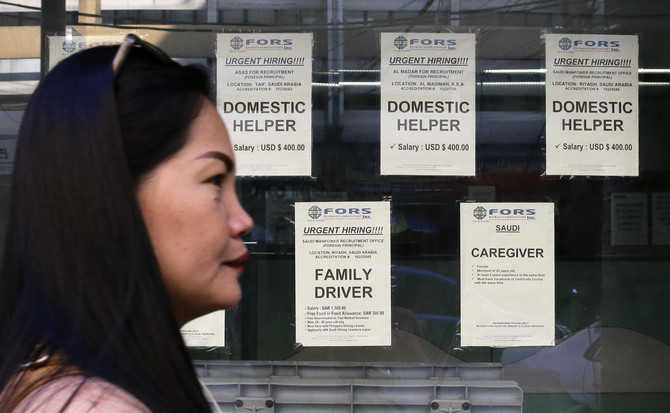
Expert says expanding ban on deployment of Filipino workers to Middle East ‘not a good idea’
Expert says expanding ban on deployment of Filipino workers to Middle East ‘not a good idea’



Latest updates


© 2026 SAUDI RESEARCH & PUBLISHING COMPANY, All Rights Reserved And subject to Terms of Use Agreement.