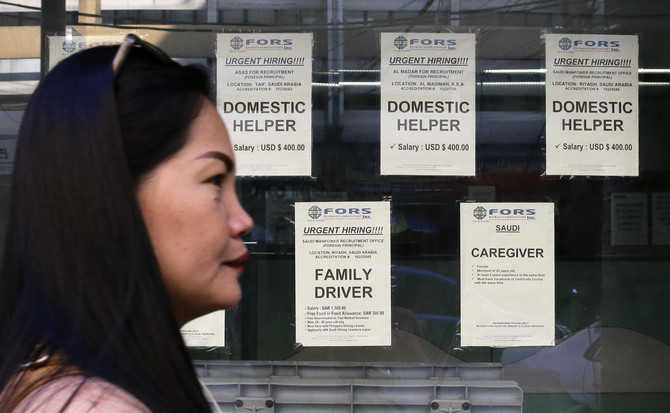
MANILA: Expanding the ban on deployment of overseas Filipino workers (OFWs), particularly household service workers, to cover other countries in the Middle East is “not a good idea,” an expert has said.
The Philippines banned the deployment of OFWs to Kuwait in January after the recent deaths of seven migrant workers.
But Emmanuel Geslani, a migration and recruitment expert, warned of possible consequences if this ban covers other Middle Eastern countries, particularly Saudi Arabia.
“We cannot totally ban (the deployment of) domestic helpers to Saudi Arabia. It will be very difficult for us to (do so) because there might be repercussions,” Geslani told Arab News.
Currently, he said, there are an estimated 1.5 to 1.8 million Filipino migrant workers in Saudi Arabia, of which about 700,000 are domestic helpers and the rest professionals and skilled workers.
“All of these skilled workers have families. Let us not exacerbate or make the situation worse than it is. The OFWs have families. That is why they are working abroad. They have to feed their families,” Geslani stressed.
“Expanding the ban is not a good idea ... We cannot just say, OK, we have jobs (for you). There are no jobs (in the Philippines), we know that. That’s why everybody leaves the country, because they (OFWs) want to get jobs,” he added.
Geslani said he believes that they are “confident that the Philippines cannot just break off ties.” While Filipinos need the jobs, (the Kingdom is) expanding the market, and need more domestic workers, especially now the KSA has allowed women to work and to drive.
“We have a special bilateral labor agreement existing with Saudi Arabia. We cannot just abrogate that agreement. Maybe we can have discussions to improve it,” he said, referring to a 2013 agreement signed by the Philippines government through the Department of Labor and Employment (DOLE) with Saudi Arabia’s Ministry of Labor in 2013.
This agreement, he said, afforded protection for Filipino workers.
Philippines Labor Secretary Silvestre Bello III last week said the ban on the deployment of OFWs may be expanded to cover other countries in the Middle East with known rampant cases of maltreatment and abuse of Filipino workers.
Bello said the widened deployment ban may be resorted to if other Middle Eastern countries fail to assure and strengthen the protection of the rights and welfare of OFWs.
“We will impose the same restrictions (like in Kuwait) and will consider a deployment ban if strengthened protection of our OFWs was not assured,” Bello added.
He added that the prohibition of the kafala (sponsorship) system is among the provisions that the government is pushing for inclusion in the agreement being negotiated with Kuwait.
Under the kafala system, the sponsor-employer has complete control over the mobility of the migrant worker. An OFW, for instance, cannot quit work or transfer jobs without first obtaining the consent of his employer.
DOLE, as part of its drastic measures to ensure protection of OFWs, sent a team to the Middle East headed by Undersecretary Ciriaco Lagunzad to further assess the condition of OFWs and provide immediate response and assistance to their needs, as well as to recommend actions to deal with their situation.
“If there is an existing bilateral labor agreement but there are still rampant cases of maltreatment, then maybe we need to amend the agreement. The minimum demand of our president is that we will only deploy in countries where our workers are properly and effectively protected,” Bello said.

Expert says expanding ban on deployment of Filipino workers to Middle East ‘not a good idea’
US shoots down Iranian drone approaching aircraft carrier, official says
- Iranian Shahed-139 drone shot down by F-35 jet
- Iranian boats harass US-flagged tanker in Strait of Hormuz, US military says
The US military on Tuesday shot down an Iranian drone that “aggressively” approached the Abraham Lincoln aircraft carrier in the Arabian Sea, the US military said, in an incident first reported by Reuters. The incident came as diplomats sought to arrange nuclear talks between Iran and the United States, and US President Donald Trump warned that with US warships heading toward Iran, “bad things” would probably happen if a deal could not be reached.
Oil futures prices rose more than $1 per barrel after news the drone was shot down.
The Iranian Shahed-139 drone was flying toward the carrier “with unclear intent” and was shot down by an F-35 US fighter jet, the US military said.
“An F-35C fighter jet from Abraham Lincoln shot down the Iranian drone in self-defense and to protect the aircraft carrier and personnel on board,” said Navy Captain Tim Hawkins, a spokesperson at the US military’s Central Command.
Iran’s UN mission declined to comment.
Iran’s Tasnim news agency said connection had been lost with a drone in international waters, but the reason was unknown.
No American service members were harmed during the incident and no US equipment was damaged, he added.
The Lincoln carrier strike group is the most visible part of a US military buildup in the Middle East following a violent crackdown against anti-government demonstrations last month, the deadliest domestic unrest in Iran since its 1979 revolution.
Trump, who stopped short of carrying out threats to intervene during the crackdown, has since demanded Tehran make nuclear concessions and sent a flotilla to its coast. He said last week Iran was “seriously talking,” while Tehran’s top security official, Ali Larijani, said arrangements for negotiations were under way.
Iranian boats harass US-flagged tanker
In a separate incident on Tuesday in the Strait of Hormuz, just hours after the drone shootdown, Iran’s Islamic Revolutionary Guard Corps forces harassed a US-flagged, US-crewed merchant vessel, according to the US military.
“Two IRGC boats and an Iranian MoHajjer drone approached M/V Stena Imperative at high speeds and threatened to board and seize the tanker,” Hawkins said.
Maritime risk management group Vanguard said the Iranian boats ordered the tanker to stop its engine and prepare to be boarded. Instead, the tanker sped up and continued its voyage.
Hawkins said a US Navy warship, the McFaul, was operating in the area and escorted the Stena Imperative.
“The situation de-escalated as a result, and the US-flagged tanker is proceeding safely,” Hawkins added.
Oil futures prices rose more than $1 per barrel after news the drone was shot down.
The Iranian Shahed-139 drone was flying toward the carrier “with unclear intent” and was shot down by an F-35 US fighter jet, the US military said.
“An F-35C fighter jet from Abraham Lincoln shot down the Iranian drone in self-defense and to protect the aircraft carrier and personnel on board,” said Navy Captain Tim Hawkins, a spokesperson at the US military’s Central Command.
Iran’s UN mission declined to comment.
Iran’s Tasnim news agency said connection had been lost with a drone in international waters, but the reason was unknown.
No American service members were harmed during the incident and no US equipment was damaged, he added.
The Lincoln carrier strike group is the most visible part of a US military buildup in the Middle East following a violent crackdown against anti-government demonstrations last month, the deadliest domestic unrest in Iran since its 1979 revolution.
Trump, who stopped short of carrying out threats to intervene during the crackdown, has since demanded Tehran make nuclear concessions and sent a flotilla to its coast. He said last week Iran was “seriously talking,” while Tehran’s top security official, Ali Larijani, said arrangements for negotiations were under way.
Iranian boats harass US-flagged tanker
In a separate incident on Tuesday in the Strait of Hormuz, just hours after the drone shootdown, Iran’s Islamic Revolutionary Guard Corps forces harassed a US-flagged, US-crewed merchant vessel, according to the US military.
“Two IRGC boats and an Iranian MoHajjer drone approached M/V Stena Imperative at high speeds and threatened to board and seize the tanker,” Hawkins said.
Maritime risk management group Vanguard said the Iranian boats ordered the tanker to stop its engine and prepare to be boarded. Instead, the tanker sped up and continued its voyage.
Hawkins said a US Navy warship, the McFaul, was operating in the area and escorted the Stena Imperative.
“The situation de-escalated as a result, and the US-flagged tanker is proceeding safely,” Hawkins added.
© 2026 SAUDI RESEARCH & PUBLISHING COMPANY, All Rights Reserved And subject to Terms of Use Agreement.