Palestinians warn of ‘catastrophe’ over major new Israeli settlement

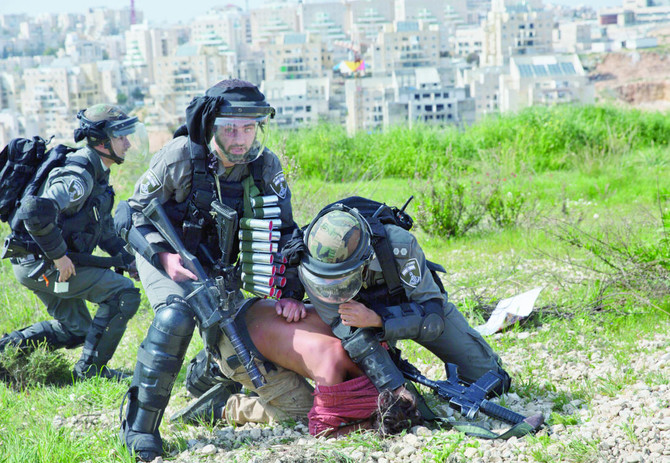
Israeli border policemen detain a foreign activist during a protest on Friday in the West Bank village of Bil’in, west of Ramallah. (AP)
Updated 04 March 2018
Follow

Palestinians warn of ‘catastrophe’ over major new Israeli settlement

AMMAN: Palestinians fear that plans for a major new Jewish settlement will place further strain on a West Bank city already surrounded by Israel’s controversial separation wall.
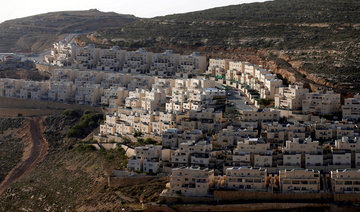
Last month Israeli television revealed that three existing settlements near Qalqilya will be unified later this year. A fourth settlement is due to be added within five years, bringing together about 20,000 settlers on land that is illegally occupied under international law.
The project throws into doubt long-awaited Palestinian plans to improve and expand Qalqilya’s infrastructure, leaving residents of the most overcrowded city in the West Bank facing an uncertain future.
In response, Qalqilya Gov. Rafi Rawajba described continued Israeli settlement as “state terror.”
He called on the international community to protect the city.
“This right-wing (Israeli) government is taking away Palestinian land and using it exclusively for expanding the Jewish settlement enterprise,” he said.
Surrounded on three sides by the Israeli separation wall, Qalqilya covers an area of just over 1.5 square miles, yet is home to an estimated 53,000 residents, making it the occupied West Bank’s most densely populated city.
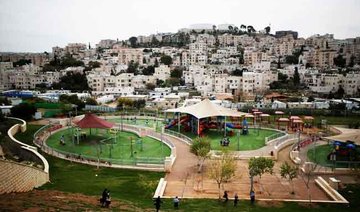
Palestinian officials had hoped to expand and improve the city by building 14,000 housing units, an industrial park and several playgrounds. The ambitious infrastructure project was approved by the Israeli Cabinet in 2016 following a recommendation from Defense Minister Avigdor Lieberman.
But concerted pressure by the powerful settler movement has since caused the Israeli government to backtrack. On July 13, 2017, the Israeli cabinet decided to freeze Qalqilya’s expansion, ignoring Palestinian concerns that any pause in the development project would be a “catastrophe” and opening the way for last month’s decision to unify the settlements.
According to Israel’s Hebrew-language Channel 7, the Israeli Interior Minister Aryeh Deri has approved a plan to unite the settlements of Sheari Tikva, Etz Efraim and Elkana to the southwest of Qalqilya. A fourth settlement, Oranit, will be added in 2023, formally creating a new Israeli city in the occupied West Bank.
However, a spokesman for the Israeli movement Peace Now downplayed the impact of the settlement expansion. Brian Reeves told Arab News the expansion would reinforce the existing situation in and around Qalqilya, but not make it significantly worse.
“This decision is primarily administrative and will not give those supporting the settlement enterprise a significant advantage to confiscate land that they did not already have,” he said.


Syria’s Kurdish fighters agree to leave Aleppo after deadly clashes

Updated 3 sec ago
Follow

Syria’s Kurdish fighters agree to leave Aleppo after deadly clashes

  • Syria’s official SANA news agency reported that “buses carrying the last batch of members of the SDF organization have left the Sheikh Maqsud neighborhood in Aleppo, heading toward northeastern Syria”

ALEPPO: Syria’s Kurdish fighters said Sunday that they agreed under a ceasefire to withdraw from Aleppo after days of fighting government forces in the city.
Hours earlier, Syria’s military said it had finished operations in the Kurdish-held Sheikh Maqsud neighborhood with state television reporting that Kurdish fighters who surrendered were being bused to the north.
The military had already announced its seizure of Aleppo’s other Kurdish-held neighborhood, Ashrafiyeh.
Kurdish forces had controlled pockets of Syria’s second city Aleppo and operate a de facto autonomous administration across swathes of the north and northeast, much of it captured during the 14-year civil war.
The latest clashes erupted after negotiations to integrate the Kurds into the country’s new government stalled.
“We reached an understanding that led to a ceasefire and secured the evacuation of the martyrs, the wounded, the trapped civilians and the fighters from Ashrafiyeh and Sheikh Maqsud neighborhoods to northern and eastern Syria,” the Kurdish-led Syrian Democratic Forces (SDF) wrote in a statement.
Syria’s official SANA news agency reported that “buses carrying the last batch of members of the SDF organization have left the Sheikh Maqsud neighborhood in Aleppo, heading toward northeastern Syria.”
The SDF initially denied its fighters were leaving, describing the bus transfers as forced displacement of civilians.
An AFP correspondent saw at least five buses on Saturday carrying men out of Sheikh Maqsud, but could not independently verify their identities.
According to the SDF statement, the ceasefire was reached “through the mediation of international parties to stop the attacks and violations against our people in Aleppo.”
The United States and European Union both called for the Syrian government and Kurdish authorities to return to political dialogue.
The fighting, some of the most intense since the ousting of long-time ruler Bashar Assad in December 2024, has killed at least 21 civilians, according to figures from both sides, while Aleppo’s governor said 155,000 people fled their homes.
Both sides blamed the other for starting the clashes on Tuesday.

Children ‘still inside’

On the outskirts of Sheikh Maqsud, families who had been trapped by the fighting were leaving, accompanied by Syrian security forces.
An AFP correspondent saw men carrying children on their backs board buses headed to shelters.
Dozens of young men in civilian clothing were separated from the crowd, with security forces making them sit on the ground before transporting them to an unknown destination, according to the correspondent.
A Syrian security official told AFP on condition of anonymity that the young men were “fighters” being “transferred to Syrian detention centers.”
At the entrance to the district, 60-year-old Imad Al-Ahmad was heading in the opposite direction, trying to seek permission to return home.
“I left four days ago...I took refuge at my sister’s house,” he told AFP. “I don’t know if we’ll be able to return today.”
Nahed Mohammad Qassab, a 40-year-old widow also waiting to return, said she left before the fighting to attend a funeral.
“My three children are still inside, at my neighbor’s house. I want to get them out,” she said.
A flight suspension at Aleppo airport was extended until further notice.

‘Return to dialogue’

US envoy Tom Barrack met Syrian President Ahmed Al-Sharaa on Saturday, and afterwards called for a “return to dialogue” with the Kurds in accordance with the integration framework agreed in March.
The deal was meant to be implemented last year, but differences, including Kurdish demands for decentralized rule, stymied progress as Damascus repeatedly rejected the idea.
The fighting in Aleppo raised fears of a regional escalation, with neighboring Turkiye, a close ally of Syria’s new Islamist authorities, saying it was ready to intervene. Israel has sided with the Kurdish forces.
The clashes have also tested the Syrian authorities’ ability to reunify the country after the brutal civil war and commitment to protecting minorities, after sectarian bloodshed rocked the country’s Alawite and Druze communities last year.