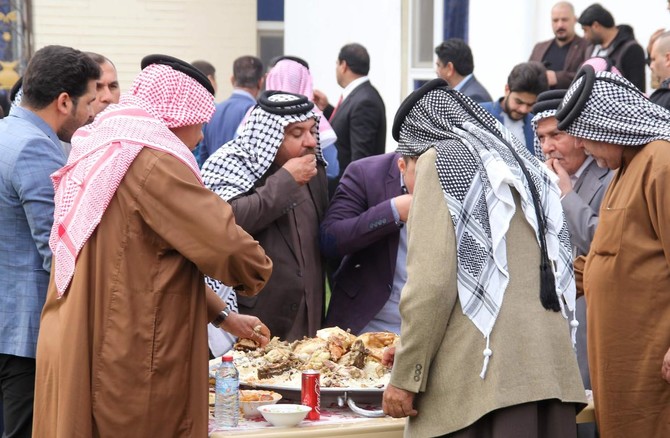
RAMADI: In Iraq’s Anbar province, visitors can be hard-pressed to find a hotel room as tribal tradition makes housing guests a point of honor.
The western region along the Syrian border was long held by Daesh, and few outsiders managed to venture into its capital Ramadi until the extremists were pushed out in 2016.
But today, traders, investors, contractors and construction workers are rushing into the desert province, as business begins to resume after years of stagnation.
Karim Al-Basrawi, a car-parts salesman in Ramadi on business, was hoping to stay in a hotel during a recent trip.
“When I arrived, I was surprised that there were no hotels,” said the 35-year-old from the southern province of Basra.
After getting lost on the way to a meeting, he decided to knock on a door and ask the family if they knew the man he was looking for.
“They said yes and invited me in. After dinner and tea — and after I repeatedly asked about the person — they told me they didn’t know him, but would send someone to look for him and that I should spend the night at their place.”
Tribal traditions of hospitality transcend community affiliation. Karim, the visitor, is Shiite, but the majority of Anbar province is Sunni.
“Hospitality is a red line for us. We respect guests as we respect God,” said Sheikh Mohammad Khalef Al-Shaabani, leader of the powerful Shaabani tribe, who lives in Ramadi.
In Anbar, hotels are out of the question.
“We will never allow their construction. We’d sell everything we have to honor a guest,” said the 45-year-old, wearing a red and white checkered keffiyeh headscarf.
“When we build our homes, we first think of the diwaniya (reception hall), which must be big, even if it means we must sleep in one room,” he added.
Omar Al-Nimer, a barber, said many families host guests even if they do not know the person.
“If he has the wrong address, for example, he’ll stay with us for one night at least before we take him to the right person. He must eat and drink and relax at ours, otherwise people will talk about us.”
French anthropologist Dawood Hosham, who is of Iraqi origin, highlights the “tribal” nature of cities like Ramadi when explaining the importance placed on hospitality.
“Under these circumstances, it is inconceivable that a visitor should be looking for a hotel, where local traditions dictate the duty of hospitality. This is the case with other cities in the province as well,” explained Hosham, author of The Tribes and Power in the Land of Islam.
In the center of Ramadi lies an abandoned concrete structure, the only attempt in 2013 by a Turkish company to erect a hotel in Anbar.
But construction stopped with the Daesh group’s takeover of the large swathes of the country in 2014. According to residents, even the terrorists stayed away from the building.
Anbar provincial council member Athal Obeid Dhahi said there is an urgent need to create hotels for “weddings, parties or receptions,” but “it is useless because the tribes here do not accept.”
The tribal opposition, combined with the area’s delicate political and security situations, means “it is difficult to imagine any tourist movement in Anbar,” said Dhahi.
Radical fighters still maintain a presence in the province, particularly along the Syrian border.
It was in Anbar that a large section of the Sunni community revolted against the Shiite-led government in Baghdad and welcomed Daesh militants — who are also Sunnis — as protectors, as they had done with Al-Qaeda 10 years before.
Although they quickly grew disillusioned, it was already too late: the extremist group had taken over the province and imposed its ruthless law.
But for Sheikh Mohammad Al-Shaabani, the province’s suffering in the past 15 years does not negate the importance of preserving tradition.
“Generosity is courage, and hotels nullify that courage,” he said.
“We always tell our visitors: You are the boss of the house, and we are the guests.”

Hotel hunting: Mission impossible in tribal Iraq
Trump, Erdogan discuss Syria and Gaza in call
WASHINGTON/ ANKARA: Turkish President Tayyip Erdogan discussed developments in Syria and Gaza with US counterpart Donald Trump in a telephone call on Tuesday as Syria’s Turkiye-backed government announced a ceasefire with US-allied Kurdish forces after days of clashes.
Turkiye separately weighed if Erdogan should join the US leader’s “Board of Peace” initiative.
“President Erdogan stated that Turkiye was closely following developments in Syria, that Syria’s unity, harmony and territorial integrity were important for Turkiye,” the Turkish presidency said in a statement.
Earlier Trump said he had a “very good call” with Erdogan, without elaborating.
Syria’s government seized swathes of territory in the northeast this week, and gave the Kurdish-led Syrian Democratic Forces four days to agree on integrating into the central state.
The SDF’s main ally, the United States, said the partnership with the group had changed nature after Syria’s new government emerged.
The Turkish presidency added that Erdogan and Trump also discussed the fight against the Islamic State militant group and the “situation” of its prisoners in Syrian jails.
Turkiye deems the SDF a terrorist organization linked with the outlawed Kurdistan Workers Party (PKK), which has mounted a four-decade insurgency against the Turkish state.
In its peace process with the PKK, Ankara has called for the group and its affilites to disband and disarm.
Ankara, the main foreign backer of Syria’s new government, has praised Damascus’ advances against the SDF and repeatedly called for it to integrate with the Syrian state apparatus.
ERDOGAN THANKS TRUMP FOR ‘BOARD OF PEACE’ INVITE
Erdogan told Trump Turkiye would continue to coordinate with Washington on Gaza, the Turkish presidency said.
“President Erdogan thanked US President Trump for the invitation to the Gaza Board of Peace,” it added.
A UN Security Council resolution, adopted in mid-November, authorized the “Board of Peace” and countries working with it to establish an international stabilization force in Gaza.
In October, a fragile ceasefire began in Gaza under a Trump plan on which Israel and Palestinian militant group Hamas had signed off.
Earlier on Tuesday, Turkiye said Erdogan would decide soon on joining the initiative. Turkiye has been critical of Israel’s assault on Gaza, casting it as genocide, while Israel has repeatedly opposed a Turkish role in Gaza.
More than 460 Palestinians, more than 100 of them children, and three Israeli soldiers have been reported killed since the Gaza truce began.
Under Trump’s Gaza plan, the board was meant to supervise Gaza’s temporary governance. Later Trump said it would be expanded to tackle conflicts around the world.
Many rights experts say that Trump’s chairing of a board to supervise a foreign territory’s affairs would resemble a colonial structure.
Diplomats fear such a board for global issues could harm the work of the United Nations.
Among those the White House has named to the board are Secretary of State Marco Rubio, Britain’s former Prime Minister Tony Blair, and Trump’s son-in-law, Jared Kushner.
Turkiye separately weighed if Erdogan should join the US leader’s “Board of Peace” initiative.
“President Erdogan stated that Turkiye was closely following developments in Syria, that Syria’s unity, harmony and territorial integrity were important for Turkiye,” the Turkish presidency said in a statement.
Earlier Trump said he had a “very good call” with Erdogan, without elaborating.
Syria’s government seized swathes of territory in the northeast this week, and gave the Kurdish-led Syrian Democratic Forces four days to agree on integrating into the central state.
The SDF’s main ally, the United States, said the partnership with the group had changed nature after Syria’s new government emerged.
The Turkish presidency added that Erdogan and Trump also discussed the fight against the Islamic State militant group and the “situation” of its prisoners in Syrian jails.
Turkiye deems the SDF a terrorist organization linked with the outlawed Kurdistan Workers Party (PKK), which has mounted a four-decade insurgency against the Turkish state.
In its peace process with the PKK, Ankara has called for the group and its affilites to disband and disarm.
Ankara, the main foreign backer of Syria’s new government, has praised Damascus’ advances against the SDF and repeatedly called for it to integrate with the Syrian state apparatus.
ERDOGAN THANKS TRUMP FOR ‘BOARD OF PEACE’ INVITE
Erdogan told Trump Turkiye would continue to coordinate with Washington on Gaza, the Turkish presidency said.
“President Erdogan thanked US President Trump for the invitation to the Gaza Board of Peace,” it added.
A UN Security Council resolution, adopted in mid-November, authorized the “Board of Peace” and countries working with it to establish an international stabilization force in Gaza.
In October, a fragile ceasefire began in Gaza under a Trump plan on which Israel and Palestinian militant group Hamas had signed off.
Earlier on Tuesday, Turkiye said Erdogan would decide soon on joining the initiative. Turkiye has been critical of Israel’s assault on Gaza, casting it as genocide, while Israel has repeatedly opposed a Turkish role in Gaza.
More than 460 Palestinians, more than 100 of them children, and three Israeli soldiers have been reported killed since the Gaza truce began.
Under Trump’s Gaza plan, the board was meant to supervise Gaza’s temporary governance. Later Trump said it would be expanded to tackle conflicts around the world.
Many rights experts say that Trump’s chairing of a board to supervise a foreign territory’s affairs would resemble a colonial structure.
Diplomats fear such a board for global issues could harm the work of the United Nations.
Among those the White House has named to the board are Secretary of State Marco Rubio, Britain’s former Prime Minister Tony Blair, and Trump’s son-in-law, Jared Kushner.
© 2026 SAUDI RESEARCH & PUBLISHING COMPANY, All Rights Reserved And subject to Terms of Use Agreement.