

Pakistan aims to revive glory of ancient Mughal city Lahore

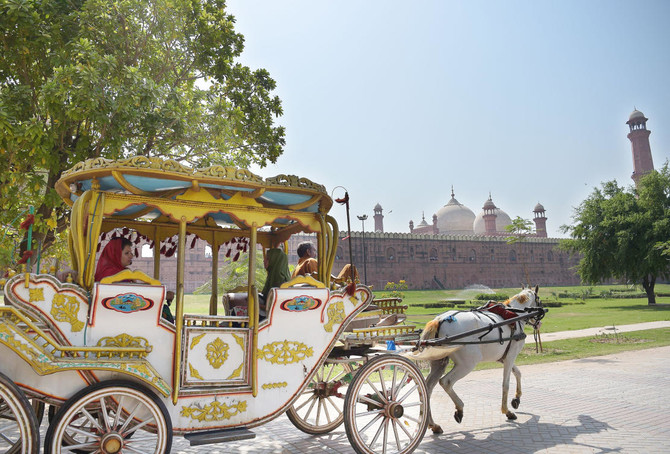
Tourists ride on a horse buggy as they look at the historic Badshahi Mosque in Lahore. (AFP)
Updated 02 March 2018
Follow

Pakistan aims to revive glory of ancient Mughal city Lahore

LAHORE: Perched on scaffolding, restoration experts chip away at decades of grime and repair broken mosaic tiles in a bid to save the colossal murals depicting historic battles and regal ceremonies on the walls of Lahore fort.
The painstaking work is part of efforts to preserve Lahore’s crumbling architectural history as officials juggle conserving its diverse heritage with building modern infrastructure in Pakistan’s chaotic second city.
The metropolis, which once served as the capital of the Mughal empire that stretched across much of the subcontinent, has been subsumed into a myriad of civilizations across the centuries.
This rich past is most visible in the milieu of architecture salted across the Walled City of Lahore — from Hindu temples and Mughal forts to Sikh gurdwaras and administrative office built during the Raj.
“You get a history of a thousand years, 500 year-old houses and monuments and mosques, shrines and a very peaceful atmosphere,” says Kamran Lashari, director general of the Walled City of Lahore Authority (WCLA).

Prime among them, and dating back to the 11th century, the Lahore fort was first built of mud and was then later reinforced with stone over the centuries by a long cast of Mughal emperors who oversaw its expansion and the accompanying artwork.
But periods of conflict along with searing heat, monsoon rains and years of neglect have taken a toll on the fort.
Despite the onset of decay, experts suggest the city’s vast Islamic architectural heritage could make it a contender to rival more established Silk Road travel destinations.
“Lahore can easily compete with Samarkand. It nearly matches Ispahan,” says Sophie Makariou, president of the Parisian-based National Museum of Asian Arts.
Makariou adds that its failure to shine is more to do with safety concerns that have plagued the nation after multiple attacks.
“Due to the bad reputation of Pakistan, it remains unknown,” she explains.
But as security across Pakistan continues to improve, officials are hoping to revive Lahore’s lost glory.
More than 40 conservationists with the the WCLA — including engineers, architects and ceramists from across the globe — are currently working on restoring the mosaic mural on the fort’s exterior.
“It’s one of the largest murals in the world. It contains over 600 tile mosaic panels and frescos,” says Emaan Sheikh from the Agha Khan Trust for Culture.
Restoration of the mural is just part of a larger project to refurbish the fort, which includes conservation projects in the royal kitchen, the summer palace and a basement, according to WCLA’s director general Kamran Lashari.
Similar work by the WCLA has already been done to revamp the artwork at the historic Wazir Khan mosque and the Shahi Hammam — one of the only surviving Turkish Baths in the subcontinent that is approximately 400 years old.
The city’s famed Delhi Gate, which once hosted extravagant Mughal processions arriving in Lahore from the east, has also been fully restored along with dozens of homes in the Walled City.
Many of those involved in the project are optimistic.
“The cities which are most famous for tourism, you can take London, Madrid, Istanbul, Rome, all the prerequisites which are available in those cities, are available in Lahore,” claims Ahmer Malik, head of Punjab’s tourism corporation, referring to Lahore’s architectural and cultural attractions.
Kamil Khan Mumtaz, President of Lahore Conservation Society (LCS), an advocacy organization promoting preservation projects, says the efforts run the risk of transforming the old city into a “Disneyland” to attract tourists.
“This was a pedestrian’s city. A pre-Industrial revolution modelled city. This should be conserved into that original state instead of remodelling buildings,” said Mumtaz, who is pushing for the use of traditional construction materials in restoration projects.
The calls runs into fresh conflict with infrastructure plans aimed at easing the city’s traffic congestion as Lahore adds high-rise buildings, malls, flyovers and amusement parks to its cityscape.
Lahore was the first Pakistani city to unveil a metro bus service, and is now constructing an inaugural metro train that Mumtaz and fellow civil society groups say will diminish the architectural history.
The city also faces fresh challenges as it it opens up to tourism.
Canadian visitor Usama Bilal complains: “There are gorgeous old colonial buildings, British era buildings but they are not well taken care of. There is no infrastructure built for tourists.”


Bangladesh sets February date for first vote since 2024 mass uprising

Updated 59 min 23 sec ago
Follow

Bangladesh sets February date for first vote since 2024 mass uprising

  • At least 1,400 protesters were killed in violent crackdown under ex-PM Hasina’s rule
  • Interim government promises ‘all necessary support’ for upcoming elections

DHAKA: Bangladesh will hold national elections on Feb. 12, its chief election commissioner has announced, setting the timeline for the nation’s first vote since a student-led uprising that ousted long-serving Prime Minister Sheikh Hasina.

Hasina, whose Awami League party-led government was marred by allegations of human rights violations, rigged elections and corruption, was removed from office in August last year after 15 uninterrupted years in power.

Bangladesh has since been led by interim leader Muhammad Yunus, a Nobel Prize-winning economist, who took over governance after Hasina fled to India, where she is now in self-exile.

In a televised address on Thursday, chief election commissioner A.M.M. Nasir Uddin confirmed the voting date to elect 300 lawmakers and said a national referendum on political reforms would also be held on the same day.

“It’s a relief for the voters; it’s a relief for the country. It’s a relief for the investors, it’s a relief for the development partners and for the political parties and the people who did a massive job in July 2024 by sacrificing their lives and limbs to oust a tyranny,” said Prof. A.S.M. Amanullah, political analyst and vice chancellor of the National University in Dhaka.

Mass protests that broke out in 2024 began in early July as peaceful demonstrations, triggered by the reinstatement of a quota system for the allocation of civil service positions.

Two weeks later, they were met with a communications blackout and a violent crackdown by security forces.

A special tribunal in Dhaka found Hasina guilty of allowing lethal force to be used against the protesters, at least 1,400 people of whom died, according to estimates from the UN’s human rights office.

After a months-long trial, she was sentenced to death in November for crimes against humanity.

The February elections will take place in the aftermath of Hasina’s reign, with the Yunus-led administration banning all activities of Awami League, meaning the former ruling party would not be able to join the race next year.

Minor political tensions now revolve around the more than 40 million voters of the Awami League, as the public speculate “how they would move, in which party they would support or whether they would remain silent,” Amanullah said.

“(But) if you consider other than Awami League, if we consider the other political parties, I think the other political parties are sufficient, you know, to make the next poll participatory, and free and fair.”

Bangladesh last held elections in January 2024, which saw Hasina return to office for a fourth consecutive term. That vote was boycotted by the country’s main opposition parties, which accused her administration of rigging the polls.

“There is a growing demand within the society and in the community that they would cast their first vote after almost 15, 16 years. And that would be an (occasion) of big national celebration,” Amanullah said.

In February, more than 127.6 million Bangladeshis will be eligible to cast their vote. It will be Bangladesh’s 13th election since the country gained independence in 1971.

The long-awaited election process now begins with the filing of nominations from Dec. 12 to 29, which will then be reviewed over the following six days. The last date for withdrawing nominations is Jan. 20.

After the voting date was announced, Yunus pledged to “provide all necessary support” to encourage festivity, participation and fairness in the upcoming polls.

“After the historic mass uprising (last year), the country is now moving toward a new path,” he said in a statement. “This election and referendum will consolidate that trajectory, prioritize the will of the people and further strengthen the foundation of a new Bangladesh.”

For Malaika Nur, a 24-year-old Dhaka University student who took part in the 2024 protests, the elections are an opportunity for young people to formally take part in politics.

“Young people have been showing much interest in politics since July 2024. They showed us how the youth can reshape a country’s political condition. If they have a few seats in the parliament, it can be a game-changer for the future of politics in Bangladesh,” she said.

“I hope this election will be different from the last three elections held in the previous regime. There will be a festive mood, people will cast their valuable votes and will get to choose their representative … I hope the elected government will ensure safety and basic rights of every citizen, and will hold fair elections in the future and will not become another fascist.”