Egypt angered by BBC report on 'enforced disappearances'

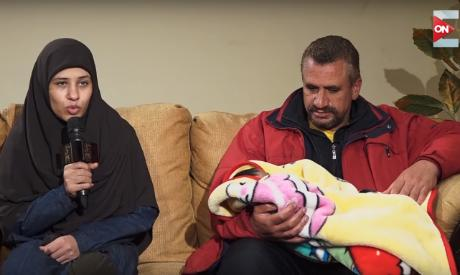
Zubeida Ibrahim Younis and husband Sayed Abdel Azim speak with TV host Amr Adib to refute BBC claims over the young woman being tortured or abducted. (Screenshot)
Updated 27 February 2018
Follow

Egypt angered by BBC report on 'enforced disappearances'

CAIRO: Egypt’s official State Information Service responded on Tuesday to a recent BBC report on the country’s human rights conditions and alleged torture, calling the report “lies and allegations.”
It has summoned the head of the BBC’s office in Egypt to receive an official letter of response on the report.
It blasted the report as “replete with contradictions as it clearly shows the author’s bias to portray an offensive image of the conditions in Egypt,” according to reports in Al-Masry Al-Youm.
The BBC published a 5,000-word article and video report on Friday called the “The Shadow over Egypt” on the topic of 'enforced disappearances'. It included interviews with families of alleged victims of torture and abductions by security officials.
A young Egyptian woman -- Zubeida Ibrahim Younis -- was mentioned in the BBC report, which suggested she had been "forcibly disappeared." But she later made a TV appearance on Monday refuting the claims.
Younis appeared on a popular local talk show explaining that she had been detained during a protest and later released, but was never tortured or abducted.
The BBC report showed photos and a video of her mother saying that Younis had been abducted.
However, Younis refuted her mother’s testimony in the BBC report, saying that she does not speak with her "due to [personal] circumstances".
"I got married, and I'm staying with my husband in Giza's Faisal, I don't speak with her," she told the talk show.


Top Hamas leader rejects disarmament or ‘foreign rule’

Updated 7 sec ago
Follow

Top Hamas leader rejects disarmament or ‘foreign rule’

  • “As long as there is occupation, there is resistance. Resistance is a right of peoples under occupation” said Meshal

DOHA: A senior Hamas leader said Sunday that the Palestinian Islamist movement would not surrender its weapons nor accept foreign intervention in Gaza, pushing back against US and Israeli demands.
“Criminalizing the resistance, its weapons, and those who carried it out is something we should not accept,” Khaled Meshal said at a conference in Doha.
“As long as there is occupation, there is resistance. Resistance is a right of peoples under occupation ... something nations take pride in,” said Meshal, who previously headed the group.
Hamas, an Islamist movement, has waged an armed struggle against what it sees as Israel’s occupation of Palestinian territories. It launched a deadly cross-border raid into Israel from Gaza on October 7, 2023, which triggered the latest war.
A US-brokered ceasefire in Gaza is in its second phase, which foresees that demilitarization of the territory — including the disarmament of Hamas — along with a gradual withdrawal of Israeli forces.
Hamas has repeatedly said that disarmament is a red line, although it has indicated it could consider handing over its weapons to a future Palestinian governing authority.
Israeli officials say that Hamas still has around 20,000 fighters and about 60,000 Kalashnikovs in Gaza.
A Palestinian technocratic committee has been set up with a goal of taking over the day-to-day governance in the battered Gaza Strip, but it remains unclear whether, or how, it will address the issue of demilitarization.
The committee operates under the so-called “Board of Peace,” an initiative launched by US President Donald Trump.
Originally conceived to oversee the Gaza truce and post-war reconstruction, the board’s mandate has since expanded, prompting concerns among critics that it could evolve into a rival to the United Nations.
Trump unveiled the board at the World Economic Forum in the Swiss ski resort of Davos last month, where leaders and officials from nearly two dozen countries joined him in signing its founding charter.
Alongside the Board of Peace, Trump also created a Gaza Executive Board — an advisory panel to the Palestinian technocratic committee — comprising international figures including US envoys Steve Witkoff and Jared Kushner, as well as former British prime minister Tony Blair.
On Sunday, Meshal urged the Board of Peace to adopt what he called a “balanced approach” that would allow for Gaza’s reconstruction and the flow of aid to its roughly 2.2 million residents, while warning that Hamas would “not accept foreign rule” over Palestinian territory.
“We adhere to our national principles and reject the logic of guardianship, external intervention, or the return of a mandate in any form,” Meshal said.
“Palestinians are to govern Palestinians. Gaza belongs to the people of Gaza and to Palestine. We will not accept foreign rule,” he added.