KARACHI: Pakistan Tehreek-e-Insaf (PTI) Chairman Imran Khan will contest the elections from the commercial capital, giving hope to his party’s leadership that his campaign will increase PTI’s popularity in the most densely populated city of Pakistan, which has the maximum number of urban constituencies.
“Khan Sahib can win any seat in Karachi,” Dr. Arif Alvi, PTI’s central leader, told Arab News.
He confirmed that the PTI chief was planning to contest the election from five National Assembly constituencies, and one of them was going to be from Karachi.
The party’s top leader in the city, Firdous Shamim Naqvi, announced at a workers’ meeting in Azizabad on Monday that Khan would contest the 2018 polls from the southern port city, adding that it was most likely going to be a seat from the central district.
“The constituency that will stand out during our membership drive will win Khan’s candidature,” Naqvi told Arab News, adding that 2,000 new members had registered with PTI from the central district.
The area has traditionally been a Muttahida Qaumi Movement (MQM) stronghold. The MQM has won all national and provincial assembly seats from the district since its inception. More recently, the party won 50 out of 51 union committees in the local government elections on Dec. 5, 2013. However the situation may have changed as MQM has fragmented in recent months.
“The party is divided into several factions. Most central district residents belong to the educated class who don’t like the Pakistan People’s Party for its corrupt practices. Other than that, the establishment wouldn’t allow Pakistan Muslim League-Nawaz (PML-N) to win. In such a scenario, we can win any seat from here,” Naqvi said.
Independent analysts, however, believe that the PTI leadership may be taking an optimistic view of the situation. Talking to Arab News, Mazhar Abbas, a senior political commentator, said: “It is a highly challenging decision to field Imran Khan from central district, which has traditionally been a stronghold of the MQM and Jamaat-e-Islami.”
Abbas said that it would be better for PTI to field it chairman from NA-250, where Arif Alvi won the last election, or from district west, where the party is popular with the Pashtun community. He said that Khan could also win from district central if his party made an election arrangement with MQM’s splinter group, Pak Sarzameen Party (PSP).
However, Arif Alvi ruled out any alliance with PSP. “We are not going to form an alliance with them,” he told Arab News.
Meanwhile, a senior leader of another MQM faction, Faisal Sabzwari, said that PTI did not have a significant chance in Karachi.
“The MQM split may damage our own party, but it will not benefit Khan since the two political factions have totally different vote banks,” he said.
“In the 2013 elections,” he added, “PTI bagged nearly 0.8 million votes from Karachi, but it could not retain them.”
“Khan’s attention to Karachi is seasonal,” Sabzwari told Arab News, adding: “The residents of this city will never be generous to a party that is playing seasonal politics.”


![]()
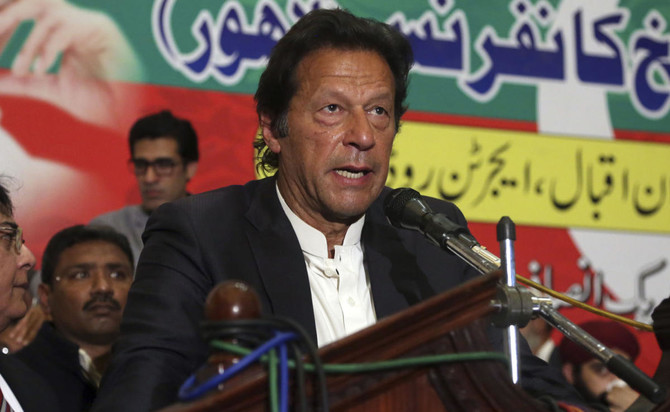
PTI party backs Imran Khan to contest elections from Karachi constituency
PTI party backs Imran Khan to contest elections from Karachi constituency
Latest updates


© 2026 SAUDI RESEARCH & PUBLISHING COMPANY, All Rights Reserved And subject to Terms of Use Agreement.