More than 4,000 Pakistani families to return from Afghanistan

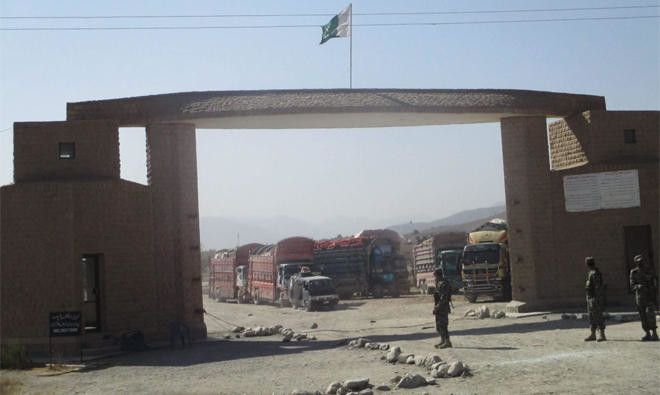
A file photo for Ghulam Khan border entry between North Waziristan Agency and Khost province in Afghanistan. Pakistan has made preparations to receive 4,329 displaced families arriving from Khost starting from today, as part of the second phase of the repatriation for Pakistani citizens, belonging to the North Waziristan who had moved to Afghanistan during operation Zarb-e-Azb. (Photo courtesy: file from the web)
Updated 26 February 2018
Follow

More than 4,000 Pakistani families to return from Afghanistan

ISLAMABAD: Pakistani citizens belonging to the North Waziristan Agency who had moved to Afghanistan during operation Zarb-e-Azb, are today moving back to their homeland, according to a statement from the office of the Political Agent of North Waziristan.
The government has made preparations to receive 4,329 displaced families from Khost, Afghanistan, starting today. While the second phase of the homecoming of Pakistani families was scheduled to begin on Feb. 6, the families were turned away at the border by Afghan authorities.
The statement added that the families were returning to Pakistan as a result of successful negotiations with Afghanistan and would enter Pakistan via the Ghulam Khan border.
All families returning would be provided with food and transportation facilities from the border town of Ghulam Khan all the way to Bannu, Khyber-Pakhtunkhwa (KP), the political agent claimed.
The statement further confirmed that, as previously practiced, the displaced families would stay at the government’s relief camp at Bakkakhel, Bannu, for debriefing before being allowed to return to their homes.
According to official estimates, 12,000 Pakistani families had migrated from North Waziristan to Afghanistan.
The political administration, however, has yet to receive the pre-registration forms of the remaining Pakistani families living in Afghanistan. “Once these forms are received, the families will be brought home on the conclusion of the second phase of repatriation when the third phase is launched,” adds the statement.
The remaining Pakistani families staying in Afghanistan will be brought back in the third phase of the repatriation.


Pakistani charity ramps up Gaza aid during Ramadan, delivering 10,000 iftar meals daily

Updated 7 sec ago
Follow

Pakistani charity ramps up Gaza aid during Ramadan, delivering 10,000 iftar meals daily

  • Al-Khidmat has sent 40 aid shipments to Gaza since Oct. 2023 war began
  • Foundation commits $30 million, plans hospital and school projects

ISLAMABAD: Pakistan’s Al-Khidmat Foundation (AKF) has expanded delivery of daily meals, water supplies and emergency relief to families in Gaza during the holy month of Ramadan, a senior official said this week, as Palestinians observe the fasting month under severe humanitarian strain following more than two years of war.

The two-year conflict, which began in October 2023, has killed more than 72,000 Palestinians and injured over 171,000 others, according to Palestinian health authorities. Vast areas of Gaza have been destroyed, leaving residents dependent on humanitarian assistance despite an October 2025 ceasefire between Israel and Hamas.

Since the war began, AKF has dispatched 40 aid shipments to Gaza, funded by public donations in Pakistan and delivered under the patronage of the government and the National Disaster Management Authority (NDMA).

“Daily, we are giving 20,000 liters of water to the people who have to break their fast,” AKF President Arshad Malik told Arab News in an interview on Monday. “Second, every day there are families who are getting 10,000 meals for iftar in Gaza.”

Malik said the organization has prioritized food staples tailored to local needs during Ramadan.

“In Ramadan, what we have prioritized is… food like it is oil, it’s hummus, it’s dates, it’s flour,” he said. “It is from people of Pakistan for the people of Gaza.”

Al-Khidmat, one of Pakistan’s largest humanitarian charities, is registered in several countries including the UK, US and Norway, and maintains offices in Japan, Italy and Turkiye. Since October 2023, it has delivered aid through chartered aircraft and sea shipments, coordinating cross-border logistics via Jordan and relying on local teams inside Gaza.

“First of all, we have employed our own people like boots on the ground. So there are people who are there, whom we are paying,” Malik said, explaining that designated camps are used to distribute daily iftar meals.

Each shipment is tracked through an identification number, he added.

“They track [shipments] and they follow that which camp has received those items and which camp has not been able to receive it so far,” Malik said.

Malik acknowledged that delivering aid into Gaza has involved complex logistical and security challenges.

“It was a challenge for us, it was a challenge for Government of Pakistan,” he said, noting that consignments required coordination with regional humanitarian organizations and clearance procedures before entering Gaza. “The logistics charges or the trawler charges were huge.”

However, he said processes have gradually streamlined, enabling faster distribution during Ramadan. Public donations in Pakistan have also increased during the fasting month, allowing the organization to expand its relief efforts.

“Since Oct. 2023, we committed $30 million and till date, we have been able to spend $23 million,” Malik said.

The foundation says it aims to spend Rs6 billion ($21.5 million) on Gaza relief during Ramadan alone.

Beyond emergency assistance, AKF is supporting Palestinian students studying in Pakistan and planning longer-term rehabilitation initiatives.

“One hospital close to Gaza border would be built, operated by Al-Khidmat Foundation Pakistan,” Malik said, adding that proposals also include building a hospital and a school inside Gaza.

Pakistan does not have diplomatic relations with Israel and maintains a policy of non-recognition, rooted in its support for an independent Palestinian state with Al-Quds Al-Sharif as its capital.