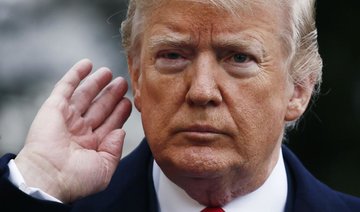
WASHINGTON: The White House said Sunday it would wait and see whether a new overture by North Korea for talks with the United States means it is serious about disarming, a step President Donald Trump and other world leaders agree must be the outcome of any future dialogue.
“We will see,” was the response from White House press secretary Sarah Huckabee Sanders, who was on the Korean peninsula Sunday as a member of the US delegation attending the Olympic games in South Korea. The delegation was led by Ivanka Trump, the president’s daughter.
Sanders said President Trump remains committed to achieving the “complete, verifiable and irreversible denuclearization” of the peninsula and that his “maximum pressure campaign” against North Korea must continue until it abandons its nuclear and missile programs.
Trump imposed fresh sanctions against North Korea late last week as part of the pressure effort.
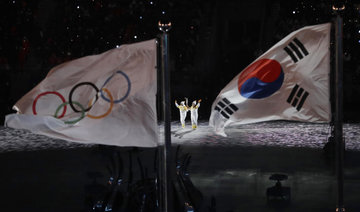
During Sunday’s closing ceremony for the games, the office of South Korean President Moon Jae-in announced that a North Korean delegate to the Olympics said his country is willing to hold talks with the US The move comes after decades of tensions between the two countries, which have no formal diplomatic relations, and a year of escalating rhetoric, including threats of war, between Trump and North Korean leader Kim Jong Un.
The North has “ample intentions of holding talks with the United States,” Moon’s office said. The North’s delegation also agreed that “South-North relations and US-North Korean relations should be improved together,” the statement said.
Sanders said the US, South Korea and the international community “broadly agree” that denuclearization must be the outcome of any dialogue with North Korea. She said North Korea has a bright path ahead of it if it chooses denuclearization.
“We will see if Pyongyang’s message today, that it is willing to hold talks, represents the first steps along the path to denuclearization,” she said in a written statement. “In the meantime, the United States and the world must continue to make clear that North Korea’s nuclear and missile programs are a dead end.”
Trump once scolded Secretary of State Rex Tillerson, who favors diplomacy with North Korea over military confrontation, for “wasting his time trying to negotiate with Little Rocket Man,” which is Trump’s derisive nickname for North Korea’s leader.
At the Olympics opening ceremony earlier this month, the North Korean leader’s sister, Kim Yo Jong, shared a VIP box with Moon and Vice President Mike Pence, who led a separate US delegation, creating some awkward moments. Though Pence stood to cheer the entrance of the US team, he remained seated when athletes from North and South Korea marched together behind a “unification” flag, leaving Moon to instinctively turn around and shake Kim’s sister’s hand.
Pence and Kim Yo Jong did not speak. Pence’s office claimed afterward that the North pulled out of a planned meeting at the last minute.
During her visit, Ivanka Trump sat in the same box with Kim Yong Choi, vice chairman of North Korea’s ruling Worker’s Party Central Committee. They did not appear to interact when Jae-in shook hands with dignitaries at the beginning of Sunday’s closing ceremony.
Trump stepped up the pressure campaign against North Korea on Friday by slapping sanctions on scores of companies and ships accused of illicit trading with the pariah nation. Treasury Secretary Steven Mnuchin said the US has now blacklisted virtually all ships being used by the North.
Trump has vowed to use force if necessary to prevent North Korea from acquiring a nuclear-tipped missile that could strike the US mainland. At a White House news conference on Friday, he warned that the US would move to “phase two” in its pressure campaign if sanctions don’t work. Trump said such a step could be “very rough” and “very unfortunate for the world.” He did not elaborate.
“If we can make a deal it will be a great thing. If we can’t, something will have to happen,” Trump said.


![]()

White House will see if North Korea is serious about talks
White House will see if North Korea is serious about talks

Latest updates


Recommended


© 2026 SAUDI RESEARCH & PUBLISHING COMPANY, All Rights Reserved And subject to Terms of Use Agreement.