BANGALORE: As much as we have been conditioned to celebrate victory, the average sports fan remembers far more than who lifted the trophy. There may be many, especially Italians, who remember what happened in the 1982 World Cup final, but for the vast majority around the globe, memories of that Spanish summer invariably revolve around a Brazilian team of matchless beauty and skill.
And as much as we might cherish Zinedine Zidane’s headed goals in the 1998 final, who can forget Sunday Olizeh’s rocket from outside the box as Nigeria upset Spain in the opening round? No one but the biggest golf tragic will remember that Paul Lawrie won the 1999 British Open at Carnoustie. But the image of poor Jean van der Velde, water up to his shins in the Barry Burn, is just indelible.
New Zealand’s All Blacks won the 2015 World Cup, as most expected them to, but the game of the tournament featured Japan’s high-risk-high-skill approach that ultimately proved too much for the once-mighty Springboks.
Cricket is no different. The first World Cup I covered, in the Caribbean in 2007, was won by Australia, the dominant team of the decade. But as eventful as the final was, floodlight failures and all, it wasn’t a patch on the drama we witnessed at Sabina Park in the tournament’s opening week, when the new boys from Ireland first tied with Zimbabwe and then upset Pakistan, winners in 1992.
The Irish were at it again four years later, embarrassing England in Bangalore as Kevin O’Brien scored one of the all-time great hundreds. And if you want to go back much further, it could be persuasively argued that cricket’s place at the top of India’s sporting totem pole is largely the result of the magnificent running catch that Kapil Dev took to dismiss a rampant Vivian Richards in the 1983 final.
But as the decades have passed and the sport has become richer, cricket has also become more and more insular and selfish. Instead of building on the gains made by the likes of Ireland and Afghanistan in recent years, the International Cricket Council (ICC) opted to shrink the World Cup. It’s still interminably long, but instead of 14 teams – already far less than football and rugby – the 2019 edition will feature just ten.
What’s more, the top seven in the rankings as of Sept. 30, 2017, and England, the hosts, didn’t even need to qualify. When you consider how mediocre some of those teams have been in recent seasons, the emerging sides’ sense of injustice only becomes more acute.
Ireland, who have beaten at least one higher ranked team in each of their three World Cup appearances, and Afghanistan, whose attack-minded cricket and drum-beating fans added so much to the 2015 spectacle, are among those left to scrap for two remaining places at the top table.
Given what’s at stake, it’s probably no exaggeration to say that the World Cup Qualifier, to be hosted by Zimbabwe between March 4 and 25, will be the most important tournament that many of these players take part in. The Netherlands, and the top three Associate nations, will get ODI status till 2022. For the rest, the price of failure will be especially catastrophic.
Zimbabwe, who reached the Super Sixes in both 1999 and 2003, are trying to claw their way back, but were recently well beaten by Afghanistan, whose spin resources will make every other side wary. West Indies, champions twice (1975 and ‘79) in the halcyon years, continue to undermine their chances by ostracizing some of their most talented white-ball cricketers, while Ireland have slipped a bit as a generation of players has grown old together.
The Netherlands’ Peter Borren and Scotland’s Preston Mommsen were two of the most articulate critics of the reduction in teams when it was announced, and both sides face a tough task to match those sides that have deeper player pools to choose from. Hong Kong are in the same boat, having lost Mark Chapman, their gun batsman, to New Zealand.
Papua New Guinea and Nepal are the Cinderella sides, especially the Nepalese who enjoy frenzied support in the Himalayan kingdom. As for the UAE, with most of the squad having roots in the subcontinent, they can call on some of the best facilities outside the established nations.
The level of competition will be as high as it has ever been, with failure potentially derailing some national programs and playing careers. Instead of learning from rugby, which will host its World Cup in Japan next year and which has grown the sport using the sevens format, cricket has pushed those that aspire to the biggest stage into the Barry Burn. Over the next month, we’ll see which two teams manage to wade out of it.


![]()
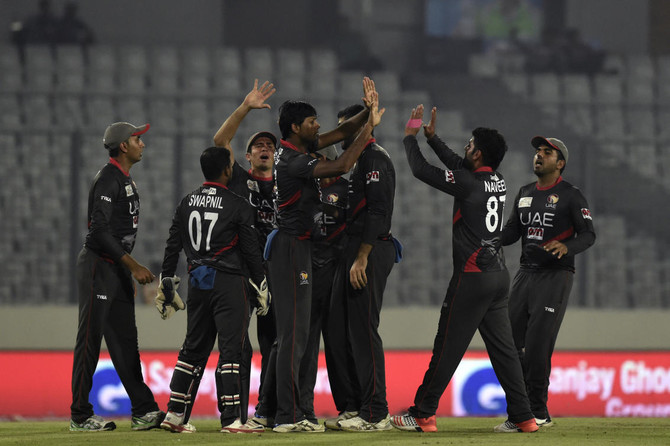
It is a case of survival of the fittest for those playing in the ICC World Cup Qualifier
It is a case of survival of the fittest for those playing in the ICC World Cup Qualifier

Latest updates


© 2026 SAUDI RESEARCH & PUBLISHING COMPANY, All Rights Reserved And subject to Terms of Use Agreement.