KARACHI: Pakistan’s commercial capital, Karachi, has thousands of industrial units, skyscrapers and corporate offices. It is also home to an ever-expanding nuclear power park that is not too far from the three main geological fault lines that run through the city.
Yet the bustling metropolis that makes significant contributions to the country’s economy remains vulnerable since its fire department has a shockingly limited capacity to serve its residents.
Karachi has 22 fire stations, 24 serviceable fire tenders and a little more than 1,100 firefighters. This is despite the fact that it has witnessed several fire incidents in the past that claimed hundreds of lives and gobbled up billions of rupees.
Fahim Zaman, former administrator of Karachi Metropolitan Corporation, told Arab News he had signed a procurement contract of 50 fire tenders in 1995. “Back then, we had 17 fire tenders,” he recalled, “but the city’s population was 9.3 million.”
According to the provisional results of the 2017 census, Karachi’s population is about 15 million. Going by the official statistics, the fire department of the most populous city in Pakistan remains deeply under-resourced.
“The fire department’s job is not just to put out flames,” Zaman said. “Evacuation in a state of emergency and rescue during earthquakes and other natural calamities is also part of its responsibility.”
Amanullah Afridi, chairman of Karachi City Council’s committee on fire and civil defense, discussed various instances of organizational irregularities and mismanagement with Arab News. “Much like the rest of the KMC,” he said, “the inductions in the fire department have been frequently carried out on a political basis.”
He also mentioned that absenteeism and ghost employees posed a great management challenge to the administration.
“Political supervision for public service delivery is the right thing,” said Zaman, “but we have seen in Karachi that such involvement can also result in extortion and corruption. Political appointees believe it is their right to draw salaries without performing their duties.”
However, the firefighters have a different story to tell.
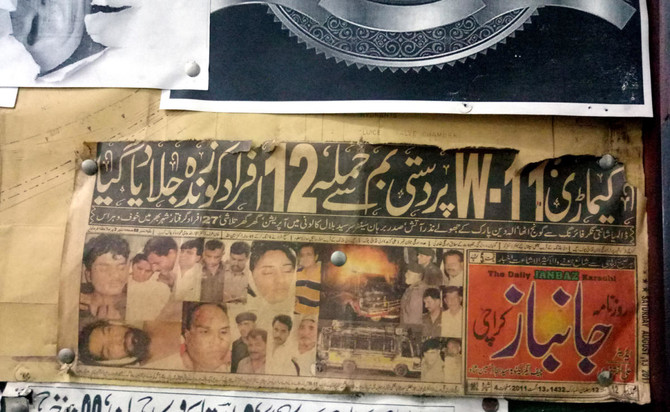
According to one of them, the fire station located in the city’s largest SITE Industrial Zone is required to cover several adjoining vicinities. The firefighters in this area fought one of the most notorious blazes in the city in September 2012 in which 258 people were burned alive. They are required to cover a dizzyingly wide area with the help of three fire tenders, one water bowser, one snorkel and a light tower.
“There have been no fresh recruitments here since 2009,” said Muhammad Arshad, a firefighter in the Saddar area. “We have not got any uniforms, gas masks, helmets and gumboots in the last five years. We have not received an operations allowance in the last five months.”
He added: “We have only one fire tender, though we should have at least three. The one that we have was procured in 1997 and has gone for repair several times. Every day we respond to two or three calls that require us to put out small fires. The media like to report on our poor performance, but no one pays attention to the conditions in which we are working.”
Firefighting is not an easy occupation. With no uniform and safety equipment, firefighters risk their own lives to save others. In January 2007, eight firemen were burned alive in a smoldering cotton factory.
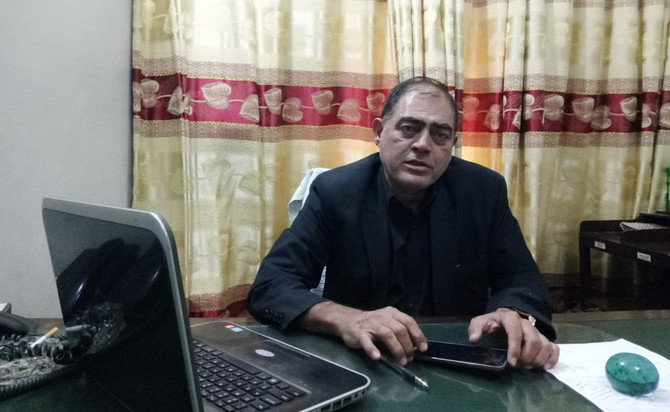
KMC’s Chief Fire Officer, Tehseen Ahmed, told Arab News that Pakistan lacked a fire prevention culture: “Only at 1 percent of places will you see minor arrangements.”
He added that Karachi had seen massive horizontal growth in the past and was now developing vertically. “This implies that we need modern equipment and better infrastructure,” he said. “Sadly, we don’t even have a comprehensive legal framework to prevent or deal with fire incidents.”
While KMC officials claim they regularly arrange training programs for firefighters, records show that the last session was held in 2006, only a year after a devastating earthquake shook the northern parts of the country.
“Firefighters in Pakistan are not just doing their job, they are performing miracles,” said Karachi Port Trust’s Chief Fire Officer, Akhter Saeed Jadoon. “Everyone knows that 258 people were killed in the Baldia factory fire, but how many are aware that 550 people were also rescued from the same inferno?”
He said it was recently announced that the city would get 55 fire tenders as part of the Prime Minister’s Karachi Package.
“We lost nearly 500 lives and hundreds of billions of rupees in the Baldia, Bolton and Gaddani fires,” Jadoon added. “But we are not ready to invest a few billion to modernize our firefighting system.”


![]()
![]()
![]()
![]()

Playing with fire: How Pakistan’s biggest city is making itself vulnerable

Playing with fire: How Pakistan’s biggest city is making itself vulnerable
Latest updates


© 2026 SAUDI RESEARCH & PUBLISHING COMPANY, All Rights Reserved And subject to Terms of Use Agreement.