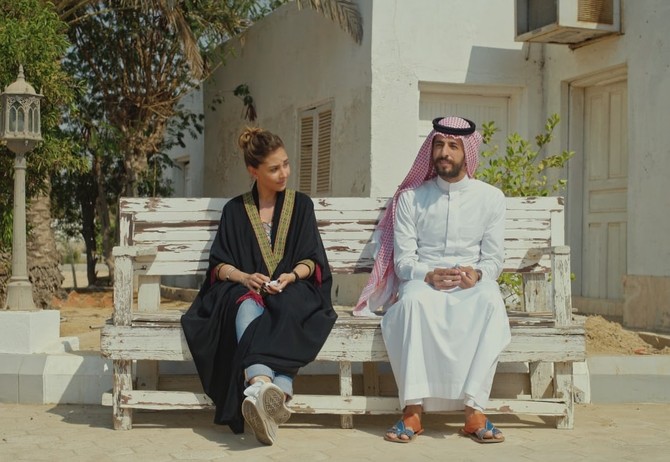
LONDON: Saudi film stars Hisham Fageeh and Fatima Al-Banawi said the arrival of cinema in the Kingdom will help open up society and “share our narrative’’ with the world.
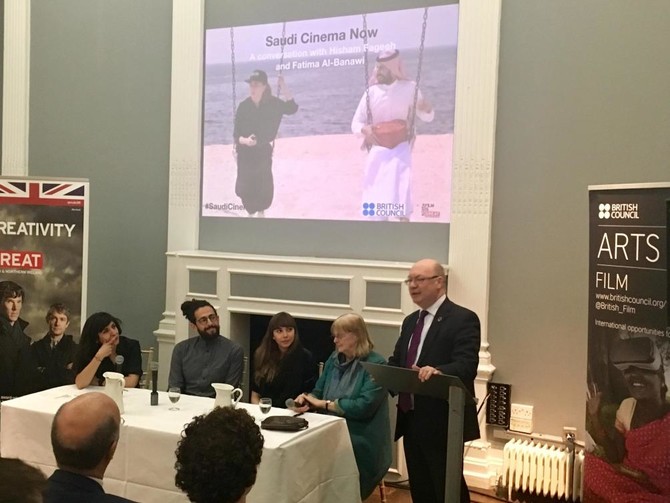
The pair — who are well-known for their roles in successful Saudi comedy “Barakah Meets Barakah,” an Oscar submission for 2016’s Best Foreign Language Film — were speaking during a gathering at the Institute of Contemporary Arts in London, hosted by the Saudi British Society.
Set in Jeddah, the production was the first award-winning romantic comedy to come out of the Kingdom and became Saudi Arabia’s first film on Netflix.
Al-Banawi, who recently co-starred in the OSN series “Bashar,” emphasized the scope of cinema to “break stereotypes’’ by telling the stories of real people.
“We’re such a private society,” she said. “It’s important to share our narratives.’’
Fageeh, an actor and producer-director who made a name as a stand-up comedian on YouTube, said people in Saudi Arabia were hungry to tell their own stories.
He said many are interested in “taking back our narrative’’ and not having Western institutions dictate the direction of Saudi Arabia’s evolving film landscape, which he described as a “gorilla industry” at this stage.
“In Saudi Arabia, if you want somebody who’s a lighting guy, you get an electrician. You want an actor, you go ask somebody who’s got liberal parents,” he said.
“The more sophisticated our art will be, the more sophisticated the viewer can become.”
Opening the discussion, Alistair Burt, the UK minister for international development and the Middle East, described Saudi Arabia’s recent move to lift the ban on cinemas as “another exciting development in the Kingdom.’’
Praising the success of “Barakah Meets Barakah,” and confessing a preference for romantic comedies including “Sleepless in Seattle” and “You’ve Got Mail,” the minister said that such films “tell us something very special about a society.’’
“Changing perceptions of the Islamic world is important,” he added. “Anything that helps build our relationships is very welcome.”

‘Barakah Meets Barakah’ stars say cinema move will help bring Saudi stories to world
Living Pyramid to bloom beyond Desert X AlUla
ALULA: Desert X AlUla officially closed on Feb. 28, but one of its most striking installations — the Living Pyramid —will continue to flourish.
Tucked away within a lush oasis surrounded by ancient rock formations, Agnes Denes’ creation fuses art and nature, offering a living testament to resilience and connection.
Through her current rendition of The Living Pyramid for Desert X AlUla 2026, Denes seeks connection, likening it to bees constructing a new hive after disaster.
The pyramid structure is teeming with indigenous plants, forming layered patterns that echo the surrounding desert landscape.
It blends harmoniously with the rocky backdrop while proudly standing apart.
“There is no specific order for the plants other than not to place larger plants on the very top of the pyramid and increase the number of smaller plants up there,” Iwona Blazwick, lead curator at Wadi AlFann in AlUla, told Arab News.
Native plants cascading down the pyramid include Aerva javanica, Leptadenia pyrotechnica, Lycium shawii, Moringa peregrina, Panicum turgidum, Pennisetum divisum, Periploca aphylla and Retama raetam.
Aromatic and flowering species such as Thymbra nabateorum, Rhanterium epapposum, wild mint, wild thyme, Portulaca oleracea, tamarisk shrubs, Achillea fragrantissima, Lavandula pubescens, Salvia rosmarinus, and Ruta graveolens form distinct layers, adding color, texture and subtle fragrance to the pyramid.
“Each Living Pyramid is different. The environment is different, the people are different. I’m very interested in the different societies that come together on something so simple,” Denes said in a statement.
“Connection is what’s important; connection is what the world needs. I keep comparing us to a lost beehive or an anthill. And I wrote a little poem: This. And this is. Bee cries out. Abandon the hive. Abandon the hive,” she said.
Denes was born in Budapest, Hungary, in 1931 and is now based in New York. While the 95-year-old has not made it physically to the site in Saudi Arabia, she designed this structure to cater to the native plants of the area.
Her Living Pyramid series has certainly taken on reincarnations over the past decade.
It debuted at Socrates Sculpture Park in New York in 2015, was recreated in Germany in 2017, appeared in Türkiye in 2022, and then London in 2023.
In 2025, she showcased a version at Desert X 2025 in Palm Springs, California, and Luxembourg City.
Most recently, in 2026, at Desert X AlUla.
While officially part of Desert X AlUla, the Living Pyramid stands apart and is housed separately, a short drive away from the other art works.
“The (Living Pyramid) artwork will stay for around a year, to showcase a full year’s effect on the plants throughout the different seasons,” Blazwick said.
After the year is up, it won’t go down. The plants will continue its metamorphosis beyond the pyramid.
“The plants will be replanted and will have a new home within an environment that will suit their needs,” Blazwick concluded.