Philippine labor ban to Kuwait stays, may be expanded, says Duterte

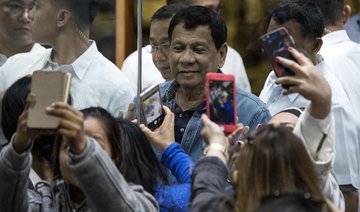
Overseas Filipino Workers (OFWs) from Kuwait gather upon arrival at the Ninoy Aquino International Airport in Pasay city on Wednesday following President Rodrigo Duterte's call to evacuate workers after a Filipina was found dead stuffed inside a freezer. (Reuters)
Updated 23 February 2018
Follow

Philippine labor ban to Kuwait stays, may be expanded, says Duterte

MANILA: The Philippine president said Thursday that a ban on the deployment of workers to Kuwait, where a Filipino was found dead in a freezer, will continue and could be expanded to other countries where Filipino workers suffer “human degradation.”
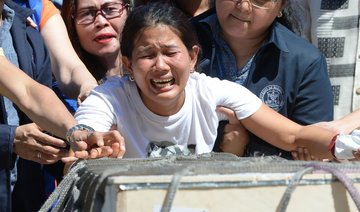
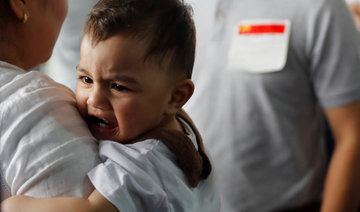
President Rodrigo Duterte made the remarks after attending the wake of Joanna Demafelis in the central Philippine town of Sara. He said he intends to file criminal charges against her employers, who are being hunted by Kuwaiti authorities.
Demafelis’s body was found stuffed in a food freezer on Feb. 6 in a Kuwait City apartment where it had reportedly been kept for more than a year. Duterte has said her body bore torture marks and there were indications she was strangled.
“The ban stays, no deployment of Filipinos whatsoever in Kuwait,” Duterte said outside the wake, where steamers and shirts worn by mourners bore messages demanding justice for the maid’s death. The ban applies only to new Kuwait-bound workers and the thousands already there, mostly maids, can continue working.
Duterte said the government is conducting an assessment to “find out the places where we deploy Filipinos and our countrymen suffer brutal treatment and human degradation.”
Her death is the latest overseas tragedy to befall workers from the Philippines, a major labor exporter with about a tenth of its more than 100 million people working abroad. The workers have been called the country’s heroes because the income they send home has propped up the Southeast Asian nation’s economy for decades, accounting for about 10 percent of its annual gross domestic product.
Duterte talked with the family of Demafelis and then briefly viewed her remains, gently touching her coffin with his hand.
Philippine officials are under increasing pressure to do more to monitor the safety of the country’s worldwide diaspora of mostly maids, construction workers and laborers.
Labor Secretary Silvestre Bello III told a Senate hearing Wednesday that he has recalled three Filipino labor officers from Kuwait to face an investigation. They failed to act on a request by Demafelis’s family for help after she went missing in January last year, he said.
Administrator Hans Leo Cacdac of the Overseas Workers Welfare Administration reported that at least 196 Filipinos had died in Kuwait in the last two years, mostly for unspecified medical reasons but also four who committed suicide. That prompted senators to ask why labor officials did not immediately order a ban on the deployment of workers to Kuwait with the spike in deaths.
A Philippine labor delegation left for Kuwait on Thursday to seek better protection for Filipino workers that may prompt the Duterte administration to lift its ban, officials said.
They will demand a stop to the practice of many Kuwaiti employers to hold on to the passports, travel papers and cellphones of Filipino maids, which has prevented them from reporting abuses and calling for help, the officials said.
Kuwait’s ruling emir has reportedly invited Duterte to his country next month to resolve the labor issues but Duterte has not said whether he will visit.
The sheer number of Filipino workers abroad makes monitoring their wellbeing an overwhelming task. That is often complicated by workers not having proper travel and work documents, such as in Kuwait, where nearly 11,000 of the more than 252,000 Filipino workers are in the country illegally or are not properly authorized.
Many desperate Filipinos have also chosen to stay in countries where the Philippines has banned Filipinos in the past, such as in war-torn Iraq and Syria.


US signs new health deals with 9 African countries that mirror Trump’s priorities

A pharmacist counts HIV medicine inside a clinic in Ha Lejone, Lesotho, July 16, 2025. (AP)
Updated 4 sec ago
Follow

US signs new health deals with 9 African countries that mirror Trump’s priorities

  • US aid cuts have crippled health systems across the developing world, including in Africa, where many countries relied on the funding for crucial programs, including those responding to outbreaks of disease
  • The agreements signed so far, with Kenya, Nigeria and Rwanda among others, are the first under the new global health framework, which makes aid dependent on negotiations between the recipient country and the US

JOHANNESBURG: The US government has signed health deals with at least nine African countries, part of its new approach to global health funding, with agreements that reflect the Trump administration’s interests and priorities and are geared toward providing less aid and more mutual benefits.
The agreements signed so far, with Kenya, Nigeria and Rwanda among others, are the first under the new global health framework, which makes aid dependent on negotiations between the recipient country and the US.
Some of the countries that have signed deals either have been hit by US aid cuts or have separate agreements with the Trump administration to accept and host third-country deportees, although officials have denied any linkage.
The Trump administration says the new “America First” global health funding agreements are meant to increase self-sufficiency and eliminate what it says are ideology and waste from international assistance. The deals replace a patchwork of previous health agreements under the now-dismantled United States Agency for International Development.
US aid cuts have crippled health systems across the developing world, including in Africa, where many countries relied on the funding for crucial programs, including those responding to outbreaks of disease.
The new approach to global health aligns with President Donald Trump’s pattern of dealing with other nations transactionally, using direct talks with foreign governments to promote his agenda abroad. It builds on his sharp turn from traditional US foreign assistance, which supporters say furthered American interests by stabilizing other countries and economies and building alliances.
A different strategy
The deals mark a sharp departure from how the US has provided health care funding over the years and mirrors the Trump administration’s interests.
South Africa, which has lost most of its US funding — including $400 million in annual support — due in part to its disputes with the US, has not signed a health deal, despite having one of the world’s highest HIV prevalence rates.
Nigeria, Africa’s most populous country, reached a deal but with an emphasis on Christian-based health facilities, although it has a slight majority Muslim population. Rwanda and Uganda, which each have deportation deals with the US, have announced the health pacts.
Cameroon, Eswatini, Lesotho, Liberia and Mozambique also are among those that have signed health deals with the US
According to the Center for Global Development, a Washington think tank, the deals “combine US funding reductions, ambitious co-financing expectations, and a shift toward direct government-to-government assistance.”
The deals represent a reduction in total US health spending for each country, the center said, with annual US financial support down 49 percent compared with 2024.
A faith-based deal in Nigeria, a lifeline for several others

Under its deal, Nigeria, a major beneficiary of USAID funds, would get support that has a “strong emphasis” on Christian faith-based health care providers.
The US provided approximately $2.3 billion in health assistance to Nigeria between 2021 and 2025, mostly through USAID, official data shows. The new five-year agreement will see US support at over $2 billion, while Nigeria is expected to raise $2.9 billion to boost its health care programs.
The agreement “was negotiated in connection with reforms the Nigerian government has made to prioritize protecting Christian populations from violence and includes significant dedicated funding to support Christian health care facilities,” the State Department said in a statement.
The department said “the president and secretary of state retain the right to pause or terminate any programs which do not align with the national interest,” urging Nigeria to ensure “that it combats extremist religious violence against vulnerable Christian populations.”
For several other countries, the new deals could be a lifeline after US aid cuts crippled their health care systems and left them racing to fill the gaps.
Under its deal, Mozambique will get US support of over $1.8 billion for HIV and malaria programs. Lesotho, one of the poorest countries in the world, clinched a deal worth over $232 million.
In the tiny kingdom of Eswatini, the US committed to provide up to $205 million to support public health data systems, disease surveillance and outbreak response, while the country agreed to increase domestic health expenditures by $37 million.
No deal for South Africa after disputes
South Africa is noticeably absent from the list of signatories following tensions with the Trump administration.
Trump has said he will cut all financial assistance to South Africa over his widely rejected claims that it is violently persecuting its Afrikaner white minority.
The dismantling of USAID resulted in the loss of over $436 million in yearly financing for HIV treatment and prevention in South Africa, putting the program and thousands of jobs in the health care industry at risk.
Health compacts with countries that signed deportation deals
At least four of the countries that have reached deals previously agreed to receive third-country deportees from the US, a controversial immigration policy that has been a trademark of the Trump administration.
The State Department has denied any linkage between the health care compacts and agreements regarding accepting third-country asylum seekers or third-country deportees from the United States. However, officials have said that political considerations unrelated to health issues may be part of the negotiations.
Rwanda, one of the countries with a deportation deal with the US, signed a $228 million health pact requiring the US to support it with $158 million.
Uganda, another such country, signed a health deal worth nearly $2.3 billion in which the US will provide up to $1.7 billion. Also Eswatini, which has started receiving flights with deported prisoners from the US