Pakistan’s narrow escape at FATF meeting triggers debate at home

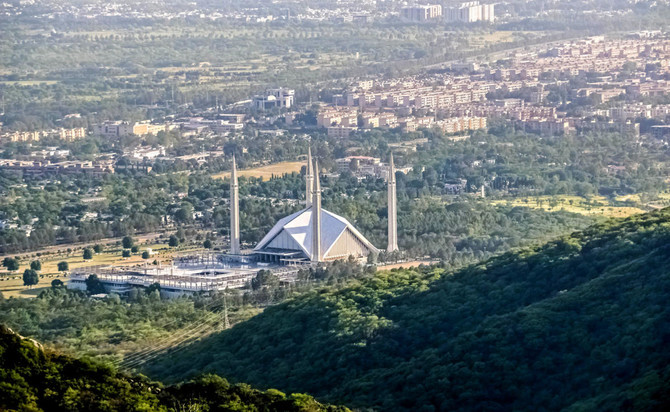
Shah Faisal Mosque seen from Margalla Hills in this undated file photo. (Shutterstock)
Updated 21 February 2018
Follow

Pakistan’s narrow escape at FATF meeting triggers debate at home

ISLAMABAD: Pakistan managed to avoid being placed on the Financial Action Task Force (FATF) global terrorism-financing watch list on Wednesday.
But the episode has triggered debate at home on how to deal with groups that have become a foreign-policy liability for the state.
Political analyst Dr. Rasul Bakhsh Rais said Islamabad has no other option but to act against banned groups and go after their sources of funding to satisfy the international community.
The government “must take cogent measures to deoxygenate proscribed outfits,” he told Arab News. “It’s also in the interest of Pakistan to crack down against extremist outfits.”
But Tahir Malik, who teaches international relations at a public university, said one should not expect the government “to take extreme measures against any outfit that enjoys public sympathy” when “the ruling party has to contest general elections within a few months.”
He termed the three-month FATF reprieve a boost for the ruling party at a time when it is confronted by various political and economic crises.
Foreign Minister Khawaja Mohammed Asif said FATF members failed to reach a consensus regarding putting Pakistan on the watch list.
The draft resolution to place Pakistan on the list was led by the US, with the support of the UK, France and Germany. Pakistan’s Interior Minister Ahsan Iqbal described the FATF motion as a US pressure tactic.
Ali Sarwar Naqvi, executive director of the Center for International Strategic Studies (CISS), told Arab News that the FATF could not act against Pakistan because “there wasn’t enough evidence” against it.
“It’s an allegation by some countries” that could not furnish supporting “evidence and facts,” so “other countries did not agree with” their contention, he said.


Pakistan high court pauses tree-cutting in Islamabad until Feb. 2

Updated 10 sec ago
Follow

Pakistan high court pauses tree-cutting in Islamabad until Feb. 2

  • Islamabad High Court asks CDA to ‘explain and justify’ tree-cutting at next hearing
  • CDA officials say 29,000 trees were cut due to allergies, deny felling in green belts

ISLAMABAD: The Islamabad High Court has ordered an immediate halt to tree-cutting in the federal capital until Feb. 2, seeking justification from civic authorities over the legality of a large-scale felling drive that has seen thousands of trees removed in recent months.

The interim order, issued by a single-judge bench led by Justice Khadim Hussain Soomro, came during proceedings on a petition challenging the Capital Development Authority’s (CDA) tree-cutting operations in Islamabad’s Shakarparian area and H-8 sector.

At the outset of the hearing, the petitioner’s counsel argued that trees were being felled in violation of the Pakistan Environmental Protection Act 1997, the Islamabad Wildlife Ordinance 1979 and the city’s master plan.

“Respondents shall not cut trees till the next date of hearing,” Justice Soomro said in the court order released on Friday while referring to CDA officials.

“Respondents are directed to come fully prepared and to file paragraph-wise comments before the next date of hearing, along with a comprehensive report explaining the justification and legal basis for the cutting of trees,” he added.

According to the court order, the petitioner maintained that the CDA had not made any public disclosure regarding the legal basis for the operation and that the felling was causing environmental harm.

The petition sought access to the official record of tree-cutting activities and called for the penalization of CDA officials responsible for the act under relevant criminal and environmental laws.

It also urged the court to impose a moratorium on infrastructure projects in Islamabad, order large-scale replanting as compensation and constitute a judicial commission headed by a retired Supreme Court judge to probe the alleged violations.

CDA officials acknowledge around 29,000 paper mulberry trees have been cut in the capital in recent months, arguing that the species triggers seasonal allergies such as sneezing, itchy eyes and nasal congestion.

They also maintain that no trees have been removed from designated green belts and that the number of replacement trees planted exceeds those felled.

Designed in the 1960s by Greek architect Constantinos Doxiadis, Islamabad was conceived as a low-density city with green belts and protected natural zones at its core.

Critics, however, say the recent felling has extended beyond paper mulberry trees and question whether authorities are adhering to the city’s master plan and the legal protections governing forested and green areas.

The court has adjourned its hearing until Feb. 2, 2026.