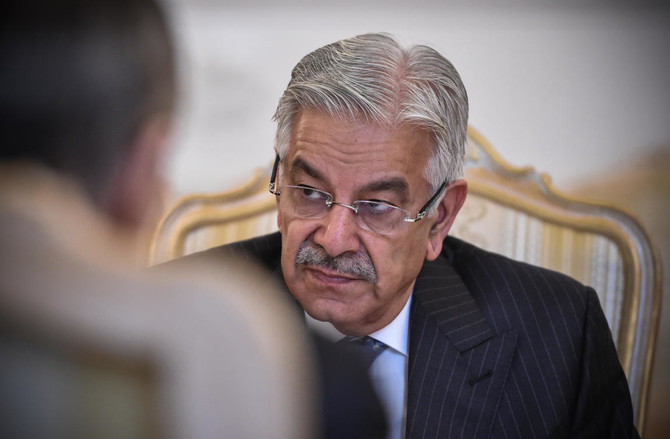
ISLAMABAD: Pakistan will not be placed on a global terrorism-financing watch list, foreign minister Khawaja Muhammad Asif revealed in a tweet.
During a meeting in Paris, money-laundering watchdog the Financial Action Task Force (FATF) failed to reach agreement on a motion co-sponsored by the United States
“Our efforts paid, no consensus for nominating Pakistan (for the grey list),” Asif posted on Twitter.
However, the decision might only be temporary. He added that the FATF proposed a three month pause, “asking APG (Asia/Pacific Group on Money Laundering) for another report to be considered in June.”
The APG is an inter-governmental organization, consisting of 41 member jurisdictions including Pakistan, focused on ensuring that its members effectively implement the international standards against money laundering, terrorist financing and proliferation financing related to weapons of mass destruction.
Asif also thanked the countries that had supported Pakistan. “Grateful to friends who helped,” he tweeted.
He is currently in Moscow at the invitation of his Russian counterpart, Sergey Lavrov, and the pair have discussed Islamabad’s concerns about the FATF motion, in an attempt to secure Russian support in opposing it.
The draft resolution to place Pakistan on the FATF list was led by the US, with the support of the UK, France and Germany. US-Pakistani relations hit a new low last year when Washington, unveiled its new strategy for Afghanistan, and accused Islamabad of harboring and supporting terrorists.
The day before Asif’s tweet, interior minister Ahsan Iqbal, speaking in Pakistan’s National Assembly, described the FATF motion as “a tactic by the United States to pressure Pakistan.”
He added: “If Pakistan is placed on the watch-list, this will affect our budget and subsequently our military operations against extremists and militants.”
Last year, FATF’s International Cooperation Review Group resolved to scrutinize Pakistan’s perceived support of proscribed groups operating on its soil, and requested a report on the country’s efforts to combat the financing of terrorism.
Pakistan sent a delegation to Paris to defend the country in the face of the motion. It was led by Syed Mansoor Shah, director-general of the financial monitoring unit of State Bank of Pakistan, and included representatives from the Foreign and Interior ministries.
Dr. Miftah Ismail, adviser to the prime minister on finance, also joined the delegation in Paris on February 20. The previous week, he visited Germany, the Netherlands and Belgium in an attempt to win support in opposing the motion.
FATF is an intergovernmental body that was established in July 1989 during a Group of Seven (G7) summit in Paris. Its objectives are to set standards and promote the effective implementation of legal, regulatory and operational measures for combating money laundering, terrorist financing and other related threats to the integrity of the international financial system.
It currently comprises 35 members and two regional organizations, representing most major financial centers around the globe, along with observer countries, organizations and associate members.
Pakistan was on the FATF watch list from 2012 until 2015. It is desperate to avoid the financial restrictions that a return to the list would bring, as it tries to keep its economy growing with help of international financial institutions such as the International Monetary Fund, World Bank and Asian Development Bank.

Pakistan avoids spot on global terrorism-financing watch list
’I begged them’: the Guinean mother deported from Belarus without her baby
CONAKRY: It’s been nine months since Mariam Soumah, a 23-year-old Guinean woman, says she last saw her baby girl Sabina. The mother is in Guinea, while her daughter is — against her will — in an orphanage in Belarus.
Several months ago, Belarus forcibly deported the young migrant mother to her west African homeland without her baby, according to Soumah and rights groups that have taken up her case.
The reports drew condemnation by UN experts, rights groups and Guinean diplomats.
“I begged them not to do it,” Soumah told AFP during an interview in the slums of Guinea’s capital Conakry, swiping through recent photos on her phone of Sabina — who turned one in November — wearing a red dress.
In a bid to escape poverty, Soumah said she had traveled across Africa to get to Belarus, hoping to get to the EU.
The migration route has become popular in recent years, with the EU accusing the regime of President Alexander Lukashenko of encouraging migrants to try to enter the bloc via Belarus.
Like many, Soumah was lured online to come to authoritarian Belarus on a student visa.
“I didn’t want to go (to Europe) by sea. I looked on a map and saw Belarus was surrounded by Schengen countries.”
- 600 grams -
Her ordeal began in Belarus just as she tried to renew her visa.
Having fallen pregnant there with a Guinean man who left to try to get to the EU, Soumah went into labor more than two months before her due date.
Sabina weighed just 600 grams when she was born in November 2024.
She was rushed to intensive care, where Belarusian doctors managed to save her.
But shortly afterwards, Soumah said she was restricted from seeing her child unless she paid hefty medical bills.
She was later imprisoned for breaking migration rules and forced on a plane without her daughter.
“I said I will only go back with my baby. I begged them, please, just let my baby recover and I will go home with her,” Soumah told AFP.
“They said no.”
Since her deportation in August, Soumah said she has been allowed two short video calls to see Sabina, who is being kept in a Minsk orphanage.
UN experts have called reports of the forced separation “extremely concerning.”
The Guinean embassy in Moscow, which oversees Belarus, told AFP it was following the case with “great humanitarian concern” and said it had demanded “clarifications.”
The embassy said UNICEF Belarus — which told AFP it cannot comment on individual cases — is aware and could help organize “humanitarian support” for the child.
Belarusian authorities did not respond to an AFP request for comment.
- ‘From morning to night’ -
Attempts to restrict Soumah from Sabina began while she was recovering from an emergency C-section.
“Already in hospital, I asked, ‘how is my baby?’ and they told me she was sick and tired,” Soumah said.
She only knew that Sabina had been moved to another hospital.
After 10 days, she walked through Minsk “looking from morning to night” before finding the hospital her daughter was in and visiting her daily.
After Sabina was discharged from intensive care and moved to another hospital, Soumah was handed a medical bill of around $33,000.
Upon seeing it, “I raised my hands into the air,” she said.
She was then blocked from seeing Sabina until she paid.
“I kept coming and they kept saying she was sleeping... or out with the nurses.”
- ‘What orphanage?’ -
According to Soumah, a woman in the hospital last summer announced to her that Sabina was being sent to an orphanage.
“I said: what? What orphanage?” Soumah, herself an orphan, recalled.
Simultaneously, immigration services were ramping up the pressure.
She tried to sign up for more studies for a new visa but was refused.
In July, Soumah said she was jailed for breaking immigration rules.
The exiled rights group Human Constanta — which monitors migrant rights in Belarus — slammed the heavy-handed response for what is classified an administrative, not criminal, offense.
“They simply did not care and separated the mother and child,” Enira Bronitskaya, of Human Constanta, said, calling the process “manipulative.”
- Deportation -
“Threatening her not to give her her child is, of course, illegal,” Bronitskaya said, since there was no official ruling to strip Soumah of her parental rights.
In prison, Soumah said immigration officers tried to get her to find a family member that could fund a ticket home.
Nobody could and “anyway I would not leave without my baby,” she said.
Then, one day she said she was handcuffed, driven to the airport, put on a flight to Istanbul and told not to come back.
In Turkiye, Soumah opened her phone to call the woman who raised her.
“I am coming,” she told her, sobbing.
“But I have nothing, not even my child.”
Several months ago, Belarus forcibly deported the young migrant mother to her west African homeland without her baby, according to Soumah and rights groups that have taken up her case.
The reports drew condemnation by UN experts, rights groups and Guinean diplomats.
“I begged them not to do it,” Soumah told AFP during an interview in the slums of Guinea’s capital Conakry, swiping through recent photos on her phone of Sabina — who turned one in November — wearing a red dress.
In a bid to escape poverty, Soumah said she had traveled across Africa to get to Belarus, hoping to get to the EU.
The migration route has become popular in recent years, with the EU accusing the regime of President Alexander Lukashenko of encouraging migrants to try to enter the bloc via Belarus.
Like many, Soumah was lured online to come to authoritarian Belarus on a student visa.
“I didn’t want to go (to Europe) by sea. I looked on a map and saw Belarus was surrounded by Schengen countries.”
- 600 grams -
Her ordeal began in Belarus just as she tried to renew her visa.
Having fallen pregnant there with a Guinean man who left to try to get to the EU, Soumah went into labor more than two months before her due date.
Sabina weighed just 600 grams when she was born in November 2024.
She was rushed to intensive care, where Belarusian doctors managed to save her.
But shortly afterwards, Soumah said she was restricted from seeing her child unless she paid hefty medical bills.
She was later imprisoned for breaking migration rules and forced on a plane without her daughter.
“I said I will only go back with my baby. I begged them, please, just let my baby recover and I will go home with her,” Soumah told AFP.
“They said no.”
Since her deportation in August, Soumah said she has been allowed two short video calls to see Sabina, who is being kept in a Minsk orphanage.
UN experts have called reports of the forced separation “extremely concerning.”
The Guinean embassy in Moscow, which oversees Belarus, told AFP it was following the case with “great humanitarian concern” and said it had demanded “clarifications.”
The embassy said UNICEF Belarus — which told AFP it cannot comment on individual cases — is aware and could help organize “humanitarian support” for the child.
Belarusian authorities did not respond to an AFP request for comment.
- ‘From morning to night’ -
Attempts to restrict Soumah from Sabina began while she was recovering from an emergency C-section.
“Already in hospital, I asked, ‘how is my baby?’ and they told me she was sick and tired,” Soumah said.
She only knew that Sabina had been moved to another hospital.
After 10 days, she walked through Minsk “looking from morning to night” before finding the hospital her daughter was in and visiting her daily.
After Sabina was discharged from intensive care and moved to another hospital, Soumah was handed a medical bill of around $33,000.
Upon seeing it, “I raised my hands into the air,” she said.
She was then blocked from seeing Sabina until she paid.
“I kept coming and they kept saying she was sleeping... or out with the nurses.”
- ‘What orphanage?’ -
According to Soumah, a woman in the hospital last summer announced to her that Sabina was being sent to an orphanage.
“I said: what? What orphanage?” Soumah, herself an orphan, recalled.
Simultaneously, immigration services were ramping up the pressure.
She tried to sign up for more studies for a new visa but was refused.
In July, Soumah said she was jailed for breaking immigration rules.
The exiled rights group Human Constanta — which monitors migrant rights in Belarus — slammed the heavy-handed response for what is classified an administrative, not criminal, offense.
“They simply did not care and separated the mother and child,” Enira Bronitskaya, of Human Constanta, said, calling the process “manipulative.”
- Deportation -
“Threatening her not to give her her child is, of course, illegal,” Bronitskaya said, since there was no official ruling to strip Soumah of her parental rights.
In prison, Soumah said immigration officers tried to get her to find a family member that could fund a ticket home.
Nobody could and “anyway I would not leave without my baby,” she said.
Then, one day she said she was handcuffed, driven to the airport, put on a flight to Istanbul and told not to come back.
In Turkiye, Soumah opened her phone to call the woman who raised her.
“I am coming,” she told her, sobbing.
“But I have nothing, not even my child.”
© 2026 SAUDI RESEARCH & PUBLISHING COMPANY, All Rights Reserved And subject to Terms of Use Agreement.