TEHRAN: The hunt for a plane that disappeared with 66 people onboard in Iran’s Zagros mountains was stopped until morning as blizzard conditions made progress impossible for rescue teams, state television said Sunday.
“With the wind intensifying, and with snow, rain and darkness, it is not possible for rescue and relief teams to reach high altitudes and the search operation has been postponed until tomorrow,” broadcaster IRIB announced.
“Five helicopters are on alert to resume the search at dawn if the weather conditions are better.”
Aseman Airlines flight EP3704 disappeared from radar 45 minutes after taking off from Tehran.
The ATR-72 twin-engine plane, in service for 25 years, left the capital’s Mehrabad airport around 8:00 am (0430 GMT) and was heading toward the city of Yasuj, some 500 kilometers (300 miles) to the south.
The Red Crescent said 45 teams had been deployed to the Dena mountain of Iran’s southwestern Zagros range, but there was still no sign of any wreckage.
“The mountainous terrain is impassable. Thick fog and snow and rain have made it impossible to use helicopters,” said Morteza Salimi, head of its rescue and relief section.
The airline said 60 passengers, including one child, were on board flight EP3704, as well as six crew.
It was the third disaster to strike Iran in recent months, after an earthquake that killed at least 620 people in Kermanshah in November and 30 Iranian sailors were lost in an oil tanker collision off China’s coast last month.
Supreme leader Ayatollah Ali Khamenei sent a message of condolence, saying the news had “left our hearts overwhelmed with sadness and sorrow,” according to state television.
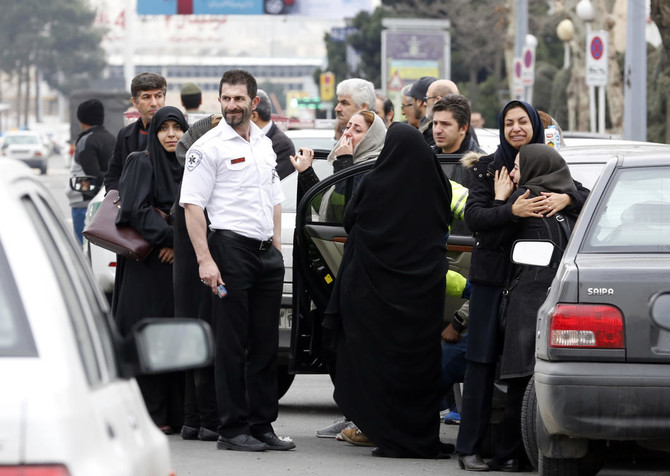
Families of the passengers gathered at a mosque near Mehrabad airport.
“I can’t bring myself to believe it,” said a woman whose husband was on board.
A man who missed the doomed flight told reporters of his conflicting emotions.
“God has been really kind to me but I am so sad from the bottom of my heart for all those dear ones who lost their lives,” the unnamed man told the Tabnak news website, which showed a picture of his unused ticket.
Decades of diplomatic isolation have left Iran’s airlines with aging fleets of passenger planes which they have struggled to maintain and modernize.
Aseman’s fleet includes at least three ATR-72s that date back to the early 1990s, according to the IRNA news agency.
A spokesman for ATR, which is part-owned by Europe’s Airbus, told AFP “the circumstances of the accident remain unknown” and that international investigators were ready to assist Iran “if needed.”
President Hassan Rouhani ordered the transport ministry to set up a crisis group to investigate the crash and coordinate rescue efforts, ISNA reported.
Aseman’s three Boeing 727-200s are almost as old as the country’s 1979 Islamic revolution, having made their first flights the following year.
Iran has suffered multiple aviation disasters, most recently in 2014 when 39 people were killed when a Sepahan Airlines plane crashed just after take-off from Tehran, narrowly avoiding many more deaths when it plummeted near a busy market.
Lifting sanctions on aviation purchases was a key clause in the nuclear deal Iran signed with world powers in 2015.
Following the deal, Aseman Airlines finalized an agreement to buy 30 Boeing 737 MAX jets for $3 billion (2.4 billion euros) last June, with an option to buy 30 more.
However, the sale could be scuppered if US President Donald Trump chooses to reimpose sanctions in the coming months, as he has threatened to do.
Israeli Prime Minister Benjamin Netanyahu offered his condolences over Sunday’s crash, just moments after he launched a blistering attack on Tehran’s government.
“I take this opportunity to send condolences to the families of the 66 civilians that lost their lives,” Netanyahu said at the Munich Security Conference.
“We have no quarrel with the people of Iran, only with the regime that torments them,” he added.
The US Treasury Department, which must approve aviation sales to Iran, has done so for 80 Boeing jets and 100 Airbus planes for national carrier Iran Air.
The first few Airbus jets have already arrived in Tehran.


![]()
Iran postpones hunt for plane lost in mountain blizzard
Iran postpones hunt for plane lost in mountain blizzard

Latest updates


© 2026 SAUDI RESEARCH & PUBLISHING COMPANY, All Rights Reserved And subject to Terms of Use Agreement.