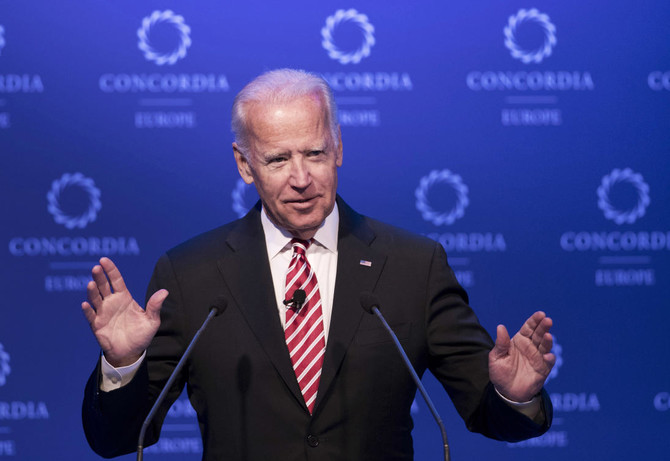
WASHINGTON: Former Vice President Joe Biden is tiptoeing toward a potential presidential run in 2020, even broaching the possibility during a recent gathering of longtime foreign policy aides.
Huddled in his newly opened office steps from the US Capitol, Biden began a planning meeting for his new diplomacy center by addressing the elephant in the room. He said he was keeping his 2020 options open, considering it a real possibility. He insisted he had made no decision, and didn’t need to yet, according to five people who either attended the meeting or were briefed on it by those who did.
Biden also expressed interest in bringing those in the room onto his team if he decides to launch a campaign. At the same time, he gave them an out: There would be no hard feelings if they decided they were content in their current roles outside of government, said the people, who demanded anonymity to discuss a private meeting.
The political world has long tried to game out Biden’s plans for 2020. After all, he came close to running last time only to see President Donald Trump pull off a victory that many Democrats openly suggest wouldn’t have happened had he, not Hillary Clinton, been their nominee. Several people came away from the meeting with the impression that if no strong Democratic candidate emerges in the next year or so, Biden would feel strongly compelled to run.
A presidential candidate twice before, Biden would be 78 on Inauguration Day if elected in 2020, a concerning prospect for some Democrats even though he’s only a few years older than Trump. One possibility that Biden’s longtime advisers have discussed privately is that he could announce his intention to serve only one term, clearing the path for his running mate to take over in 2024 and potentially setting up Democrats for a 12-year White House stretch.
Biden’s brief discussion about his 2020 deliberations came as he brought foreign policy staffers together to set the 2018 agenda for the newly opened Penn Biden Center for Diplomacy and Global Engagement — where many of them are now working, including Colin Kahl, his vice presidential national security adviser, and Steve Ricchetti, his former chief of staff. Eli Ratner, his former deputy national security adviser, and Mike Carpenter, the former Pentagon and State Department official who’s now the center’s senior director, also attended, as did Julianne Smith, a Biden adviser in the Obama administration’s first term who now works at the Center for a New American Security, a Washington think tank.
A Biden spokesman declined to comment. But in a recent NBC News interview, Biden said he’d decide on running in 2020 based on whether it was “the right thing to do.”
“I’m focused on one thing: electing a Democratic Congress to stop this erosion of the core of who we are,” Biden said. “I’ll look at that a year from now. I have plenty of time to consider whether or not to run.”
The meeting was one of several signs that Biden is beginning to position himself as an alternative to Trump. Biden has started denouncing the current president’s leadership more frequently in public, as he crisscrosses the United States and beyond to promote his new book, his cancer initiative, his new domestic policy institute in Delaware, the diplomacy center and his new political action committee, American Possibilities.
He’s also been gearing up to play a major role campaigning for Democrats seeking to retake the House and Senate in the 2018 midterms.
“Donald Trump’s looking out for Donald Trump. Republicans are looking out for Donald Trump. Who’s looking out for everyone else? Democrats,” Biden wrote in a recent fundraising pitch to the PAC’s supporters. He said in 2018, he would “beat a path all across this country to stand up for leaders who will stand up for all of us.”
In 2015, Biden’s face was plastered across cable news channels and newspaper front pages for months as he carried out a lengthy deliberation about whether to challenge Clinton for the nomination. Ultimately, he decided he and his family weren’t in position to run so soon after his son, former Delaware Attorney General Beau Biden, died from brain cancer earlier that year. Yet many Democrats have argued that his “everyman” brand and blue-collar appeal would make him particularly well-suited to challenge Trump.

Biden, in public and private, tiptoes toward a 2020 run
Mexico and El Salvador make big cocaine seizures at sea as US continues lethal strikes
MEXICO CITY: The navies of El Salvador and Mexico announced drug seizures in the Pacific Ocean this week of more than 10 tons of cocaine, in contrast to deadly strikes by the US government that just this week left 11 people dead on three boats suspected of carrying drugs in Latin American waters.
The latest announcement came Thursday, when Mexico said it had seized nearly four tons of suspected drugs and detained three people from a semisubmersible craft, 250 nautical miles (463 kilometers) south of the port of Manzanillo.
Mexican Security Secretary Omar García Harfuch said via X that the seizure from the sleek, low-riding boat with three visible motors brought the weekly total to nearly 10 tons, but he did not provide detail on the other seizures.
Mexican authorities said the seizure was made with intelligence shared US Northern Command and the US Joint Interagency Task Force South.
On Sunday, El Salvador’s navy announced the largest drug seizure in the country’s history of 6.6 tons of cocaine. The navy had intercepted a 180-foot boat registered to Tanzania, 380 miles (611 kilometers) southwest of the coast. Navy divers found 330 packages of cocaine hidden in the boat’s ballast tanks. Ten men were arrested from Colombia, Nicaragua, Panama and Ecuador.
On Thursday, Salvadoran authorities gave access to the seized ship FMS Eagle, which had just arrived in the port of La Union. More than 200 wrapped bundles were lined up on the deck.
The Trump administration has pressured Mexico to make more drug seizures over the past year. The trafficking of drugs like fentanyl was the president’s justification for tariffs on Mexican imports.
Mexican President Claudia Sheinbaum has responded with a more aggressive stance toward drug cartels than her predecessor, that has included sending dozens of drug trafficking prisoners to the United States for prosecution.
Sheinbaum has also expressed her disagreement with strikes by the US military in the Caribbean Sea and Pacific Ocean against boats suspected of carrying drugs.
At least 145 people have been killed in those strikes since the US government began targeting those it calls “narcoterrorists” last September.
The US strikes this week included two vessels carrying four people each in the eastern Pacific Ocean and another boat in the Caribbean carrying three people. The administration provided images of the boats being destroyed, but not evidence they were carrying drugs.
The latest announcement came Thursday, when Mexico said it had seized nearly four tons of suspected drugs and detained three people from a semisubmersible craft, 250 nautical miles (463 kilometers) south of the port of Manzanillo.
Mexican Security Secretary Omar García Harfuch said via X that the seizure from the sleek, low-riding boat with three visible motors brought the weekly total to nearly 10 tons, but he did not provide detail on the other seizures.
Mexican authorities said the seizure was made with intelligence shared US Northern Command and the US Joint Interagency Task Force South.
On Sunday, El Salvador’s navy announced the largest drug seizure in the country’s history of 6.6 tons of cocaine. The navy had intercepted a 180-foot boat registered to Tanzania, 380 miles (611 kilometers) southwest of the coast. Navy divers found 330 packages of cocaine hidden in the boat’s ballast tanks. Ten men were arrested from Colombia, Nicaragua, Panama and Ecuador.
On Thursday, Salvadoran authorities gave access to the seized ship FMS Eagle, which had just arrived in the port of La Union. More than 200 wrapped bundles were lined up on the deck.
The Trump administration has pressured Mexico to make more drug seizures over the past year. The trafficking of drugs like fentanyl was the president’s justification for tariffs on Mexican imports.
Mexican President Claudia Sheinbaum has responded with a more aggressive stance toward drug cartels than her predecessor, that has included sending dozens of drug trafficking prisoners to the United States for prosecution.
Sheinbaum has also expressed her disagreement with strikes by the US military in the Caribbean Sea and Pacific Ocean against boats suspected of carrying drugs.
At least 145 people have been killed in those strikes since the US government began targeting those it calls “narcoterrorists” last September.
The US strikes this week included two vessels carrying four people each in the eastern Pacific Ocean and another boat in the Caribbean carrying three people. The administration provided images of the boats being destroyed, but not evidence they were carrying drugs.
© 2026 SAUDI RESEARCH & PUBLISHING COMPANY, All Rights Reserved And subject to Terms of Use Agreement.