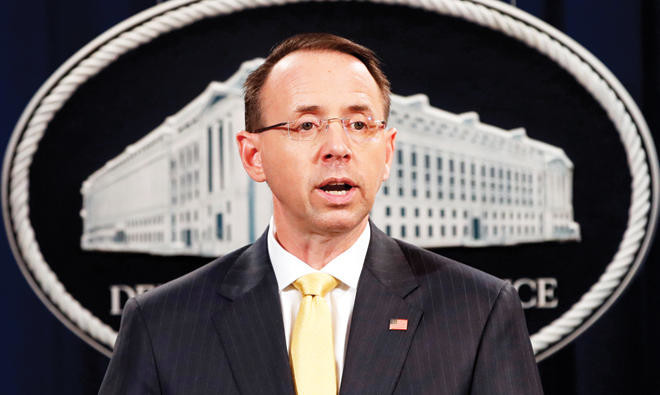
WASHINGTON: In an extraordinary indictment, the US special counsel has accused 13 Russians of an elaborate plot to disrupt the 2016 presidential election, charging them with running a huge but hidden social media trolling campaign aimed in part at helping Republican Donald Trump defeat Democrat Hillary Clinton.
The federal indictment, brought on Friday by special counsel Robert Mueller, represents the most detailed allegations to date of illegal Russian meddling during the campaign that sent Trump to the White House. It also marks the first criminal charges against Russians believed to have secretly worked to influence the outcome.
The Russian organization was funded by Yevgeny Prigozhin, the indictment said. He is a wealthy St. Petersburg businessman with ties to the Russian government and President Vladimir Putin.
Trump quickly claimed vindication on Friday, noting in a tweet that the alleged interference efforts began in 2014 — “long before I announced that I would run for President.”
“The results of the election were not impacted. The Trump campaign did nothing wrong — no collusion!” he tweeted.
But the indictment does not resolve the collusion question at the heart of the continuing Mueller probe, which before Friday had produced charges against four Trump associates. US intelligence agencies have previously said the Russian government interfered to benefit Trump, including by orchestrating the hacking of Democratic emails, and Mueller has been assessing whether the campaign coordinated with the Kremlin.
The latest indictment does not focus on the hacking but instead centers on a social media propaganda effort that began in 2014 and continued past the election, with the goal of producing distrust in the American political process. Trump himself has been reluctant to acknowledge the interference and any role that it might have played in propelling him to the White House.
The indictment does not allege that any American knowingly participated in Russian meddling, or suggest that Trump campaign associates had more than “unwitting” contact with some of the defendants who posed as Americans during election season.
But it does lay out a vast and wide-ranging Russian effort to sway political opinion in the US through a strategy that involved creating Internet postings in the names of Americans whose identities had been stolen; staging political rallies while posing as American political activists and paying people in the US to promote or disparage candidates.
The 13 Russians are not in custody and not likely to ever face trial. The Justice Department has for years supported indicting foreign defendants in absentia as a way of publicly shaming them and effectively barring them from foreign travel.
The surreptitious campaign was organized by the Internet Research Agency, a notorious Russian troll farm that the indictment says sought to conduct “information warfare against the United States of America.”

Russians charged with meddling in 2016 race
South Korea: Civilians sent drones to North Korea four times, harming ties
SEOUL: South Korea’s Unification Minister Chung Dong-young said on Wednesday that three civilians had sent drones to North Korea on four occasions since President Lee Jae Myung took office last year, harming inter-Korean ties.
The trio flew the aircraft between September 2025 and January, Chung said, citing an ongoing investigation by police and the military. Drones crashed on two occasions in North Korea, in line with claims made by Pyongyang, he said.
On two other attempts the drones returned to Paju, a border settlement in South Korea, after flying over Kaesong, a city in North Korea, Chung said.
South Korean authorities were investigating the three civilians on suspicion of violating the aviation safety act and breaching criminal law by benefiting the enemy, he said.
Some officials at South Korea’s military intelligence agency and the National Intelligence Service were also under investigation for alleged involvement with the trio, he said.
“We express official regret to the North,” Chung said, adding that the government was taking the drone incursion incidents very seriously.
North Korea has reacted angrily, saying last month that drones from South Korea entered its airspace, after another intrusion in September.
Kim Yo Jong, the powerful sister of North Korean leader Kim Jong Un, urged Seoul to investigate the incident, warning provocations could result in “terrible situations.”
Chung also expressed regret over South Korea sending 18 drones to North Korea under the direction of ousted President Yoon Suk Yeol.
“It was an extremely dangerous incident aimed to induce an attack against South Korea by sending 18 drones on 11 occasions, to sensitive areas in North Korea including the airspace over the Workers’ Party office,” he said.
South Korean prosecutors have
indicted Yoon
, who was ousted in April 2025, on charges that include aiding an enemy state.
They accused him and his military commanders of ordering a covert drone operation into the North to raise tensions and justify his martial law decree.
Yoon denies wrongdoing.
South Korea’s government plans to strengthen penalties for sending drones to the North, Chung said, including up to a one-year jail term or a 10 million won ($6,928) fine.
A clause will also be added to South Korea’s inter-Korean relations development act to block actions that heighten tensions on the peninsula, he said.
The trio flew the aircraft between September 2025 and January, Chung said, citing an ongoing investigation by police and the military. Drones crashed on two occasions in North Korea, in line with claims made by Pyongyang, he said.
On two other attempts the drones returned to Paju, a border settlement in South Korea, after flying over Kaesong, a city in North Korea, Chung said.
South Korean authorities were investigating the three civilians on suspicion of violating the aviation safety act and breaching criminal law by benefiting the enemy, he said.
Some officials at South Korea’s military intelligence agency and the National Intelligence Service were also under investigation for alleged involvement with the trio, he said.
“We express official regret to the North,” Chung said, adding that the government was taking the drone incursion incidents very seriously.
North Korea has reacted angrily, saying last month that drones from South Korea entered its airspace, after another intrusion in September.
Kim Yo Jong, the powerful sister of North Korean leader Kim Jong Un, urged Seoul to investigate the incident, warning provocations could result in “terrible situations.”
Chung also expressed regret over South Korea sending 18 drones to North Korea under the direction of ousted President Yoon Suk Yeol.
“It was an extremely dangerous incident aimed to induce an attack against South Korea by sending 18 drones on 11 occasions, to sensitive areas in North Korea including the airspace over the Workers’ Party office,” he said.
South Korean prosecutors have
indicted Yoon
, who was ousted in April 2025, on charges that include aiding an enemy state.
They accused him and his military commanders of ordering a covert drone operation into the North to raise tensions and justify his martial law decree.
Yoon denies wrongdoing.
South Korea’s government plans to strengthen penalties for sending drones to the North, Chung said, including up to a one-year jail term or a 10 million won ($6,928) fine.
A clause will also be added to South Korea’s inter-Korean relations development act to block actions that heighten tensions on the peninsula, he said.
© 2026 SAUDI RESEARCH & PUBLISHING COMPANY, All Rights Reserved And subject to Terms of Use Agreement.